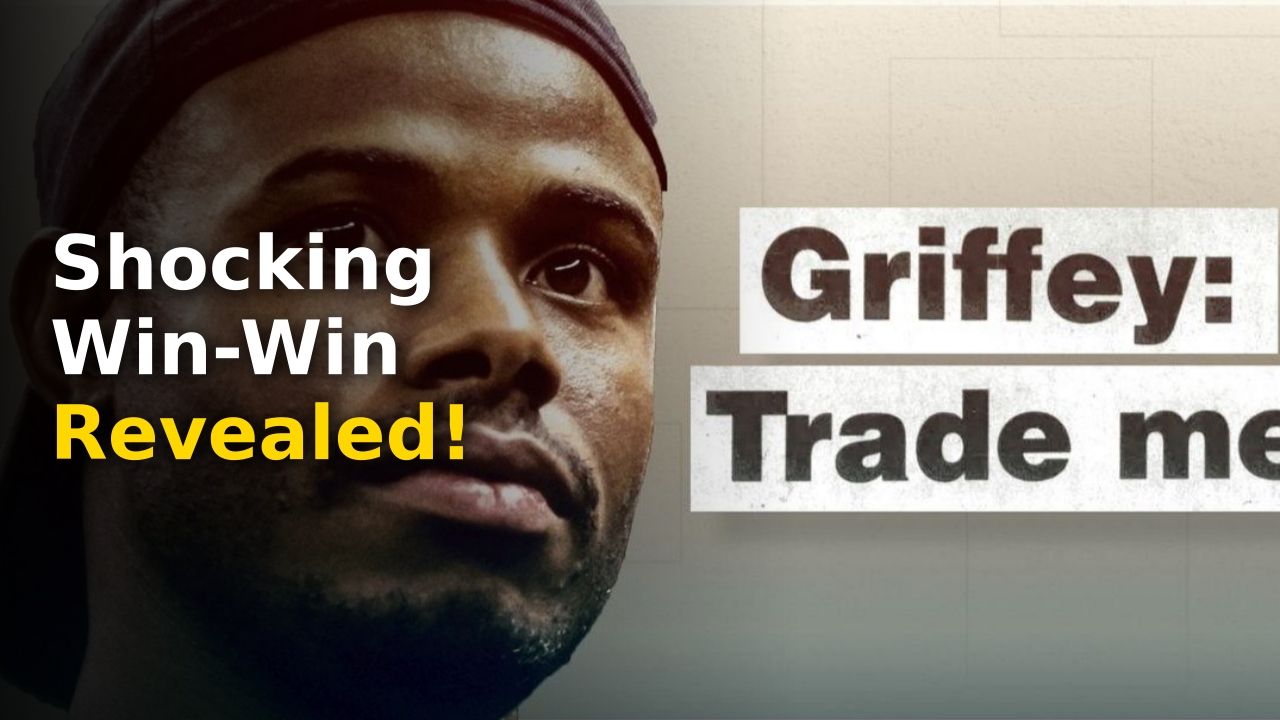
⚡ Key Takeaways
- Ken Griffey Jr. forced the move to Cincinnati to be closer to his family home.
- The Mariners nearly traded him to the Mets, but Griffey utilized his 10-5 veto rights.
- Seattle received Mike Cameron, who became a defensive anchor and an All-Star.
- Following the trade, the Mariners set an AL record with 116 wins in 2001.
- The trade is now studied by GMs as the blueprint for moving a superstar.
The **Griffey Trade** remains one of the most polarizing and fascinating chapters in Major League Baseball history, proving that losing a superstar doesn’t always lead to a rebuild. You might remember the shockwaves that rippled through the Pacific Northwest when “The Kid” decided he had enough of the Emerald City. It was a move that felt like the end of an era, but for the Seattle Mariners, it was actually a hidden beginning.
When **Ken Griffey Jr.** walked into the front office in 1999, he wasn’t just a player; he was the heartbeat of a franchise that he personally helped save from relocation. His demand to be traded to the **Cincinnati Reds** put General Manager **Pat Gillick** in an impossible corner with very little leverage. Yet, the sequence of events that followed would defy every conventional logic found in professional sports management.
This deep dive explores how a team lost the best player in the world and somehow became the winningest regular-season team in the history of the American League. We analyze the failed deals, the clubhouse shifts, and the statistical anomalies that turned a PR nightmare into a masterclass in roster construction.
Griffey Trade: The Day Seattle Wept
The announcement of the **Griffey Trade** in February 2000 felt like a localized earthquake for fans who grew up watching the backwards-cap wearing icon. **Ken Griffey Jr.** had spent 11 seasons in Seattle, amassing 398 home runs and winning the 1997 MVP award. He was more than a center fielder; he was a cultural phenomenon who made baseball cool again in the 1990s.
By the end of the 1999 season, the cracks were showing as Griffey grew weary of the travel and the distance from his family in **Orlando, Florida**. He officially requested a trade, specifically naming the **Cincinnati Reds** as his preferred destination to follow in his father’s footsteps. This put the Mariners in a defensive position, as every other MLB team knew Seattle’s hands were tied by Griffey’s 10-5 rights.
The 10-5 rule allows any player with ten years of service time and five years with the same team to veto any trade. This meant Griffey could essentially hand-pick his next employer, leaving **Pat Gillick** to negotiate with a Cincinnati front office that knew they held all the cards. It was a high-stakes poker game where the Mariners were playing with an open hand against a focused opponent.
Despite the lack of leverage, Gillick refused to settle for a mediocre package, even as fans grew restless and local media predicted a decade of losing. The pressure was mounting to move the $116 million superstar before he could walk away for nothing in free agency. Seattle needed players who could contribute immediately to sustain the momentum of their brand-new stadium, **Safeco Field**.

The Failed New York Mets Deal
Before the Reds deal was finalized, the Mariners actually reached an agreement with the **New York Mets**. The proposed package would have sent Griffey to Queens in exchange for **Armando Benitez**, **Roger Cedeño**, and **Octavio Dotel**. This deal was arguably better on paper for Seattle at the time, providing a lockdown closer and high-upside young pitching.
However, **Ken Griffey Jr.** exercised his veto power, famously stating that he had no interest in playing in New York at that stage of his career. This rejection forced Gillick back to the table with the Reds, who were offering a package centered around **Mike Cameron**. Many critics at the time viewed Cameron as a mere “consolation prize” compared to the legendary Griffey.
Expert Take: The Gillick Philosophy
Industry insiders often cite **Pat Gillick**’s patience during the **Griffey Trade** negotiations as a turning point for modern GM strategies. Rather than panicking, Gillick focused on defensive metrics and clubhouse chemistry, identifying **Mike Cameron** as a player whose WAR (Wins Above Replacement) could stabilize a post-Griffey outfield. By prioritizing a high-floor defensive specialist over a high-ceiling prospect, Gillick ensured the Mariners’ pitching staff wouldn’t suffer from the loss of an elite center fielder.
Shocking Return on a Living Legend
When the dust finally settled on the **Griffey Trade**, the Mariners received **Mike Cameron**, **Brett Tomko**, **Antonio Perez**, and **Jake Meyer**. On the surface, it looked like a lopsided victory for Cincinnati, who landed a 30-year-old superstar in his physical prime. The Reds fans were ecstatic, believing they had secured the final piece of a championship puzzle in the NL Central.
But the chemistry in Seattle began to shift almost immediately in the spring of 2000. Without the singular gravity of Griffey, the Mariners’ clubhouse became a more egalitarian environment where veteran leaders like **Edgar Martinez** and **Jay Buhner** flourished. **Mike Cameron** didn’t try to be the next Junior; he simply played elite defense and provided surprising power from the middle of the lineup.
In his first season in Seattle, Cameron hit 20 home runs and stole 24 bases while winning a Gold Glove. His presence allowed the Mariners to maintain their defensive identity, which was crucial for a pitching staff that relied on fly-ball outs. While Griffey struggled with hamstring injuries in Cincinnati, Cameron was becoming a cornerstone of a new, gritty Seattle identity.
The trade also cleared significant salary-cap space, allowing the Mariners to be aggressive in the international market. This financial flexibility directly paved the way for the signing of Japanese superstar **Ichiro Suzuki** in 2001. You can track a direct line from the departure of Griffey to the arrival of Ichiro, a transition that defined the next decade of Mariners baseball.
By the time 2001 rolled around, the Mariners weren’t just “better”—they were historic. They tied the MLB record with **116 wins**, a feat that seems impossible for a team that had just traded away the best player in its history. The “Refuse to Lose” mantra of 1995 evolved into a clinical, professional dominance that overwhelmed the American League.
Comparative Data: The Post-Trade Explosion
| Metric | 1999 (With Griffey) | 2001 (Post-Trade) |
|---|---|---|
| Regular Season Wins | 79 | 116 |
| Team ERA | 5.24 | 3.54 |
| Runs Scored | 859 | 927 |
| Attendance | 2,916,346 | 3,507,326 |
As the table above illustrates, the Mariners improved in every major category after the **Griffey Trade**. The most shocking leap was in the pitching department, where the team ERA dropped by nearly two full runs. This improvement was largely credited to the superior outfield defense provided by **Mike Cameron** and **Ichiro Suzuki**, who covered ground that an aging Griffey could no longer reach.
For more insights into how superstar transactions affect franchise values, you can visit brightcelebrity.com for deep dives into the business of sports icons. The financial pivot Seattle made allowed them to invest in a deeper bullpen and a more versatile bench, creating a roster with no obvious weaknesses.

The Decline of the Reds Era
While Seattle was celebrating record-breaking win totals, the results of the **Griffey Trade** in Cincinnati were far more somber. Ken Griffey Jr. signed a massive nine-year, **$116.5 million** contract with the Reds, a move that was intended to revitalize the historic franchise. Unfortunately, the homecoming quickly turned into a tragedy of repetitive injuries.
Between 2001 and 2004, Griffey missed a staggering number of games due to torn hamstrings, knee surgeries, and a ruptured ankle tendon. During this same window, the players Seattle received in the trade were logging heavy innings and providing consistent value. **Brett Tomko** became a reliable starter, while **Antonio Perez** eventually became a valuable trade chip in later deals.
The Reds’ payroll was heavily weighted toward Griffey, leaving them unable to build a competent pitching staff around him. This is the “superstar trap” that many teams fall into—sacrificing depth for a singular marquee name. The Mariners avoided this by spreading the talent across several positions, ensuring that a single injury wouldn’t derail their entire season.
By The Numbers: The WAR Gap
From 2000 to 2003, **Mike Cameron** accumulated a total of 18.2 WAR for the Seattle Mariners, emerging as one of the most underrated players in the league. During that same period, **Ken Griffey Jr.** managed only 6.6 WAR for the Cincinnati Reds due to his extensive time on the disabled list. By this metric alone, the Mariners didn’t just “get lucky”—they objectively won the trade by a massive margin in terms of on-field production.
Frequently Asked Questions
Why did Ken Griffey Jr. want to leave Seattle?
Griffey wanted to be closer to his family in Orlando, Florida, and desired to play for the team his father, Ken Griffey Sr., made famous. The travel schedule from Seattle was the most grueling in the MLB, and at age 30, Junior wanted a better work-life balance.
Who were the key players in the Griffey Trade?
The Mariners received center fielder **Mike Cameron**, pitcher **Brett Tomko**, infielder **Antonio Perez**, and minor leaguer **Jake Meyer**. The Reds received only **Ken Griffey Jr.**, who then signed a long-term extension with the club.
How many games did the Mariners win after the trade?
In the two seasons following the trade, the Mariners won 91 games (2000) and an American League record 116 games (2001). This period remains the most successful regular-season stretch in the history of the franchise.
Did the Cincinnati Reds win any championships with Griffey?
No, the Reds failed to reach the postseason during Griffey’s primary tenure with the team. While he hit his 500th and 600th home runs in a Reds uniform, the team’s lack of pitching depth prevented them from being serious contenders in the National League.
Evolution Post Griffey Trade
The legacy of the **Griffey Trade** serves as a vital lesson for modern sports franchises: no player is bigger than the system. Seattle fans will always love Junior, and his statue stands proudly outside T-Mobile Park today, but the trade was the necessary medicine for a stagnant roster. It forced the organization to innovate and look globally for talent, leading to the Ichiro era.
You can see the ripples of this trade in modern deals, such as the Juan Soto or Tyreek Hill trades, where teams opt for a quantity of high-quality assets over a single elite producer. The Mariners proved that with the right scouting and a bit of luck, you can trade a Hall of Famer and actually improve your win total. According to Ken Griffey Jr. career stats, his production remained elite when healthy, but Seattle needed the health and durability of the players they got in return.
Ultimately, the **Griffey Trade** was a rare “win-win” for the individuals involved—Griffey got to go home, and Seattle got to build a juggernaut—even if the Reds suffered the brunt of the bad luck. It remains the gold standard for how to handle a superstar who wants out without destroying your team’s future. The Mariners didn’t just survive the loss of their greatest icon; they thrived because of it.
As we look back on the 2001 season, it becomes clear that the **Griffey Trade** was the catalyst for a cultural shift in Seattle. The team moved from being a “one-man show” to a disciplined, 25-man unit that valued every single out. That transition is why the Mariners were able to dominate the league long after their biggest star had departed for the banks of the Ohio River.
More Like This
For more updates, check out our latest entertainment and sports news.