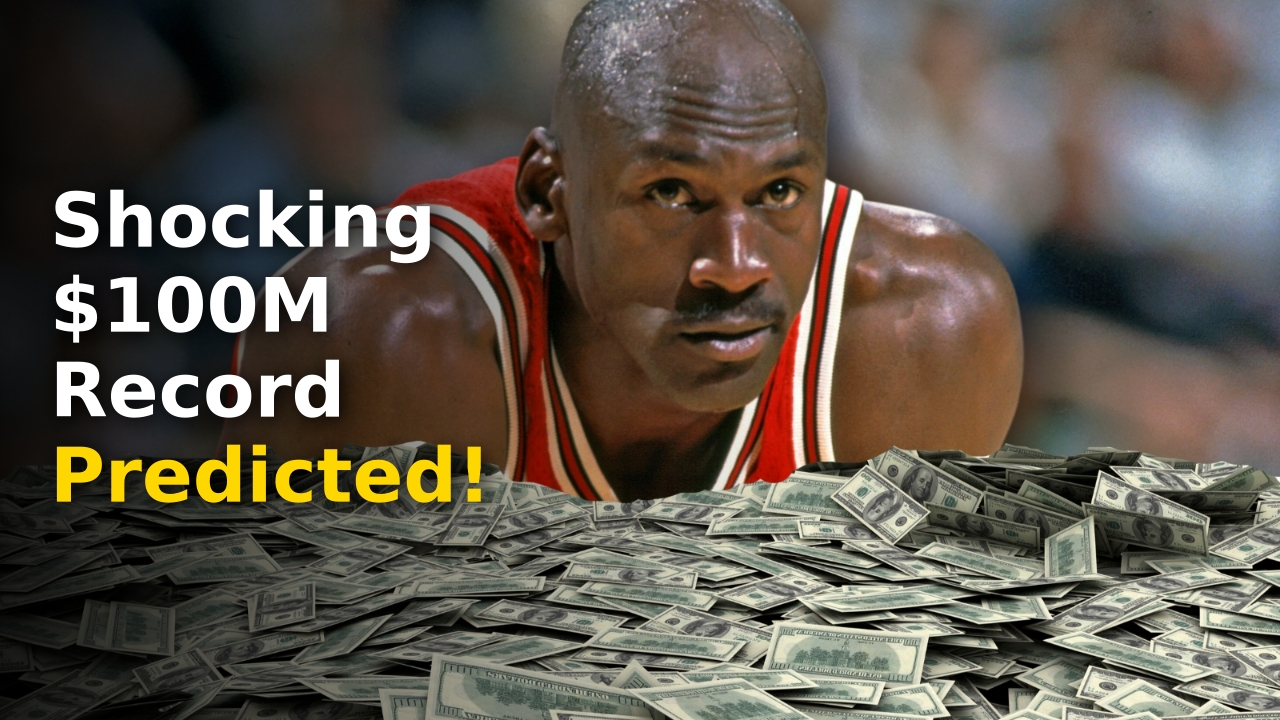
**Jordan Jersey** markets are currently witnessing an unprecedented seismic shift that could redefine the value of sports history forever.
You are looking at a piece of fabric that represents the pinnacle of athletic excellence, and according to its current owner, it might just become the most expensive piece of sports memorabilia in human history. The item in question is the iconic white Chicago Bulls jersey worn by **Michael Jordan** during Game 3 of the **1998 NBA Finals**, a series forever immortalized by the global phenomenon documentary, The Last Dance.
While traditional auction estimates place the value in the tens of millions, investor **Rob Gough** believes this specific artifact will shatter the glass ceiling of the collectibles market. He has publicly predicted that this **Jordan Jersey** will be the first to ever cross the $100 million threshold, a figure that has sent shockwaves through the community of high-net-worth collectors and sports enthusiasts alike.
Jordan Jersey: The $100 Million Prediction
The current owner, Rob Gough, is not a stranger to high-stakes investments in the sports world. He famously purchased a rare 1952 Mickey Mantle card for $5.2 million in 2021, proving he has the vision to spot assets that appreciate at astronomical rates. When discussing the upcoming auction through **Pharrell Williams’ Joopiter** platform, Gough emphasized that the sheer dominance displayed in this specific jersey justifies a valuation ten times higher than any previous record.
You might wonder how a single garment could possibly be worth the same as a private jet or a sprawling Malibu estate. The answer lies in the scarcity and the narrative attached to the 1998 season, often referred to as the peak of the Chicago Bulls dynasty. The official presale estimate from Joopiter sits between $10 million and $15 million, but Gough views this as a conservative baseline rather than a ceiling.
To understand the gravity of this claim, one must look at the current record holder. In 2022, another **Jordan Jersey** from the same Finals series—the red Game 1 jersey—sold for a staggering $10.1 million at Sotheby’s. That sale set the tone for the modern era of sports investing, showing that institutional and private money is flowing into physical assets that represent cultural milestones.
The Joopiter Auction Dynamics
The auction is scheduled to open on September 15, and the choice of platform is significant. Joopiter, founded by music and fashion icon Pharrell Williams, focuses on high-end, culturally significant artifacts that bridge the gap between sports, art, and fashion. This positioning helps attract a different breed of billionaire collectors who view a **Jordan Jersey** as a piece of 20th-century art rather than just a sports uniform.
Bidding for this item is expected to be fierce, with international interest from Asia, the Middle East, and Silicon Valley. The digital nature of the auction allows for a global reach, potentially sparking a bidding war that could propel the price toward Gough’s nine-figure target. Collectors are no longer just buying a shirt; they are buying the definitive symbol of the “G.O.A.T.” (Greatest of All Time).
Financial analysts at Bright Celebrity note that the trend of “alternative assets” has exploded over the last five years. High-end collectibles are often seen as a hedge against market volatility, providing a physical store of value that carries immense social prestige. In this context, a $100 million price tag is a statement of dominance as much as it is a financial investment.

The Historic Dominance of Game 3
The reason this specific **Jordan Jersey** is held in such high regard compared to the Game 1 version is the outcome of the game itself. On June 7, 1998, Michael Jordan led the Chicago Bulls to a 96-54 victory over the Utah Jazz. This 42-point margin remains the largest margin of victory in the history of the NBA Finals, a feat of collective and individual brilliance that may never be repeated.
Jordan was the catalyst for this demolition, scoring a game-high 24 points in just 32 minutes of play. While his scoring numbers in other games might have been higher, the efficiency and defensive pressure exerted by the Bulls in Game 3 are legendary. Holding an opponent to only 54 points in a championship game is an anomaly that highlights the absolute control Jordan had over the court.
The Utah Jazz, led by Hall of Famers **Karl Malone** and **John Stockton**, were completely dismantled. For collectors, owning the jersey from a record-breaking blowout is more appealing than owning one from a loss. Since Game 1 of that series resulted in a Bulls defeat, the Game 3 jersey carries the energy of a winner, which is a psychological trigger for many high-end buyers.
Technical Verification and Photo-Matching
In the world of sports memorabilia, provenance is everything. This **Jordan Jersey** has been meticulously authenticated and photo-matched by **MeiGray**, the industry leader in game-worn item verification. Photo-matching involves comparing the unique weave, mesh patterns, and loose threads of the jersey with high-resolution photography from the actual game.
Because every jersey has tiny individual quirks, authentication experts can prove with 100% certainty that this specific garment was on Jordan’s back during that historic June night. This level of verification is essential for an asset expected to sell for millions. Without it, the jersey would merely be a replica; with it, it is a primary source of history.
The white home jersey of the Bulls is also considered more aesthetically pleasing by many collectors. It features the classic red and black trim that has become synonymous with 1990s basketball. The visual impact of the white fabric makes the iconic number “23” pop, making it a perfect centerpiece for a private museum or a luxury office display.
Comparing High-End Sports Memorabilia Sales
To grasp why a $100 million goal is being discussed, we must look at the trajectory of the market over the last few years. The sports memorabilia industry has transitioned from a hobby for enthusiasts into a legitimate asset class for the ultra-wealthy. Items that once sold for thousands are now commanding prices comparable to works by Picasso or Basquiat.
| Artifact Description | Athlete Name | Sale Price (USD) | Year Sold |
|---|---|---|---|
| “Called Shot” Jersey | Babe Ruth | $24.12 Million | 2024 |
| 1998 Finals Game 1 Jersey | Michael Jordan | $10.10 Million | 2022 |
| “Hand of God” Jersey | Diego Maradona | $9.30 Million | 2022 |
| Game 3 Finals Jersey (Est.) | Michael Jordan | $15M – $100M | 2024 |
As you can see, the current world record for a game-worn jersey belongs to **Babe Ruth**, whose 1932 “Called Shot” jersey fetched over $24 million earlier this year. According to ESPN, the demand for vintage sports items is at an all-time high. For the **Jordan Jersey** to hit $100 million, it would need to nearly quadruple the current world record.
However, proponents of the $100 million valuation argue that Jordan’s global reach is significantly wider than Babe Ruth’s. While Ruth is an American icon, Michael Jordan is a global brand. His influence extends into fashion via the Jordan Brand and into cinema and streaming through various documentaries. This global footprint multiplies the potential buyer pool by a factor of ten.
Furthermore, the 1998 Finals were the swan song of the greatest team in basketball history. The emotional connection fans have to that era is visceral. Many of the people who grew up idolizing Jordan are now in their prime earning years, possessing the disposable income necessary to acquire the objects of their childhood dreams.
Why This Jordan Jersey Defies Market Logic
Standard economic models struggle to explain the pricing of top-tier memorabilia. Usually, value is derived from utility or expected cash flows. But a **Jordan Jersey** has a utility of zero—you can’t wear it, and it doesn’t produce dividends. Instead, its value is purely psychological and social, driven by the “Veblen Good” effect where demand increases as the price goes up.
Owning this jersey makes the buyer part of Michael Jordan’s story. It is a form of immortality by association. When Rob Gough suggests a $100 million price tag, he is banking on the idea that for a billionaire, the difference between $20 million and $100 million is less important than the prestige of owning the “ultimate” Jordan artifact.
The “Last Dance” effect cannot be overstated. When the documentary aired during the 2020 lockdowns, it reintroduced Jordan to a younger generation and revitalized his legend for older fans. It served as a massive, multi-hour commercial for the value of 1998 Bulls memorabilia. Since then, prices for everything Jordan-related have skyrocketed.
The Scarcity of Finals Jerseys
There are only a handful of jerseys from the 1998 Finals that have been authenticated and made available to the public. Most are either in the Jordan family’s private collection, in museums, or held by very private long-term investors. Every time one of these items hits the market, it is a rare liquidity event.
If this Game 3 jersey sells and goes into a private collection, it might not see the light of day for another thirty years. This “now or never” pressure often forces bidders to exceed their budgets. In a world with thousands of billionaires but only one Game 3 winning **Jordan Jersey**, the math of scarcity begins to favor the seller.
The investor community also looks at the “replacement cost.” If you wanted to buy something of equal cultural significance, what would it be? Perhaps the jersey from the “Flu Game” or the jersey from his final championship-winning shot in Game 6. Since those aren’t currently for sale, the Game 3 jersey becomes the proxy for the entire 1998 season.
The Cultural Impact of The Last Dance
The 1998 NBA Finals weren’t just a sporting event; they were a cultural epoch. Michael Jordan was arguably the most famous person on the planet at the time. The narrative of the “Last Dance”—the final season of a legendary core of players before the team was disbanded—adds a layer of tragedy and finality to every item from that year.
For many, the Bulls’ victory in 1998 represents the end of an era of basketball dominance that has never been matched. This **Jordan Jersey** is a physical manifestation of that sentiment. It represents a time when the world stood still to watch a single man perform at the absolute height of his powers. This emotional resonance is what drives prices into the stratosphere.
According to historical records on Wikipedia, the television ratings for the 1998 Finals remain some of the highest in sports history. This means the jersey is recognizable to hundreds of millions of people worldwide. Unlike a rare stamp or a specific coin, the visual language of the Chicago Bulls jersey is universal.
The Celebrity Collector Influence
We are seeing an influx of celebrities entering the memorabilia space. High-profile figures like **Drake**, **Logan Paul**, and various tech CEOs have made headlines for their massive purchases of sports cards and jerseys. This “celebrity heat” brings more eyes to the Joopiter auction and validates the idea of memorabilia as a luxury lifestyle asset.
When a celebrity or a high-profile influencer buys a piece like this, they often share it with their millions of followers, further increasing the item’s fame. This creates a feedback loop where the item becomes more valuable simply because it is famous. The Game 3 **Jordan Jersey** is perfectly positioned to benefit from this modern hype machine.
Ultimately, the auction on September 15 will be a litmus test for the entire collectibles market. If the jersey sells for $15 million, it’s a solid success. If it approaches $50 million, the market is on fire. If it hits $100 million, as Rob Gough predicts, it will signal a new age where sports history is valued on par with the world’s most precious treasures.
Final Thoughts on the Ultimate MJ Auction
Whether or not the **Jordan Jersey** actually reaches the $100 million mark, its journey to the auction block is a testament to the enduring legacy of Michael Jordan. He remains the gold standard for excellence, and his memorabilia continues to outperform almost every other asset class in the long run. You are witnessing a moment where sports, finance, and culture collide in a spectacular fashion.
The 1998 Game 3 jersey is more than just mesh and thread; it is a relic of a time when the Chicago Bulls were the kings of the world. As the bidding begins, all eyes will be on Joopiter to see if the sports world is ready to crown its first $100 million garment. If history has taught us anything, it’s that betting against Michael Jordan—or the value of his **Jordan Jersey**—is usually a losing proposition.
As we look toward the future, the valuation of such items will likely continue to climb. The combination of historical significance, undisputed authenticity, and the sheer star power of the man who wore it makes this auction a once-in-a-generation event. Only time will tell if Rob Gough’s prediction comes true, but one thing is certain: Michael Jordan’s reign over the world of sports collectibles is far from over.
More Like This
For more updates, check out our latest entertainment and sports news.