
Can a legendary pilot shatter another speed record on the blinding salt flats of Utah? Andy Green, the iconic British driver who became the first human to break the sound barrier in a car, is back on the track. He arrives at the famous Bonneville Salt Flats near Wendover, Utah with a groundbreaking vehicle powered by zero-emission hydrogen technology.
Twenty years after making history with a diesel-powered car, Green aims to rewrite the record books. Racing enthusiasts and tech analysts are focusing their attention on this high-stakes desert test run.
Speed Record Legend Returns
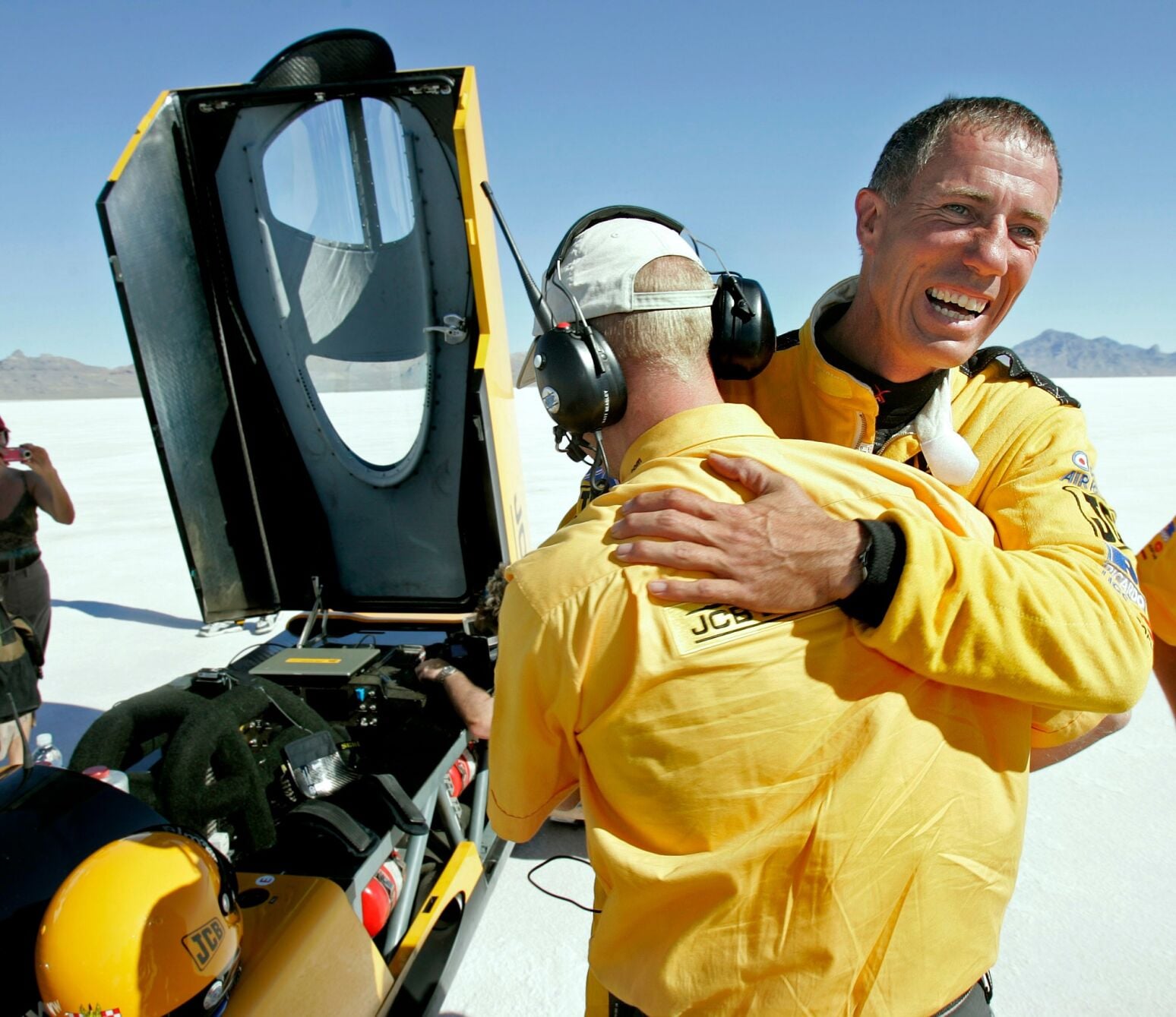
Andy Green established his legendary standing in August 2006 at the Bonneville Salt Flats International Speedway. He piloted the twin-engined JCB Dieselmax to an extraordinary speed of 350.092 mph (563.4 kph). That astonishing mark proved that heavy diesel engines could achieve extreme velocity under brutal desert conditions.
Now, two decades later, Green is stepping back onto the exact same white expanse. The lunarlike landscape of Utah provides an ideal proving ground for extreme aerodynamic vehicles. Green will attempt to break his previous benchmark using an eco-friendly hydrogen powertrain.
Preparing for a run on the salt requires radical engineering solutions. Crew members historically packed massive bags of ice directly around key engine bays. The ice acts as an immediate heat exchanger because standard cooling radiators create massive aerodynamic drag at speeds above 300 mph.
Extreme temperature management remains a huge obstacle on the blinding salt crust. Desert heat combined with massive mechanical friction can destroy ultra-sensitive engine components in seconds. Ice packing remains a low-tech survival key for high-tech racing machinery.
Support crews work tirelessly under the desert sun to prepare the track surface. The flat, dried salt bed stretches across miles of open space near the Nevada border. Even subtle moisture or texture changes in the salt can cause dynamic unstable drifting at maximum velocity.
Green’s return represents a pivotal moment for alternative fuel innovation. Transitioning from fossil fuels to hydrogen demonstrates that high-performance vehicles can achieve blistering speeds without carbon emissions.
Legendary Achievements on Salt
- 1997 Sound Barrier Break: Reached 763.035 mph in ThrustSSC across Nevada’s Black Rock Desert.
- 2006 Diesel Benchmark: Set the world diesel standard at 350.092 mph in the JCB Dieselmax.
- 2026 Clean Energy Push: Returning to Utah to establish a landmark zero-emission hydrogen velocity standard.

Breaking Sound and Speed Barriers
Long before his current hydrogen project, Green captured worldwide attention by conquering the sound barrier on land. On October 15, 1997, he drove the jet-powered ThrustSSC to a record speed of 763.035 mph (Mach 1.02). That dramatic event marked the first official supersonic land travel in human history.
As a former Royal Air Force fighter pilot, Green brought exceptional focus and precision control to the driver’s seat. Steering a land vehicle through supersonic shockwaves requires extreme mental composure. Small steering corrections at those speeds can cause catastrophic rollover events.
Following the jet engine triumph, Green shifted focus toward conventional wheel-driven records. In August 2006, he teamed up with British manufacturer JCB. They constructed a sleek yellow streamliner powered by two modified diesel engines generating over 1,500 horsepower.
Over two official runs on the salt flats, Green averaged 350.092 mph, obliterating the previous diesel mark. That success cemented his status as the premier land speed driver of his generation. Dedicated fans often check exclusive motorsports updates on Bright Celebrity to follow his remarkable career transitions.
The mechanical physics of wheel-driven streamliners differ significantly from jet cars. Power must transfer directly through tires to the slick salt surface. Wheel spin can occur easily at speeds over 200 mph, demanding sensitive throttle input.
Green’s team carefully monitored tire temperature and tread integrity during every run. Custom solid aluminum wheels or reinforced low-profile rubber tires were essential to prevent centrifugal destruction at high RPMs.
Hydrogen Revolution Hits Utah Flats
The current project abandons internal combustion completely in favor of zero-emission hydrogen fuel cells. Hydrogen power offers instant torque delivery and clean water exhaust. However, delivering sustained full-throttle power presents unique chemical and thermodynamic hurdles.
Fuel cell stacks require precise air mixture ratios and effective thermal balance. Storing high-pressure compressed hydrogen inside a lightweight streamliner body requires advanced carbon fiber fuel tanks. Safety protocols are elevated to maximum military-grade standards.
The Bonneville Salt Flats sit at an elevation of 4,218 feet above sea level. Thinner mountain air affects both aerodynamic drag and fuel cell oxygen intake. Engineers must calibrate fuel cell management computers specifically for high-altitude desert atmospheric conditions.
For complete historical background on global velocity milestones, enthusiasts frequently review Land Speed Record history archives. Green’s transition to clean technology marks an important new chapter in this centuries-old pursuit.
Ground crews spend hours testing fuel cell outputs before releasing the vehicle onto the course. The silence of electric and hydrogen propulsion contrasts sharply with the roaring twin diesel engines of 2006.
Observers note that silent power makes velocity sensation even more disorienting for the driver. Without engine noise, aerodynamic wind shear becomes the primary acoustic feedback during acceleration.
Historic Speed Record Milestones
Examining the evolution of high-speed streamliners reveals remarkable progress in propulsion technology. From jet engines to diesels and modern hydrogen fuel cells, each era pushed materials engineering to new limits.
The table below illustrates how different fuel types and powerplants compare across major speed attempts throughout modern racing history.
| Vehicle Name | Driver | Power Source | Top Speed (MPH) | Year |
|---|---|---|---|---|
| ThrustSSC | Andy Green | Turbofan Jet Fuel | 763.035 | 1997 |
| JCB Dieselmax | Andy Green | Twin Turbo Diesel | 350.092 | 2006 |
| Blue Flame | Gary Gabelich | LNG / Hydrogen Peroxide | 622.407 | 1970 |
| Spirit of America | Craig Breedlove | Jet Engine | 600.601 | 1965 |
| Hydrogen Project | Andy Green | Hydrogen Fuel Cell | Targeting 350+ | 2026 |
Notice how engine configurations shifted dramatically over the past several decades. Early pioneers relied on massive piston engines, while post-war builders adopted surplus military jet turbines.
Modern attempts focus heavily on energy density and environmental efficiency. Hydrogen fuel cells bridge the gap between instant electric torque and long-range energy delivery required for timed miles.
Bonneville’s unique salt crust provides an extended flat runway that is virtually impossible to replicate on asphalt tracks. However, climate shifts and commercial salt mining have reduced salt depth in recent decades.
Preserving the salt flats remains essential for future speed attempts. Drivers like Green advocate for salt restoration programs to keep this iconic speedway open for generations.
Extreme Engineering on Bonneville Salt
Driving across dry salt at 350 mph feels like sliding on wet glass. The surface provides surprisingly low traction compared to traditional tarmac courses. Drivers must manage subtle yaw angles to keep streamliners pointed straight down the marked course track.
Brake systems on land speed vehicles rely heavily on high-speed parachutes. High-friction carbon-ceramic disc brakes are only deployed after parachutes slow the car below 150 mph. Deploying mechanical brakes at top speed could lock the wheels and send the vehicle spinning uncontrollably.
Aerodynamic downforce must be balanced carefully against aerodynamic drag. Too much downforce buries the chassis into soft salt pockets, while too little downforce causes dangerous high-speed lift.
Wind conditions at Wendover, Utah can change rapidly during morning test runs. Crosswinds exceeding 5 mph are often enough to scrub a record run due to rollover hazards on narrow-track streamliners.
Green’s vast experience in RAF fighter jets gives him a distinct advantage when managing emergency situations. Cockpit layouts resemble fighter aircraft, featuring multi-point harnesses, oxygen systems, and rapid canopy ejection options.
The combination of human courage, advanced materials science, and clean propulsion technology makes this project one of the most exciting motorsports ventures of 2026.
Final Surge Across Salt Flats
Andy Green continues to push the boundaries of what is possible on four wheels. Returning to Utah with a hydrogen-powered vehicle proves that high speed and environmental responsibility can coexist.
As the support crew completes final systems checks, motorsport fans around the world await the results. Every run across the salt bed offers critical data that could shape the future of commercial hydrogen transport.
Whether Green shatters his previous mark or establishes a new baseline for clean energy vehicles, his courage remains unquestioned. Utah’s historic salt flats are once again witness to extreme human ambition.
Technicians will spend hours analyzing telemetry data following each high-speed pass. Measurements include fuel cell voltage drop, tire wear patterns, track surface displacement, and deceleration force.
The global racing community recognizes the enormous commitment required to stage a land speed project. Sponsors, engineers, and mechanics sacrifice months of effort for a few intense seconds of high-speed operation.
As conditions align over the desert, Green prepares to execute another historical attempt. Breaking a speed record requires perfect harmony between driver, machine, and nature on the legendary Utah salt.
More Like This
For more updates, check out our latest entertainment and sports news.