Key Takeaways
| The trade was triggered by an 11-1 blowout loss to the Detroit Red Wings on Dec. 2, 1995. |
| Patrick Roy famously told Montreal president Ronald Corey he would never play for the Canadiens again. |
| Colorado surrendered Jocelyn Thibault, Martin Rucinsky, and Andrei Kovalenko to land the legend. |
| Within six months of the trade, Roy led the Avalanche to their first Stanley Cup in franchise history. |
You might think you’ve witnessed a locker room meltdown, but you have never seen a legend sever ties with a dynasty in a single period quite like the Patrick Roy Colorado trade. This wasn’t just a mid-season roster move; it was a seismic shift that redefined the power balance of the National Hockey League for a decade. On December 2, 1995, the Montreal Canadiens faced the Detroit Red Wings in a game that should have been a standard regular-season matchup, but it became the catalyst for the most impactful goaltending transaction in sports history.
When head coach Mario Tremblay left Roy in the net to surrender nine goals before finally pulling him, he didn’t just embarrass a player; he insulted a national icon. Roy’s defiant walk past the bench to tell team president Ronald Corey that he had played his final game in Montreal remains the most dramatic exit in hockey lore. Four days later, the Patrick Roy Colorado trade was finalized, sending the netminder to a fledgling Denver market that was hungry for a championship identity.
The arrival of “Saint Patrick” in the Mile High City turned a talented group of youngsters into a juggernaut. With Joe Sakic and Peter Forsberg already established as elite offensive threats, Roy provided the mental fortitude and postseason pedigree that had been missing. This article explores the intricate details of that fateful night, the mechanics of the blockbuster trade, and how one angry goaltender changed the trajectory of two historic franchises forever.
The Patrick Roy Colorado Trade Incident at the Forum
The tension between Patrick Roy and rookie head coach Mario Tremblay was a ticking time bomb long before the puck dropped on December 2, 1995. Tremblay, a former teammate of Roy’s, had a notoriously prickly relationship with the star goalie, often clashing over discipline and ego. When the Detroit Red Wings began their onslaught at the Montreal Forum, Tremblay saw an opportunity to humble the man who essentially ran the locker room. It was a tactical error of historic proportions.
As the goals piled up—one, two, five, seven—the crowd’s cheers turned into mocking Bronx cheers every time Roy made a routine save. By the time the score reached 9-1, the atmosphere was toxic. Tremblay’s refusal to pull Roy was seen by many as a public execution of a legend’s dignity. When the hook finally came, Roy didn’t sit on the bench; he marched straight to Ronald Corey, who sat behind the glass, and delivered the ultimatum that shook the hockey world: “It’s my last game in Montreal.”
The immediate aftermath was pure chaos in the Montreal front office. General manager Rejean Houle was forced into a corner, knowing his star player would never lace up his skates for the Bleu, Blanc, et Rouge again. This leverage—or lack thereof—allowed Pierre Lacroix, the GM of the newly relocated Colorado Avalanche, to swoop in. Lacroix, who was Roy’s former agent, knew exactly what the goaltender was worth and how his presence could transform a team that had just moved from Quebec City to Denver.
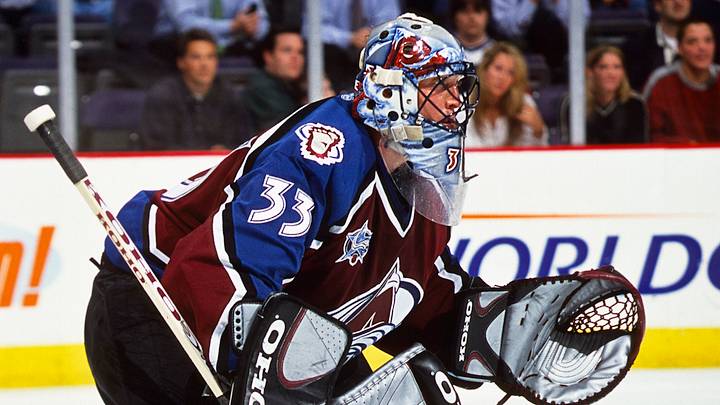
The Tipping Point of the Roy-Tremblay Feud
The feud between the two men was rooted in a power struggle. Tremblay wanted to assert authority, while Roy expected the respect due to a two-time Conn Smythe Trophy winner. Insiders at the time suggested that Tremblay’s decision to leave Roy in was a deliberate attempt to “break” the superstar. Instead, he broke the franchise’s relationship with its most important player since Guy Lafleur.
For fans of the Montreal Canadiens, this remains the darkest day in modern history. The team lost the greatest big-game goalie of his generation for a package that, while respectable, never approached the value of a Hall of Famer in his prime. Roy was 30 years old at the time—young enough to still have another decade of elite hockey left in him, as he would soon prove in the Western Conference.
By the Numbers: The 1995 Blockbuster Breakdown
To understand the scope of the Patrick Roy Colorado trade, one must look at the specific assets moved during that cold December week. It wasn’t a one-for-one swap; it was a complex exchange involving multiple high-level players. Colorado didn’t just get Roy; they also landed Mike Keane, a gritty forward with championship experience who would become a vital part of their checking line and leadership group.
| Team | Players Acquired | Key Statistics (at time of trade) |
|---|---|---|
| Colorado Avalanche | Patrick Roy, Mike Keane | Roy: 2 Stanley Cups, 2 Conn Smythes |
| Montreal Canadiens | Jocelyn Thibault, Martin Rucinsky, Andrei Kovalenko | Rucinsky: 15G, 23A (1994-95 season) |
While Jocelyn Thibault was a highly touted young goaltender, he faced the impossible task of replacing a legend in a market that demanded immediate results. Martin Rucinsky and Andrei Kovalenko were talented offensive wingers, but they didn’t possess the game-breaking ability that Roy provided between the pipes. The trade is frequently cited in ESPN’s analysis of the greatest NHL trades as a masterclass in opportunistic management by Pierre Lacroix.
Expert Take: “The Patrick Roy Colorado trade is the ultimate example of why you never trade a franchise goaltender out of spite. Montreal received 60 cents on the dollar because they let the situation go public. In contrast, Colorado gained an identity that allowed them to compete with the Detroit Red Wings and Dallas Stars for the next decade. Without Roy, the Avalanche are likely a one-and-done playoff team in 1996 rather than champions.”
Impact on the Colorado Avalanche Dynasty
The immediate impact of the Patrick Roy Colorado trade was felt in the standings and the locker room. Roy brought an aura of invincibility. Prior to his arrival, the Avalanche were a flashy, offensive-minded team that often struggled to close out tight games. Roy changed that overnight. His aggressive “butterfly” style and legendary puck-tracking skills meant that the Avalanche only needed two or three goals to win on most nights.
In the 1996 playoffs, the move paid dividends almost instantly. Roy was spectacular in the Western Conference Final, coincidentally facing the Detroit Red Wings—the same team that had chased him out of Montreal. He stopped 203 of 218 shots in that series, propelling Colorado to the Stanley Cup Final. There, the Avalanche swept the Florida Panthers, with Roy allowing only four goals in the entire series. It was a masterclass in goaltending that justified every penny of his salary and every asset given up in the trade.
The success didn’t stop in 1996. Roy’s presence allowed Joe Sakic and Peter Forsberg to play with more freedom, knowing they had a literal wall behind them. This era of Avalanche hockey saw them reach the Western Conference Finals in six out of seven seasons. The pinnacle of this run came in 2001, when Roy won his record-breaking third Conn Smythe Trophy after a grueling seven-game series against the New Jersey Devils, cementing his status as the greatest clutch performer in the history of the sport.

The Development of the Butterfly Style in Denver
While Roy pioneered the butterfly style in Montreal under goalie coach Francois Allaire, he perfected it in Denver. His ability to take away the bottom of the net forced shooters to aim for small corners, which he often covered with his lightning-fast glove hand. This technical superiority was matched only by his psychological warfare; Roy was famous for talking to his goalposts and winking at opposing players like Jeremy Roenick after making highlight-reel saves.
You can find more about Roy’s career milestones on his Hockey Hall of Fame profile. His influence on the position is still visible today, as almost every modern NHL goaltender employs some variation of the techniques Roy brought to the forefront during his tenure in Colorado. His 551 career wins stood as an NHL record for years until it was eventually surpassed by Martin Brodeur.
The Rivalry: Patrick Roy vs. The Detroit Red Wings
No discussion of the Patrick Roy Colorado trade is complete without mentioning the blood feud it created between the Avalanche and the Detroit Red Wings. Because it was Detroit that humiliated Roy in his final Montreal game, there was an added layer of venom every time the two teams met. This rivalry became the gold standard for NHL intensity in the late 1990s, featuring multiple bench-clearing brawls and legendary goalie fights.
The most famous incident, known as “Bloody Wednesday” or the “Brawl in Motown,” occurred on March 26, 1997. Following a hit by Claude Lemieux on Kris Draper in the previous year’s playoffs, the Red Wings sought revenge. Roy, never one to back down, famously skated to center ice to fight Detroit goalie Mike Vernon. It was a chaotic scene that symbolized the era: high-skill hockey played with a level of hatred that the modern game rarely sees.
By the Numbers: Between 1996 and 2002, either Colorado or Detroit represented the Western Conference in the Stanley Cup Final five times. The two teams combined for five championships in that span. Roy was the centerpiece of this rivalry, often serving as the primary villain in Detroit and the ultimate hero in Denver. His performance in Game 7 of the 2002 Western Conference Finals remains one of the few blemishes in his Denver career, but even that loss didn’t diminish his overall legacy as the man who turned Colorado into a hockey town.
People Also Ask
Why was Patrick Roy traded to Colorado in 1995?
Patrick Roy was traded after a massive falling out with Montreal Canadiens head coach Mario Tremblay. During an 11-1 loss to Detroit, Roy was left in for nine goals, leading him to tell the team president he would never play for Montreal again.
Who did the Montreal Canadiens get in the Patrick Roy trade?
The Canadiens received goaltender Jocelyn Thibault and forwards Martin Rucinsky and Andrei Kovalenko. While Rucinsky had a productive career in Montreal, the trade is widely considered one of the worst in franchise history because they lost a Hall of Fame goalie.
How many Stanley Cups did Patrick Roy win with the Avalanche?
Patrick Roy won two Stanley Cups with the Colorado Avalanche, the first in 1996 during his first season with the team and the second in 2001. He also won two previously with the Montreal Canadiens in 1986 and 1993.
Did Patrick Roy win a Conn Smythe with Colorado?
Yes, Patrick Roy won the Conn Smythe Trophy as playoff MVP in 2001. This made him the only player in NHL history to win the award three times, having previously won it in 1986 and 1993 with Montreal.
The Permanent Shift in NHL Goaltending History
The legacy of the Patrick Roy Colorado trade extends far beyond the trophies and the statistics. It signaled the end of the Montreal Canadiens’ era of dominance and the birth of the modern Western Conference powerhouse. For Montreal, the trade began a decades-long search for a consistent identity and another championship-caliber roster. For Colorado, it provided the foundation for a brand that remains one of the most successful in the NHL today, as seen in their continued excellence with players like Nathan MacKinnon and Cale Makar.
Roy’s retirement in 2003 was the end of an era, but his impact remains. He eventually returned to the Avalanche as a head coach, winning the Jack Adams Award in 2014, further cementing his bond with the Denver community. The trade taught the league two valuable lessons: never let a coaching feud boil over in public, and never underestimate the power of a motivated, elite goaltender. If you want to see more about the current state of the team, check out the latest Colorado Avalanche news and updates.
Ultimately, the Patrick Roy Colorado trade was a moment where the stars aligned perfectly for one franchise and collapsed for another. It was a combination of pride, anger, and elite talent that resulted in a decade of excellence in the Rockies. Whether you are a fan of the Canadiens, the Red Wings, or the Avalanche, there is no denying that the events of December 1995 changed the sport of hockey forever. You can read more about other famous sports trades and legacies or explore the net worth of NHL legends to see how the game has evolved financially since Roy’s historic move.
More Like This
For more updates, check out our latest entertainment and sports news.