⚡ Key Takeaways
- Jeremy Levesque takes the helm as the new head coach following Marshall Maxwell’s retirement.
- Over a dozen four-year veterans have graduated, leaving the Hurricanes with a fresh roster for 2026.
- MIAA rule changes have expanded the regular season to nine games while shrinking the playoff field.
- The Taconic and Pittsfield High co-op represents a major shift in the Berkshire football landscape.
- Emerging stars like Terrell Johnson are poised to lead the offensive charge in the coming year.
Hoosac Football is entering a period of seismic shift that you need to watch closely as the Hurricanes prepare for a 2026 season unlike any other in Cheshire’s history. You might think that losing a legendary coach and a massive class of seniors would signal a rebuilding year, but the atmosphere in the locker room suggests a different story entirely. There is a palpable energy radiating from the practice fields in Cheshire, driven by a combination of fresh coaching philosophy and young athletes hungry to prove their worth on the gridiron. The transition from the Marshall Maxwell era to the leadership of Jeremy Levesque is not just a change in personnel; it is a full-scale evolution of a program that has long been a powerhouse in Western Massachusetts.
The community of Cheshire has always viewed Hoosac Football as a cornerstone of local identity, and the stakes for the 2026 season could not be higher. After two straight years of making the state tournament, including a deep run into the quarterfinals last season, the Hurricanes are facing the daunting task of replacing over a dozen four-year starters. These players were the backbone of the team’s recent success, providing the veteran leadership and physical presence necessary to compete at the highest levels of the MIAA. However, the vacuum left by their departure has created an unprecedented opportunity for a new generation of players to step into the spotlight and define their own legacy under the Friday night lights.
Hoosac Football Evolution Under Coach Levesque
The appointment of Jeremy Levesque as the first-year head coach marks a significant turning point for the program. Levesque, who has been a staple in the Hurricanes’ coaching circle, is well-acquainted with the high expectations that come with the role. He isn’t just stepping into a vacancy; he is inheriting a culture of excellence that he helped build as an assistant. His approach to the 2026 season focuses on aggressive development and technical precision, particularly among the younger offensive linemen who are seeing their first real taste of varsity action. During preseason drills, Levesque can be seen at the center of the huddle, dressed in his signature red, instilling a sense of urgency and discipline that has become the hallmark of Hoosac Football.
Coach Levesque faces the unique challenge of molding a raw roster into a cohesive unit before the first kickoff. He has emphasized that while the faces are new, the standards remain the same. The departure of Marshall Maxwell, who retired after two successful seasons, left a void in veteran leadership, but Levesque’s familiarity with the returning underclassmen has smoothed the transition. He understands the nuances of the Wing-T or Wishbone sets that the Hurricanes have historically utilized, yet he is also open to modernizing the playbook to suit the speed and agility of his new offensive weapons. This blend of tradition and innovation is what makes the 2026 outlook so intriguing for fans and analysts alike.
The Tactical Shift in Practice
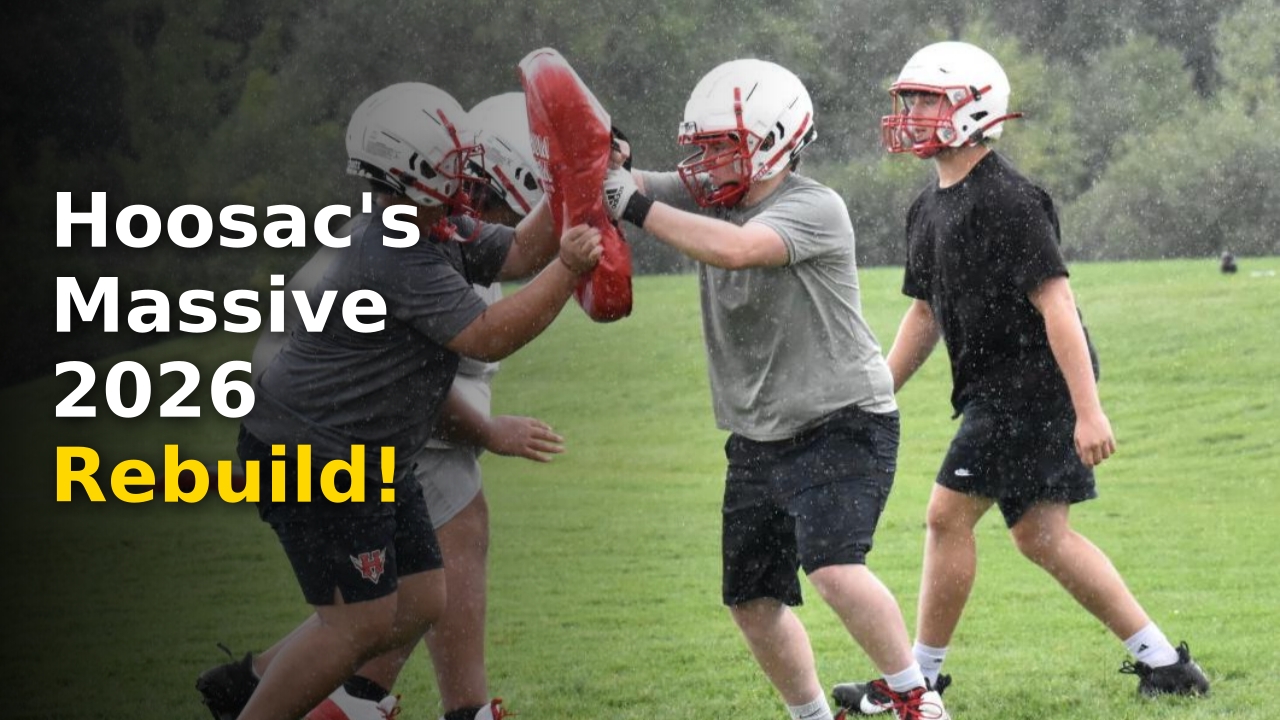
Practice sessions this summer have been grueling, with a heavy emphasis on fundamental line work. You can see the intensity in the trenches where the “big men” are undergoing a trial by fire. Because the Hurricanes lost so much experience on the line, Levesque is spending extra time on hand placement, leverage, and footwork. These drills are designed to build the muscle memory required to protect the quarterback and open lanes for the running game. The coaching staff is essentially rebuilding the engine of the team from the ground up, ensuring that the physical identity of the program remains intact despite the turnover.
By The Numbers: Historical data suggests that teams replacing more than 60% of their starters typically see a 15% dip in win percentage in the first year. However, Hoosac Football has historically defied these trends due to its robust youth feeder program. In the last decade, the Hurricanes have maintained a winning record in 80% of their transition years. Coach Levesque is banking on this structural stability to navigate the early season hurdles. He isn’t looking for a rebuild; he’s looking for a reload, utilizing the deep-seated football IQ that Cheshire athletes seem to possess from a young age.

Building a Culture of Accountability
Beyond the X’s and O’s, Levesque is focused on the psychological aspect of the game. He frequently addresses the team after practice, reminding them that the “Hurricanes” name on their jersey carries the weight of past championships. This accountability is what keeps the players motivated during the dog days of August. Every drill, every sprint, and every film session is framed as a step toward maintaining the program’s elite status. The players are responding well, with a noticeable uptick in vocal leadership from those who were previously quiet backups. This internal growth is often more valuable than external recruitment in high school sports.
Roster Rebuild and Analytical Outlook
One of the most exciting prospects for the 2026 season is the emergence of Terrell Johnson. As a primary ball carrier, Johnson has shown flashes of brilliance during preseason practices. His ability to take a handoff and find the smallest seam in the defense is reminiscent of the great Hurricane backs of the past. Johnson isn’t just a speedster; he has the vision to cut back across the grain and the strength to finish runs. For Hoosac Football to be successful this year, Johnson will need to be the focal point of the offense, taking the pressure off whichever young quarterback wins the starting job. His development is the single most important factor in the team’s offensive production.
The offensive line is the biggest question mark, but also the area of most significant potential. Linemen drills have been the primary focus of the early preseason, as the coaching staff works to identify the best five starters. There is a lot of size on the roster, but it is unpolished. The 2026 season will likely see a rotation of players on the line as the staff looks for the right chemistry. Chemistry on the line is often the difference between a four-yard gain and a loss in the backfield. If this unit can gel by the third week of the season, the Hurricanes will be a force to be reckoned with in the Berkshire league.
| Category | 2025 Statistics | 2026 Projections |
|---|---|---|
| Returning Starters | 14 | 4 |
| Avg. Rushing Yards/Game | 210 | 185 |
| Reg. Season Games | 8 | 9 |
| Playoff Berths | 16 Teams/Div | 8 Teams/Div |
Expert Take: From a scouting perspective, the drop in returning starters is significant, but the increase in regular-season games to nine provides a larger margin for error for a young team. According to ESPN analysts who follow high school development patterns, the extra game allows coaching staffs to experiment more in the early weeks without sacrificing their playoff hopes. For the Hurricanes, this ninth game is a blessing. It allows Levesque to blood his new linemen in a competitive environment before the high-stakes divisional matchups begin in late October.
The Impact of MIAA Policy Changes
The 2026 season isn’t just about new players; it’s about a fundamental shift in how high school football is structured in Massachusetts. The MIAA Board of Directors recently voted to expand the regular season to nine games. This is a massive win for programs like Hoosac Football, as it provides more gate revenue and more opportunities for student-athletes to put film together for college recruiters. However, the trade-off is a significantly more difficult path to the postseason. The playoff field has been slashed from 16 teams per division down to just eight. This means that every single game carries immense weight, and a two-loss season could potentially keep a talented team out of the tournament.
Furthermore, the creation of a “Super 8” tournament—similar to the one used in Massachusetts high school hockey—will change the landscape for elite programs. While the Hurricanes currently compete in their respective division, the prospect of a Super 8 adds a layer of prestige and competition that has been missing. The goal for any top-tier program is now clear: dominate the regular season to ensure a top-eight seed. The margin for error has evaporated, and the intensity of the regular season will likely resemble a playoff atmosphere from week one. For a young Hoosac team, this pressure will be a true test of their mettle.
Regional Shifts and Co-op Teams
Another major storyline in Berkshire County is the merger of the Pittsfield High and Taconic football programs. Longtime PHS head coach Brian Jezewski has been named the leader of this new co-op team, which will be hosted by Taconic. This merger creates a new powerhouse in the region, as the Generals and Thunder join forces. For Hoosac Football, this means a new, more formidable opponent on the schedule. The pooling of resources and talent in Pittsfield is a response to changing demographics and participation numbers, a trend seen across the country as detailed on Wikipedia.
The Hurricanes have always thrived on local rivalries, and the Taconic-Pittsfield co-op provides a high-stakes matchup that will surely draw huge crowds. These regional shifts are important because they force smaller programs to elevate their game. Hoosac Valley, being a smaller school compared to the combined Pittsfield programs, will have to rely on their tight-knit community and disciplined systems to overcome the sheer numbers that larger co-ops can bring to the field. It’s a classic David vs. Goliath scenario that high school football fans in the Berkshires absolutely love.

A New Era of Berkshire Football
As the final issues of the *Huddle* wrap up the 2025 honors and All-Berkshire teams, the focus is already shifting to the names you will become familiar with in 2026. The departure of a dozen seniors is a story of loss, but the arrival of the 2026 season is a story of potential. The Hurricanes are not just looking to survive this transition; they are looking to thrive. Under the guidance of Levesque and with the explosive talent of players like Johnson, the team is working to ensure that the tradition of excellence in Cheshire remains uninterrupted. High school sports are often cyclical, and Hoosac is currently at the start of a very promising new cycle.
You can find more updates on local sports trends and how athletic success impacts local culture at brightcelebrity.com. The intersection of sports and community pride is nowhere more evident than in a small town like Cheshire. When the Hurricanes win, the whole town feels the lift. As we look ahead, the 2026 season promises to be a masterclass in adaptation. With a nine-game schedule and a tighter playoff race, every snap will be critical. The coaches are ready, the new faces are prepared, and the excitement in the Berkshires is reaching a fever pitch as the season approaches.
Frequently Asked Questions
Who is the new head coach for Hoosac Valley football?
Jeremy Levesque is the new head coach for the 2026 season. He takes over for Marshall Maxwell, who retired after leading the Hurricanes to two consecutive state tournament appearances. Levesque has a deep history with the program and was a key assistant coach before his promotion.
How many games will be in the 2026 high school football season?
The MIAA Board of Directors has officially expanded the high school football regular season to nine games. This is an increase from the previous eight-game format, allowing for more competition and development time for players across Massachusetts.
How has the MIAA playoff structure changed?
The playoff field has been reduced from 16 teams per division to only eight. Additionally, the MIAA has introduced a “Super 8” tournament, which will feature the top teams in the state. This change makes the regular season much more competitive, as only the top performers will qualify for the postseason.
What is happening with the Pittsfield and Taconic football teams?
Beginning in the 2026 season, Pittsfield High and Taconic will join forces to form a co-op football team. The team will be hosted by Taconic, and longtime PHS coach Brian Jezewski will lead the combined program. This merger is intended to consolidate talent and resources in the Pittsfield area.
The Future of Hoosac Football Excitement
In conclusion, while the roster may be filled with new faces, the soul of Hoosac Football remains as vibrant as ever. The 2026 season is set to be a transformative year that tests the depth and resilience of the Hurricanes. With a new head coach in Jeremy Levesque and a revamped MIAA schedule, the team is navigating a landscape of both challenge and opportunity. The excitement in Cheshire is not just about the wins and losses; it is about watching a new generation of athletes rise to meet the high standards of their predecessors. As the community gathers at the field this fall, they won’t just see a team in transition—they will see the future of Hoosac Football in the making.
More Like This
For more updates, check out our latest entertainment and sports news.