Key Takeaways
| The Ultimate A/B Test: This weekend features a direct scheduling swap between Fox and ABC to measure the power of time slots versus team brands. |
| Big Noon Challenger: Oklahoma at Michigan moves from last year’s ABC primetime window to Fox’s Big Noon slot. |
| Primetime Powerhouse: Ohio State at Texas moves from last year’s Fox Noon window to ABC’s Saturday Night Football. |
| Realignment Fallout: The loss of Texas and Oklahoma to the SEC has significantly weakened Fox’s scheduling leverage while boosting ESPN and ABC. |
You are witnessing a multi-billion-dollar game of chess where television executives, not quarterbacks, make the most critical plays on autumn Saturdays. The battle for college football TV ratings supremacy has reached an unprecedented boiling point as Fox and ABC prepare to run the ultimate scheduling experiment. This weekend, the two media giants will execute a fascinating time-slot swap that will definitively prove whether kick-off times or team brands hold the true power over viewership metrics.
By swapping the broadcast windows of two of last year’s most-watched matchups, executives will finally obtain a clean dataset to evaluate audience habits. For years, networks have debated whether the early morning slot can consistently outperform the traditional allure of Saturday night lights. This weekend’s results will shape scheduling strategies and television rights valuations for the next decade.
The High-Stakes Battle Over College Football TV Ratings
For decades, college football broadcast strategies followed a predictable, almost sacred rhythm that fans could set their watches by. The afternoon was anchored by iconic matchups, while the evening was reserved for the most glamorous, high-stakes games under stadium floodlights. However, Fox shattered this traditional arrangement by introducing its highly controversial “Big Noon Saturday” broadcast initiative.
This aggressive counter-programming strategy was born out of pure survival instinct rather than casual experimentation. Fox executives realized they were losing the traditional evening timeslot battle to ABC and ESPN, who had long-standing claims to premium primetime real estate. By moving their marquee matchups to the early 12:00 PM Eastern window, Fox capitalized on a relative vacuum in early-day programming.

The Legacy of the Afternoon Window
Historically, the 3:30 PM Eastern window was considered the crown jewel of college football broadcasting, largely dominated by CBS and its legendary Southeastern Conference package. Fans grew accustomed to the national anthem of college football airing precisely in the late afternoon, establishing a cultural ritual. When Disney and ESPN began steering their premier matchups to the ESPN’s comprehensive college football coverage hub on ABC, they cemented primetime as the ultimate destination for elite programs.
This dual-monopoly left Fox struggling to find consistent traction with its own college football product. Attempting to go head-to-head with established evening broadcasts yielded poor financial returns and disappointing audience metrics. The network needed a radical paradigm shift to justify its massive investments in media rights.
Fox’s Big Noon Disruption
The decision to place elite matchups at noon Eastern was met with immediate resistance from university athletic departments, coaches, and traveling fanbases. Despite the public outcry, the calculated risk paid off handsomely, as the network captured millions of casual viewers who previously had no premium viewing options at that hour. Between 2021 and 2023, Fox boasted the most-watched individual window in the sport, validating their disruptive strategy.
By consolidating their biggest games into a single early-morning block, Fox created a highly lucrative destination for premium advertisers. Fans who wanted to keep track of elite programs like Ohio State and Michigan were forced to adjust their weekend routines. To explore how media trends intersect with popular culture, you can check out exclusive updates on celebrity athletics online.
By the Numbers: Comparing Saturday Broadcasting Windows
While Fox enjoyed several years of undisputed dominance in the early window, the landscape has dramatically shifted. The massive wave of conference realignment has stripped Fox of some of its most reliable television draws. With the departure of Oklahoma and Texas to the SEC, ABC and ESPN have gained an overwhelming advantage in inventory.
Recent data indicates that the traditional afternoon and evening windows on ABC are once again pulling ahead of Fox’s early-day experiment. The sheer volume of viewers available in the evening remains vastly superior to the noon pool, provided the matchup features highly recognizable brands. This dynamic has left Fox’s early window fighting to maintain its status against a rejuvenated ABC lineup.
To understand the current state of play, we must analyze the average weekly viewership figures across the major networks during the current campaign. The following table highlights the stark differences in performance across the competitive Saturday broadcasting windows.
| Broadcast Window | Primary Network | Avg. Viewers (2025) | Primary Audience Draw |
|---|---|---|---|
| Big Noon Saturday | Fox Sports | 6.3 Million | Exclusive premium matchup in early slot |
| Late Afternoon (3:30 PM) | ABC / ESPN | 7.8 Million | SEC and ACC national game of the week |
| Saturday Night Football | ABC | 8.0 Million | High-production marquee primetime event |
This empirical breakdown illustrates why Fox is eager to defend its turf, as its signature window has slipped to third place in overall averages. The resurgence of ABC’s mid-afternoon and primetime offerings has compromised Fox’s market share. Advertisers are closely monitoring these trends to determine where to allocate their massive multi-million-dollar fourth-quarter promotional budgets.
As conferences plan their future media rights distribution, these specific numbers dictate the leverage schools hold during contract extensions. The sports media ecosystem relies heavily on these metrics to justify the massive payouts distributed to member institutions. To understand the business forces behind these shifts, read about trends in high-profile sports business and how they shape the landscape.
The Great Swap: Analyzing the Ultimate Scheduling Experiment
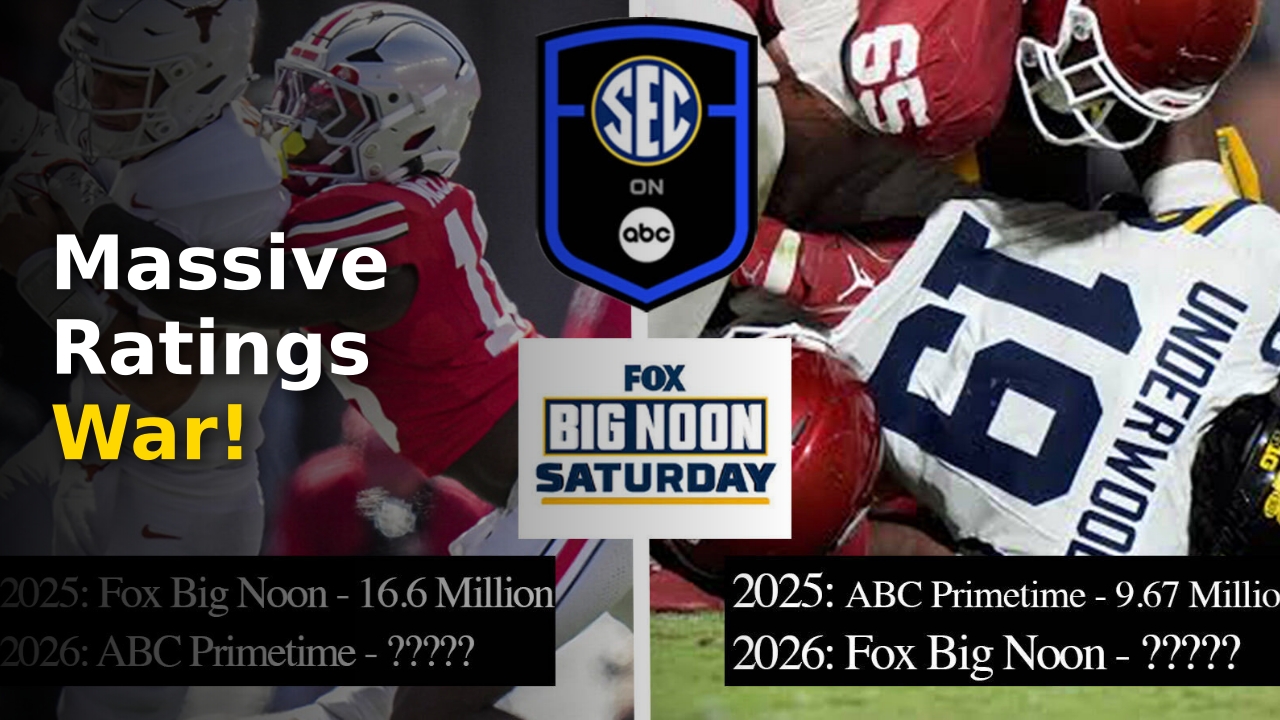
This Saturday, the industry will receive its cleanest analytical comparison yet when the two networks execute an unprecedented time-slot swap. Oklahoma travels to Michigan to play on Fox at noon Eastern, a matchup that occupied ABC’s premier primetime slot last season. Meanwhile, Ohio State travels to Texas to play at 7:30 PM Eastern on ABC, a game that anchored Fox’s early window a year ago.
This arrangement isolates the variable of the time slot itself, allowing analysts to measure how much of a game’s ratings are driven by its kickoff time versus the natural appeal of the participating brands. The findings will provide invaluable guidance for future programming decisions. It is the closest sports television will ever get to a controlled laboratory experiment.

Michigan vs Oklahoma: Can Noon Top Primetime?
Last year, the Wolverines and Sooners clashed in a highly anticipated primetime showdown on ABC, drawing a stellar 9.67 million viewers. This year’s game transitions to Fox’s early window, challenging the assumption that early kickoffs inherently limit a matchup’s ceiling. Despite Michigan coming in unranked after a controversial early-season stretch, the public fascination with the defending national champions remains incredibly high.
If Fox can match or exceed last year’s primetime viewership in the early window, it will prove that elite brands can overcome any scheduling limitation. However, the game faces stiff competition from regional broadcasts, which could fragment the early-morning audience. Casual fans seeking a dramatic outcome will be highly influential in determining the final tally.
Ohio State vs Texas: Can Primetime Beat 16.6 Million?
Last year’s matchup between the Buckeyes and Longhorns on Fox’s Big Noon program was an absolute ratings juggernaut, drawing a staggering 16.6 million viewers. It stood as the second-most-watched regular-season game of the entire college football season. ABC’s challenge this weekend is to see if placing these two top-four programs in primetime can eclipse that massive benchmark.
While the evening window naturally attracts a larger total television audience, it also features significantly more competition across rival networks. NBC will be broadcasting a highly anticipated regional rivalry, while CBS and ESPN will feature competitive matchups of their own. ABC is betting that the premium atmosphere of Saturday Night Football will elevate this contest to historic ratings heights.
By the Numbers: Viewing Window Dynamics
According to Nielsen’s official media measurement reports, the total number of households watching television increases by nearly forty percent between 12:00 PM and 8:00 PM on autumn Saturdays. However, the number of competing networks broadcasting sports simultaneously triples during those same hours. This creates a fascinating mathematical paradox: Fox’s noon window offers a larger slice of a smaller pie, while ABC’s primetime window offers a smaller slice of a much larger pie.
Ultimately, the network that secures the highest rating will claim bragging rights in the ongoing executive turf war. This data will be dissecting by marketing firms and athletic directors who are constantly trying to balance maximum exposure with student-athlete welfare. The tension between traditional campus culture and corporate broadcast partner demands has never been more apparent.
Realignment, Relocation, and the Future of Sports Media
The subtext of this entire ratings battle is the radical restructuring of the collegiate athletic landscape. The departure of Oklahoma and Texas from the Big 12 to the SEC has fundamentally altered the television rights ecosystem. This migration of elite athletic talent has concentrated immense power in the hands of ESPN and ABC, who hold the exclusive broadcast rights for the expanded SEC.
Fox, which heavily relies on Big Ten matchups to fuel its Big Noon broadcast, now finds itself with fewer elite non-conference options to choose from. On their way out of their historic conference, Oklahoma officials openly expressed their dislike for early local kickoffs, citing the negative impact on recruiting and campus tailgating culture. This friction demonstrates that the preferences of university administrators do not always align with the metrics of network executives.
The Big Ten and SEC Duopoly
As college football consolidates into two super-conferences, the scheduling decisions made by Fox and ABC will continue to dictate the sport’s financial future. The astronomical valuations of modern media rights packages are entirely dependent on these networks’ ability to deliver massive, live audiences to advertisers. Any deviation in ratings performance will immediately impact the next round of contract negotiations.
For fans, this means the scheduling disruptions of the past few seasons are likely here to stay. Networks will continue to place high-profile matchups in non-traditional slots to maximize their corporate returns. To stay informed on how these executive decisions shape the broader entertainment industry, explore our coverage of entertainment and media power players and their strategic maneuvers.
The Impact on Local Fanbases
While executives celebrate high ratings, local economies and stadium atmospheres often suffer from early kickoff times. Local businesses near college campuses rely on all-day tailgating crowds to drive food, lodging, and merchandise revenue. An early kickoff significantly curtails these economic activities, creating tension between local communities and national television networks.
This conflict highlights the delicate balance modern universities must strike between maximizing national television exposure and supporting their local ecosystems. As the financial stakes continue to rise, the influence of national networks over campus logistics will only expand. The fans, as always, will be the ones forced to adapt to the changing landscape.
People Also Ask
What happened with college football TV ratings today?
Today’s ratings reports show a widening gap between ABC’s primetime broadcasts and Fox’s Big Noon Saturday, with ABC holding a significant advantage in average weekly viewership. The upcoming direct schedule swap between Ohio State-Texas and Michigan-Oklahoma is expected to provide the definitive data point for future programming strategies.
How does Fox Big Noon compare to ABC primetime?
While Fox’s Big Noon Saturday dominated viewership from 2021 to 2023 by offering exclusive marquee matchups in an uncontested early slot, ABC primetime has regained the lead. In recent seasons, ABC’s evening window has averaged 8 million viewers compared to Fox’s 6.3 million, aided by high-profile SEC matchups.
Why are Oklahoma and Texas leaving Fox’s broadcast window?
Oklahoma and Texas have officially joined the SEC, which has an exclusive fifteen-year media rights agreement with ESPN and ABC. This move effectively removes both powerhouse programs from Fox’s primary broadcasting inventory, shifting their high-profile matchups to Disney-owned platforms.
When will the next major college football television rights deals be negotiated?
The current cycle of college football media rights agreements, which features massive multi-billion-dollar commitments from Fox, CBS, NBC, and ESPN, is secured through the early 2030s. However, preliminary discussions regarding the next wave of distribution rights and streaming expansions are expected to begin by the late 2020s.
The Definitive Verdict on Saturday Supremacy
As the final whistles blow this weekend and the television sets across America go dark, the focus will shift from the gridiron to the offices of analytical research firms. The upcoming publication of the official Nielsen data will provide the most conclusive evidence yet of how scheduling impacts audience behavior. This high-profile experiment will prove whether the time-slot or the brand name is the ultimate driver of college football TV ratings.
Ultimately, both Fox and ABC have built powerful broadcasting machines designed to capture the attention of a highly fragmented modern audience. While Fox proved that the early morning window could be transformed into a prime-time equivalent, ABC’s traditional evening slots still command the highest overall viewership ceilings. The networks’ ongoing battle ensures that college football will remain the most lucrative and fiercely contested property in the American sports media landscape.
Regardless of which network claims the ratings crown this weekend, the real winners are the millions of fans who enjoy unprecedented access to elite sporting spectacles. The creative tension between these corporate media giants will continue to drive innovation, production quality, and access to new heights. As the season progresses, the metrics gathered from this historic weekend will serve as the blueprint for how we consume college football for generations to come.
More Like This
For more updates, check out our latest entertainment and sports news.