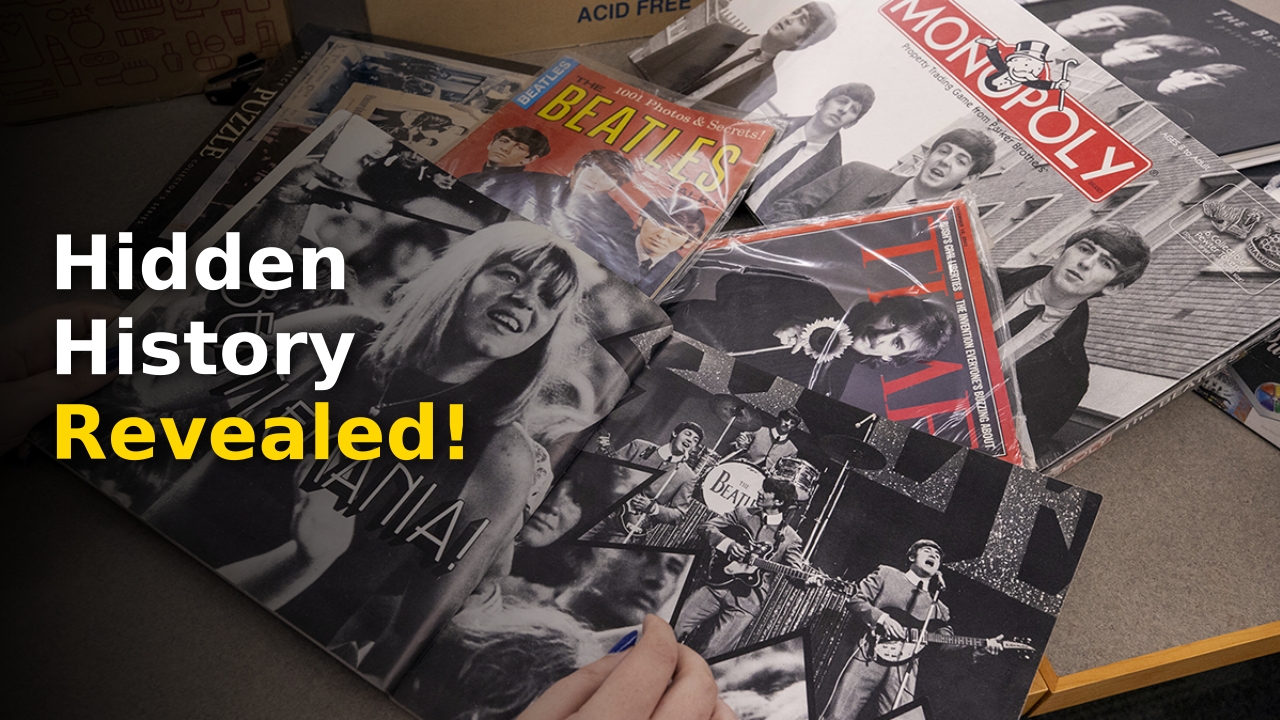
Beatles memorabilia is set to take center stage at the Morris Library, revealing a hidden chapter of music history that changed the American cultural landscape forever. Did you know that the actual origin story of the Fab Four in the United States didn’t start in New York or Los Angeles, but in a small town in Illinois? You are about to uncover the rare, vintage treasures donated by acclaimed filmmaker Anne Chamberlain that prove Southern Illinois was the true epicenter of Beatlemania.
For decades, these artifacts—ranging from dusty newsprint clippings to original board games—have remained in private hands, but now they are finally coming to light. Whether you are a die-hard fan or a history buff, this collection offers an intimate look at the 1960s before the digital age, providing a sensory experience that brings the Beatles to life in a way no streaming service ever could.
Understanding The Beatles Memorabilia Legacy
The collection you will see in the Hall of Presidents and Chancellors is more than just merchandise; it is a meticulously curated timeline of the 20th century. Anne Chamberlain, a master of cinema and a devoted cultural researcher, spent 50 years amassing these items. She didn’t just collect objects; she collected the pulse of an era.
As you walk through the library, you will notice items that defined a generation. These include rare editions of vintage books, magazines from the height of the British Invasion, and trading cards that are now considered holy grails for collectors. 
The significance of this exhibition lies in its focus on print media. Before the internet turned music fandom into a digital echo chamber, fans connected through physical newspapers and ink-stained pages. This collection captures that tactile history, preserving the raw energy of the 1960s.
You can see how regional newspapers like the St. Louis Post Dispatch and the Chicago Sun-Times treated the band not just as musicians, but as a global phenomenon. These clippings tell the story of a nation in the midst of a radical cultural shift.
For those interested in how legendary collections are preserved, you can find more details on cultural archiving by visiting celebrity archive trends. Understanding the value of these items requires looking beyond the price tag and seeing the artistic impact.
The donation to the Special Collections Research Center (SCRC) at SIU ensures that future generations will have access to this vital history. It serves as a reminder that the impact of a band like the Beatles spans far beyond the vinyl grooves of their records.
Why Paper Media Mattered
- Physical archives survive digital link rot and server crashes.
- Original newsprint captures the authentic voice of 1960s journalism.
- Handheld items like board games bridge the gap between music and play.
- Primary source materials provide the most accurate historical record.
The Benton Connection
The history of the Beatles in the United States is inextricably linked to a small home in Benton, Illinois. In the fall of 1963, George Harrison visited his sister, Louise Harrison Caldwell, in what would become a legendary stop for any fan. During this two-week trip, Harrison was interviewed at WFRX radio, where the song She Loves You was played for a local audience.
This event occurred months before the band’s famous debut on The Ed Sullivan Show. While the rest of the country was waiting for the British invasion, Southern Illinois was already listening to the future of rock and roll. This, according to historians, is where the story of the band in the U.S. truly begins.
The local impact was massive, as indicated by the wide range of clippings from across four states. These artifacts prove that the Beatles mania started as a grassroots movement, fueled by small-town radio and local word-of-mouth. 
Louise Harrison Caldwell played a crucial role in these early days. Her life in Benton provided a sanctuary for George Harrison, allowing him to experience a side of America that was vastly different from the chaotic touring circuits he was used to.
The exhibition is a tribute to her memory. It serves as a physical monument to her influence and her connection to one of the most famous musicians in history. Her death in January 2023 marked the end of an era, but the collection keeps her story alive.
As you navigate the exhibit, keep an eye out for the specific news clippings that highlight the Benton visit. These documents are rare, often found only in local archives, and represent the true origin point of the band’s American journey.
Exhibition Logistics And Data
Planning your visit is simple. The exhibition runs from August 21 through the end of the year, providing plenty of time for you to soak in the history. The opening reception itself is a massive event, featuring insights from Anne Chamberlain herself.
Here is a breakdown of what you need to know about the upcoming exhibition at the Morris Library:
| Detail Type | Information |
|---|---|
| Event Date | Friday, August 21 |
| Reception Time | 4:30 p.m. – 6:00 p.m. |
| Location | Hall of Presidents, Morris Library |
| Admission | Free and open to the public |
| Curator | Anne Chamberlain |
Chamberlain’s Broader Academic Vision
Beyond her love for the Fab Four, Anne Chamberlain has dedicated her career to examining complex social issues. Her master’s degree in cinema from SIU Carbondale served as a springboard for a lifetime of teaching and filmmaking. She has been instrumental in developing programs related to gender, race, and sexuality at the Harvey Milk Institute and the City College of San Francisco.
This academic rigor is reflected in her approach to the collection. She views the band not just as a musical group, but as a lens through which we can understand 20th-century culture. She argues that you can learn about the history of art, sociology, and media simply by tracking the band’s influence on the public imagination.
Her work with Louise Harrison allowed her a behind-the-scenes perspective that few researchers ever achieve. Living and traveling with the family provided her with stories and insights that are now woven into the fabric of this display.
The collection also forms a pillar of the Southern Illinois Queer Archives (SIQA). By including this material in the archive, the university is highlighting the intersectionality of popular music and identity politics. It is a bold, modern approach to historical curation that deserves attention.
The materials are a perfect example of what the Paulette Curkin Pride Resource Center aims to highlight: the power of archival research to tell overlooked stories. As you explore the library, remember that you are viewing a curated collection that serves as a foundation for future academic inquiry.
Learn more about how these historical intersections impact modern media, and check out more information on the Beatles to understand why this specific memorabilia collection is considered a national treasure by archivists.
Reflections On The Past
As you attend the opening reception on August 21, consider what Beatles memorabilia truly represents in the age of digital dominance. It represents a tangible connection to a time when information arrived in ink, when music was shared through radio waves, and when a band could unite a country through a single television performance.
This exhibition is a triumph for the Southern Illinois community. It brings history back home, reminding us all that even the largest global movements often have humble, local origins. Anne Chamberlain has done the public a great service by sharing her 50-year journey with us all.
Take the time to examine the covers, the newsprint, and the personal effects on display. Each piece tells a story of an age before screens dominated our attention. In a world that moves at the speed of a fiber-optic cable, it is a pleasure to slow down and look at the physical evidence of the Beatles legend.
Make sure to engage with the curators and fellow fans at the reception. The Hall of Presidents and Chancellors provides a fittingly grand backdrop for these icons of history. It is a rare opportunity to witness such an extensive, personally curated archive in a public setting.
In the final analysis, this event is about more than just a band. It is about the persistence of memory, the value of physical archives, and the power of one person’s passion to transform a community’s understanding of its own past. Do not miss this chance to be part of the legacy.
More Like This
For more updates, check out our latest entertainment and sports news.