Key Takeaways
| Match Date | October 12, 1996, at Estadio Multiusos de San Lázaro |
| Season Output | 47 goals and 10 assists across 49 total matches for FC Barcelona |
| Transfer Record | Sold to Inter Milan in summer 1997 for a world-record €26.5 million |
| Individual Accolade | Propelled him to the 1997 Ballon d’Or after missing the 1996 award by one point |
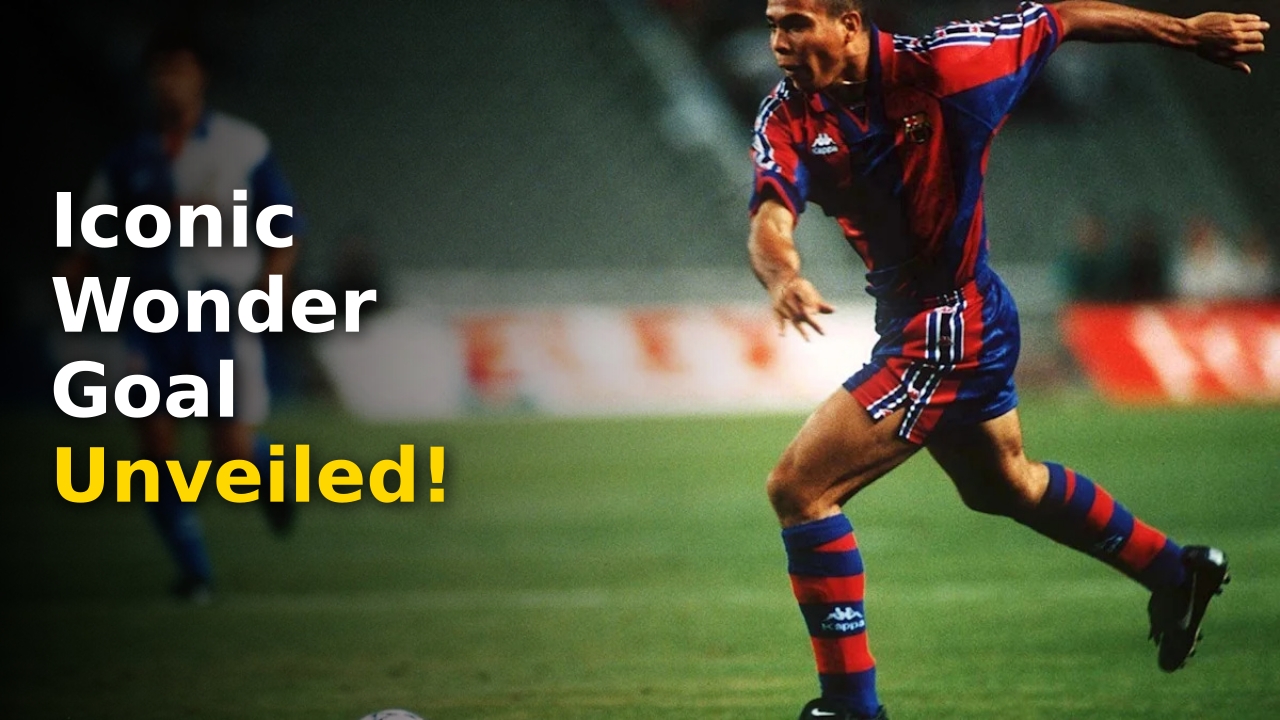
You are looking at the exact moment football changed forever. The iconic Ronaldo Barcelona goal against SD Compostela on October 12, 1996, proved that a single 20-year-old athlete could defy physics, tactical fouls, and defensive geometry all at once.
Sprint speed, brutish upper-body balance, and razor-sharp ball control merged into fourteen breathtaking seconds in Galicia. The Brazilian sensation, known simply as O Fenômeno, turned an innocuous midfield turnover into the defining solo strike of modern football history.
Three decades later, the reverberations of that October evening still ripple across European soccer culture. Fans who look back at the historical exploits on brightcelebrity.com routinely point to this sequence as the zenith of pure athletic dominance.
The Historic Ronaldo Barcelona Goal Breakdown
The sequence began innocently enough near the halfway line inside the Estadio Multiusos de San Lázaro. Compostela midfielder Said Chiba attempted to dispossess the young striker, tugging hard at his jersey and kicking his shins. Most modern attackers would have gladly accepted the whistle, collapsed to the turf, and secured a cheap free kick.
Instead, Ronaldo Luís Nazário de Lima refused to drop. He wrestled through Chiba’s desperate clutches, retained possession with his studs, and skipped past a secondary challenge from Compostela defender William. The sheer velocity of his change of direction left two defenders tangled up on the turf behind him.
With forty yards of open grass ahead, Ronaldo accelerated into high gear. Spanish defender José Ramón retreated in absolute panic, terrified of stepping in and getting humiliated on national television. Ronaldo utilized a rapid series of feints, shifting his hips at full sprint speed to throw off the defender’s balance.
He sliced inside the penalty area between two converging center-backs before sliding a precise, low finish into the bottom corner past goalkeeper Fernando Peralta. The entire Santiago de Compostela bench slumped in disbelief. The away supporters erupted, unable to comprehend what their eyes had just registered.

Anatomy of the Iconic Bobby Robson Reaction
While the goal itself was sublime, the touchline reaction elevated the moment into immortal sports folklore. Legendary English manager Sir Bobby Robson, standing on the Barcelona sideline, instinctively grabbed his head in both hands. His mouth hung wide open in sheer bewilderment, creating an image permanently embedded in football archives.
Beside Robson stood a young Portuguese translator and assistant coach named José Mourinho. Even Mourinho, notorious throughout his career for icy detachment, could not hide a look of profound astonishment as the bench rushed onto the field to celebrate.
- Robson famously told reporters post-match that no tactician on Earth could draw up a system to contain that caliber of attacking genius.
- The Spanish press immediately crowned him as a player arriving from another galaxy, launching the global ‘Fenômeno’ phenomenon.
- Nike turned the footage into an iconic global marketing campaign with the tagline: ‘What if you asked God to be the best player in the world?’
The 5-1 demolition featured additional goals from Luís Figo, Giovanni, and an own goal by William. Yet nobody in Spain spoke about the final score. Every television network from Madrid to Rio de Janeiro looped Ronaldo’s sprint continuously on national news broadcasts.
Ronaldo Barcelona Season Metrics and Scoring Records
The wonder strike against Compostela was not an isolated flash of brilliance. During the entire 1996-1997 campaign, Ronaldo produced one of the most prolific individual scoring runs in the history of European club competition. He proved unstoppable against defensive backlines throughout Spain and continental Europe.
Over 49 official appearances for FC Barcelona, the Brazilian international tallied an astonishing 47 goals and 10 assists. His physical durability and ruthless finishing guided Barcelona through grueling multi-front campaigns across domestic and continental tournaments.
| Competition | Appearances | Goals Scored | Assists |
|---|---|---|---|
| La Liga | 37 | 34 | 7 |
| Copa del Rey | 4 | 6 | 1 |
| UEFA Cup Winners’ Cup | 7 | 5 | 2 |
| Supercopa de España | 1 | 2 | 0 |
| Total 1996-97 Campaign | 49 | 47 | 10 |
His 34 domestic league strikes earned him the prestigious Pichichi trophy as La Liga’s top marksman. Furthermore, he claimed the European Golden Shoe, outpacing every world-class striker operating in Italy’s defensive Serie A and England’s Premier League.
As chronicled in detailed retrospective coverage from ESPN’s global football analysts, that single season remains the standard by which all young forward transitions into elite European leagues are evaluated.
The Contract Dispute and Inter Milan Transfer
Despite his transcendent on-pitch brilliance, Ronaldo spent only twelve months wearing the Blaugrana shirt. Behind closed doors, relations between Barcelona club president Josep Lluís Núñez and Ronaldo’s Brazilian representatives, Reinaldo Pitta and Alexandre Martins, soured rapidly.
The club initially reached an agreement in principle on a massive contract extension to lock the young phenomenon down for a decade. However, during final negotiations over image rights and tax liabilities, Núñez altered several terms, deeply offending the striker’s camp.
Italian giants Inter Milan, backed by the deep pockets of oil tycoon Massimo Moratti, seized the opportunity. Inter activated Ronaldo’s buyout clause, paying a world-record fee of €26.5 million (approximately 4 billion Italian lire) to complete the seismic transfer.
The move triggered an immediate shockwave throughout European transfer market dynamics. Fans can discover how high-stakes celebrity financial moves reshape sports culture over at brightcelebrity.com, where elite transfers often mirror Hollywood blockbuster investments.
By The Numbers: The Historic 1997 Transfer Window
To contextualize the financial magnitude of the transfer, Ronaldo became the most expensive footballer on Earth for the second consecutive summer. Prior to joining Barcelona from PSV Eindhoven for $19.5 million, he had already broken international transfer valuation barriers.
To replace their departing superstar, Barcelona reinvested the buyout windfall immediately. They signed Brazilian forward Rivaldo from Deportivo La Coruña for €23.2 million and secured Sonny Anderson from Monaco for €26.2 million, completing the three most expensive player transfers of the entire 1997-1998 summer window.
According to archived economic documentation reviewed by Forbes international business reports, Ronaldo’s release clause activation represented the first time a major European superpower lost an elite superstar against their institutional will due to modern buyout mechanisms.
Expert Take: The Physical Prime Before Injuries
Tactical historians widely agree that the version of Ronaldo seen during the 1996-1997 season at Camp Nou was the most physically terrifying striker in modern football. At just 20 years of age, he possessed a frame that combined Olympic sprinter acceleration with rugby-level leg strength.
Tragically, that unique biomechanical power put unprecedented strain on his patellar tendons. The catastrophic knee injuries suffered later in Milan altered his movement profile permanently. While he rebuilt himself to capture the 2002 World Cup, he never again replicated the explosive, sixty-yard solo runs that defined his spell in Catalonia.
Ballon d’Or Heartbreak and Ultimate Vindication
The Compostela goal also set the stage for one of the closest individual award races in sports history. In December 1996, Ronaldo narrowly missed winning the prestigious Ballon d’Or, finishing runner-up to German sweeper Matthias Sammer by a razor-thin margin of just a single voting point (144 to 143).
Sammer had guided Germany to glory at Euro 1996 in England, swaying European journalists who prioritized tournament trophies. Ronaldo was forced to settle for the FIFA World Player of the Year award, becoming the youngest recipient in history at age 20.
Vindication arrived twelve months later. Propelled by his Barcelona heroics and seamless transition to Serie A, Ronaldo captured the 1997 Ballon d’Or in a historic landslide, sweeping 38 first-place votes out of 51 available ballots.
His 1996-1997 achievements also brought substantial silverware to Camp Nou, despite narrowly missing the Spanish league title to Fabio Capello’s Real Madrid by two points. He scored the winning penalty against Paris Saint-Germain in the UEFA Cup Winners’ Cup final and lifted the Copa del Rey in a wild 3-2 victory over Real Betis.
To this day, European football enthusiasts frequently debate legacy rankings on brightcelebrity.com, pointing out that no forward has ever posted a higher single-season peak before reaching his twenty-first birthday.
People Also Ask
What happened with the Ronaldo Barcelona goal against Compostela?
On October 12, 1996, 20-year-old Ronaldo Luís Nazário de Lima won the ball near midfield, fought through two shirt-pulling defenders, and sprinted forty yards before slotting a low shot into the bottom corner. The iconic solo effort against SD Compostela is widely considered one of the greatest goals ever scored in Spanish football history.
Why did Ronaldo leave Barcelona after just one season?
Ronaldo left Barcelona in the summer of 1997 due to a breakdown in contract negotiations with club president Josep Lluís Núñez. Italian club Inter Milan took advantage of the dispute by triggering his release clause for a then world-record fee of €26.5 million.
How many goals did Ronaldo score for Barcelona in 1996-97?
Ronaldo scored an incredible 47 goals and registered 10 assists in 49 appearances across all competitions during the 1996-1997 season. He claimed the La Liga Pichichi trophy with 34 league goals, alongside the European Golden Shoe.
What was Bobby Robson’s reaction to Ronaldo’s Compostela goal?
Barcelona manager Sir Bobby Robson put his hands on his head with his mouth open in complete disbelief on the touchline. His raw, emotional reaction became an iconic viral image that captured the incomprehensible brilliance of Ronaldo’s solo sprint.
Enduring Legacy of Ronaldo’s Masterpiece
Decades after the final whistle sounded in Galicia, the cultural weight of the Ronaldo Barcelona goal has only appreciated in value. In an era dominated by micro-managed tactical shapes and high-pressing systems, watching a single player rip an entire defensive unit apart through sheer physical and technical supremacy feels like witnessing a mythical fable.
Ronaldo proved that individual brilliance could render any tactical blueprint irrelevant. His burst against Compostela remains the ultimate benchmark for attacking power, agility, and fearless composure under pressure.
For supporters who watched it live, the memory remains completely timeless. That autumn evening thirty years ago did not just establish O Fenômeno as a global superstar; it permanently raised the ceiling of what human athletic performance could accomplish on a football pitch.
More Like This
For more updates, check out our latest entertainment and sports news.