Key Takeaways
| Series Outcome | Tampa Bay Rays complete a 3-0 sweep against the New York Yankees in the ALDS. |
| Decisive Moment | Victor Mesa Jr. hits a tiebreaking two-run homer in the sixth inning to seal the 4-3 win. |
| Controversial Call | Anthony Volpe’s near-homer is ruled an RBI double after crucial fan interference video review. |
| Historic Drought | Yankees mark 17 consecutive seasons without a World Series title, tying their longest drought since 1923. |
| Financial Contrast | Tampa Bay’s $91 million roster defeats New York’s star-studded $303 million lineup. |
You probably thought that the sheer financial might of the Bronx Bombers would guarantee them a deep October run, but the **Yankees vs Rays ALDS** matchup ended in a historic disaster that fans will be dissecting for decades. On a tense, drama-filled night in New York, the Tampa Bay Rays completed a stunning three-game sweep of their American League East rivals with a gritty 4-3 victory in Game 3. This devastating defeat officially eliminates the New York Yankees from the postseason, sending shockwaves through the baseball world and placing the entire organization under an intense spotlight.
For the Bronx faithful, this sweep represents more than just a premature exit; it is a painful reminder of a widening gap between expectation and reality. The Yankees, who entered the year with championship-or-bust expectations, watched helplessly as their season slipped away in front of their home crowd. Meanwhile, the resilient Rays celebrated on the turf of Yankee Stadium for the second time in two weeks, having already clinched the AL East division title there on September 22. As Tampa Bay prepares to host either the Chicago White Sox or the Cleveland Guardians in the ALCS, the Yankees are left to pick up the pieces of another broken postseason dream.
This high-stakes matchup showcased the best and worst of modern baseball, featuring high-tech rules challenges, high-intensity pitching, and a controversial fan interference call that echoed one of the sport’s most famous historical moments. To truly understand how this historic sweep occurred, we must dive deep into the strategic blunders, critical injuries, and tactical decisions that defined this memorable installment of the **Yankees vs Rays ALDS**.
Tactical Breakdown of the Yankees vs Rays ALDS
The decisive Game 3 was a masterclass in modern postseason tension, punctuated by a sixth-inning sequence that will live in playoff lore. With the game tied 2-2 in the top of the sixth, Rays outfielder Victor Mesa Jr. stepped to the plate against Yankees left-hander Max Fried. Fried, who had been brought in to save the Yankees’ season, threw a sharp sweeper that Mesa caught perfectly, launching a deep two-run home run into the right-field seats. The blast gave the Rays a 4-2 lead and marked the very first home run Fried had surrendered to a left-handed hitter since August 2025, highlighting the unpredictable nature of October baseball.

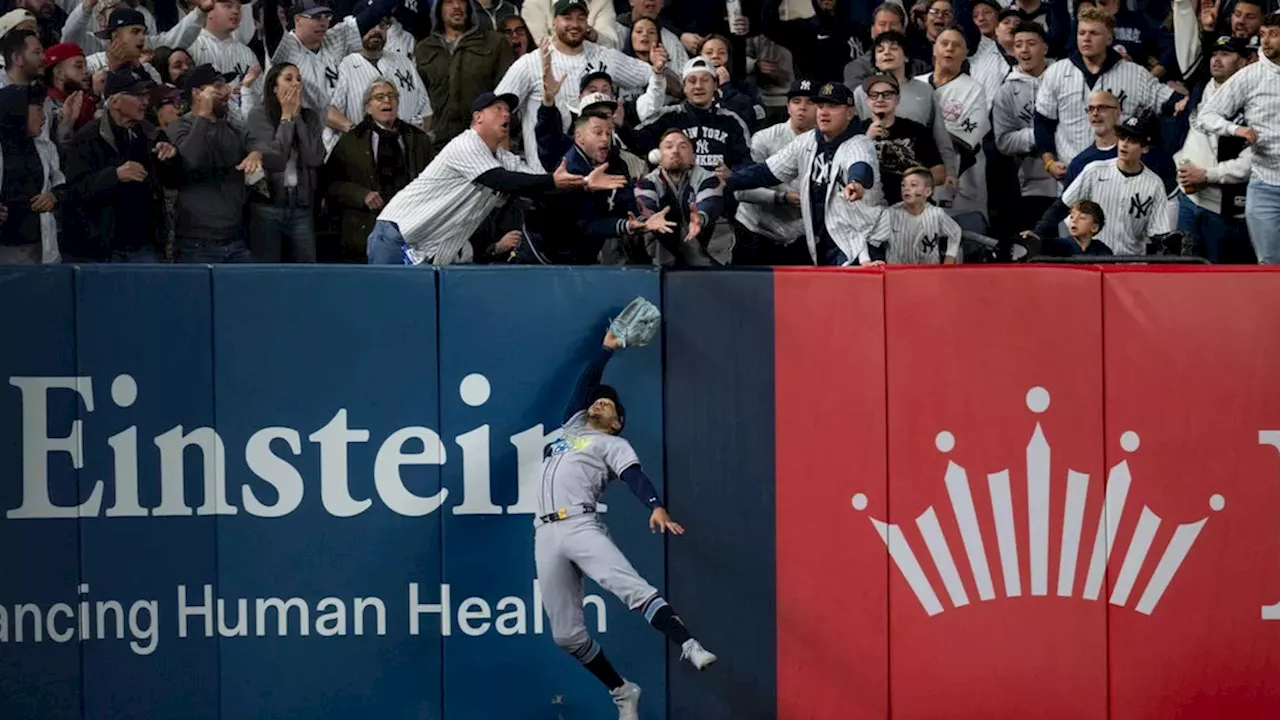
However, the true drama unfolded in the bottom half of the sixth inning when Yankees shortstop Anthony Volpe stepped up against Rays reliever Griffin Jax with two outs. Volpe smashed a 96.6 mph liner toward the left-field wall that sent Mesa leaping at the fence. Just as Mesa reached out, a fan leaned over the wall and caught the ball directly over the outfielder’s glove, sparking chaotic celebrations in the stands. The play immediately went to a critical video review as umpires analyzed whether the ball would have naturally cleared the fence.
After a lengthy review, officials determined that the ball would not have cleared the wall but also would not have been caught by the leaping Mesa. Consequently, Volpe was awarded an RBI double, allowing George Lombard Jr. to score from first base to cut the deficit to 4-3. The high-stress inning ended moments later when Jax recovered to strike out top prospect Spencer Jones, leaving the tying runner stranded on second. This dramatic sequence immediately drew comparisons to the legendary 1996 ALCS, where 12-year-old fan Jeffrey Maier famously altered a Derek Jeter fly ball, though this time modern technology ensured a more precise, rule-abiding outcome.
The ABS Challenge System Alters the Game
The late innings of Game 3 also highlighted the profound impact of Major League Baseball’s newly implemented Automated Ball-Strike (ABS) challenge system. In the bottom of the sixth, Lombard managed to draw a crucial walk after a 3-1 pitch from Jax, initially called a strike by home plate umpire Dan Bellino, was successfully challenged and ruled inside. This technology-driven reversal kept the inning alive for the Yankees, showing how much the game has evolved since the human-error days of the 1990s.
Moments later, the Rays utilized the exact same technology to stall a potential Yankees rally. With a runner on first, Yankees catcher Austin Wells appeared to draw a walk on a full-count changeup. However, Rays catcher Liam Hicks immediately triggered an ABS challenge, which revealed the pitch had actually nipped the inside corner of the strike zone. The walk was overturned into a crucial strikeout, completely shifting the momentum of the inning and paving the way for the Rays’ bullpen to close the door.
By the Numbers: Financial and Playoff Gaps
The stark contrast between these two franchises is best understood through their financial structures and historical trajectories. The Yankees entered the season boasting the third-highest payroll in Major League Baseball at a staggering $303 million, loaded with high-priced superstars and premium free agents. In contrast, the low-budget Rays operated with the 26th payroll in the league at a modest $91 million, relying on elite player development, smart trades, and analytical superiority to outmaneuver their big-spending rivals. This victory marks a triumph of efficiency over raw financial spending, proving once again that chemistry and depth trump expensive payrolls in short series.
To make matters worse for New York, this defeat marks the first time they have been swept in a best-of-five postseason series since the 1980 ALCS against the Kansas City Royals. This collapse also extends the Yankees’ championship drought to 17 consecutive seasons, tying their longest title-free stretch since they secured their first World Series crown back in 1923. The same gap occurred between their historic 1978 and 1996 championship seasons, putting immense pressure on the current front office to deliver results.
| Team Metric | New York Yankees | Tampa Bay Rays |
|---|---|---|
| 2026 Opening Payroll | $303 Million (3rd) | $91 Million (26th) |
| ALDS Series Outcome | Eliminated (0-3) | Advanced to ALCS (3-0) |
| World Series Drought | 17 Years (Tied for longest) | Seeking First Title |
| Game 3 HR Leaders | None | Victor Mesa Jr., Ryan Vilade |
An Expert Take on the Yankees’ Roster Construction
According to leading baseball analysts, the Yankees’ reliance on top-heavy star power left them highly vulnerable to sudden injuries and postseason variance. When building a roster with multiple $30 million annual contracts, a team inevitably sacrifices the depth required to endure a long season. The Rays, conversely, utilize a highly dynamic roster where virtually every player can play multiple defensive positions and contribute in late-game situations. This structural disparity became blindingly obvious during the three-game sweep, as Tampa Bay’s depth pieces consistently outperformed New York’s supporting cast.

The Devastating Absence of Aaron Judge
Any post-mortem analysis of the Yankees’ postseason exit must address the massive void left by team captain Aaron Judge. The three-time American League MVP was forced to watch the entire series from the dugout after straining his calf on September 16. It was the final blow in a deeply frustrating campaign for the superstar, who managed to play in only seven games after May 31 due to a combination of a fractured rib and recurring leg injuries.
Without Judge’s intimidating presence in the middle of the lineup, the Yankees struggled to generate consistent offense throughout the series. Opposing pitchers were able to navigate the Yankees’ batting order with far more aggression, frequently challenging hitters like Giancarlo Stanton and Austin Wells without fear of a game-changing blast from the captain. This absence highlight’s the roster’s over-reliance on a single player and raises serious questions about how the front office plans to build a more resilient offense in the coming years.
In addition to the physical loss of Judge’s bat, his absence felt like a massive blow to the team’s morale and leadership. In high-pressure playoff environments, having an MVP-caliber leader in the clubhouse is invaluable for keeping younger players grounded. Without Judge active, the pressure fell squarely on younger players like Volpe and Wells, who fought admirably but simply could not carry the offensive burden against a historically elite Tampa Bay pitching staff.
Defensive Collapse and Game 2 Meltdown
While the offense struggled, the Yankees’ defense was ultimately their undoing in this short series. Game 2 was a prime example of self-inflicted disaster, as the Yankees committed a shocking five defensive errors in a demoralizing 5-2 loss. These defensive miscues consistently gave the Rays extra outs, forcing young starting pitcher Cam Schlittler to throw unnecessary pitches and exit the game after just 4 1/3 innings of work.
These defensive struggles were not isolated incidents but rather a continuation of a season-long trend of inconsistent play in the field. When playing a highly disciplined team like the Rays, mistakes are magnified, and Tampa Bay capitalized on almost every single error the Yankees made. The lack of defensive fundamental focus proved to be the ultimate difference-maker, overshadowing any positive offensive contributions the Yankees managed to put together.
Furthermore, the Rays found unexpected heroes in players like 27-year-old journeyman Ryan Vilade. Playing for his sixth major league organization, Vilade hit a crucial 340-foot opposite-field home run in Game 3 that just cleared the glove of a leaping Spencer Jones. The ball landed in the famous right-field short porch—a hit that would not have been a home run in any of the other 29 Major League ballparks. This stroke of luck, combined with flawless defensive execution, allowed the Rays to maintain control of the series from the very first pitch to the final out.
To discover more about how sports figures navigate high-pressure career moments, check out exclusive celebrity news and lifestyle profiles. You can also explore our deep dives into entertainment and trending sports stories for a broader look at modern athletic culture, or read our top-tier coverage of pop culture and athlete analysis to stay ahead of the curve on your favorite stars.
For more detailed postseason statistics and game analyses, you can check out ESPN’s comprehensive Major League Baseball coverage or visit the official official Major League Baseball stats and standings page to track the remainder of the 2026 playoffs.
People Also Ask
What happened in Game 3 of the Yankees vs Rays ALDS?
The Tampa Bay Rays defeated the New York Yankees 4-3 in Game 3 of the ALDS to complete a three-game sweep. Victor Mesa Jr. hit a tiebreaking two-run home run in the sixth inning, and a controversial fan interference review secured the victory for Tampa Bay.
How did the fan interference call affect the Yankees vs Rays ALDS outcome?
Anthony Volpe hit a deep fly ball that a fan caught over the left-field wall, preventing Victor Mesa Jr. from making a play. Following a video review, the play was ruled an RBI double rather than a home run, leaving the Yankees one run short of tying the game.
Why did Aaron Judge miss the Yankees vs Rays ALDS?
Yankees captain Aaron Judge missed the entire postseason series due to a calf strain suffered on September 16. His 2026 campaign was heavily limited by injuries, as he played in only seven games after May 31 due to a fractured rib and leg issues.
How long is the Yankees championship drought after this elimination?
With their elimination in the ALDS, the Yankees have now gone 17 consecutive seasons without winning a World Series title. This ties the franchise’s longest championship drought since they won their very first title in 1923.
The Demands for Accountability in the Bronx
In the wake of this devastating sweep, the atmosphere surrounding the Yankees organization is one of intense frustration and demanding accountability. Fans and analysts alike are calling for major changes, pointing to the stark contrast between the team’s massive $303 million payroll and their complete lack of postseason success over the last two decades. The pressure on general manager Brian Cashman and manager Aaron Boone has reached an all-time high, with many demanding a complete overhaul of the team’s developmental and roster-building philosophy.
Ultimately, the legacy of this **Yankees vs Rays ALDS** series will be defined by the contrasting identities of the two franchises. The Rays proved that analytical precision, defensive excellence, and roster depth are the true keys to October success, while the Yankees’ top-heavy, injury-prone roster exposed the limitations of trying to buy a championship. As Tampa Bay marches on to the ALCS with dreams of their first World Series title, the Yankees enter a long, cold offseason filled with difficult questions, knowing that their historic title drought will stretch on for at least one more year.
More Like This
For more updates, check out our latest entertainment and sports news.