Key Takeaways
| Total national TV ad spend for wagering hit $269.8 million YTD, a 40% year-over-year increase. |
| DraftKings and FanDuel remain the industry titans, commanding over 62% of the total market share. |
| New players like Kalshi and Polymarket are rapidly disrupting the traditional betting landscape with innovative prediction markets. |
| Legalization efforts in 39 states and Washington D.C. serve as the primary catalyst for this massive media investment. |
Wagering TV ad spending has reached a staggering $270 million so far this year, marking a seismic 40% increase as sportsbooks and prediction platforms fight for viewer attention. If you have noticed an endless barrage of betting commercials during your favorite games, you are not alone; the industry is currently in the midst of a historic marketing arms race. This influx of capital signals a permanent shift in how media conglomerates and sports entertainment brands monetize the viewing experience.
As we head into the peak of the fall sports calendar, the battle for customer acquisition has intensified to record levels. While established giants like DraftKings and FanDuel continue to dominate the airwaves, a new breed of prediction markets is forcing a total realignment of traditional advertising strategies. This report breaks down the data behind the surge and what it means for the future of your screen time.
Understanding The Wagering TV Ad Spending Surge
The 40% jump in wagering TV ad spending is not merely a product of increased budgets; it is a direct result of aggressive territorial expansion. Legalized wagering is now active in 39 states plus Washington D.C., creating a massive addressable market that operators are desperate to capture before the competition arrives. By saturating the national airwaves, these companies are building brand recall that acts as a moat against smaller, localized competitors.
Major global sporting events, including the FIFA World Cup and the Milan-Cortina Winter Olympics, have served as the perfect high-traffic launchpads for these ad campaigns. These events deliver the exact demographic that sportsbooks crave: high-intent viewers who are already primed for live-action excitement. You can read more about how ESPN’s coverage of betting trends has evolved alongside this massive shift in corporate strategy.

The shift is also structural. With DraftKings expanding its sweepstakes product to all 50 states, the company is bypassing regulatory hurdles that previously limited its growth. This creates a feedback loop where massive ad spending drives user registrations, which in turn justifies even higher future marketing expenditures. It is a classic high-growth tech model applied to the rapidly expanding sports betting market.
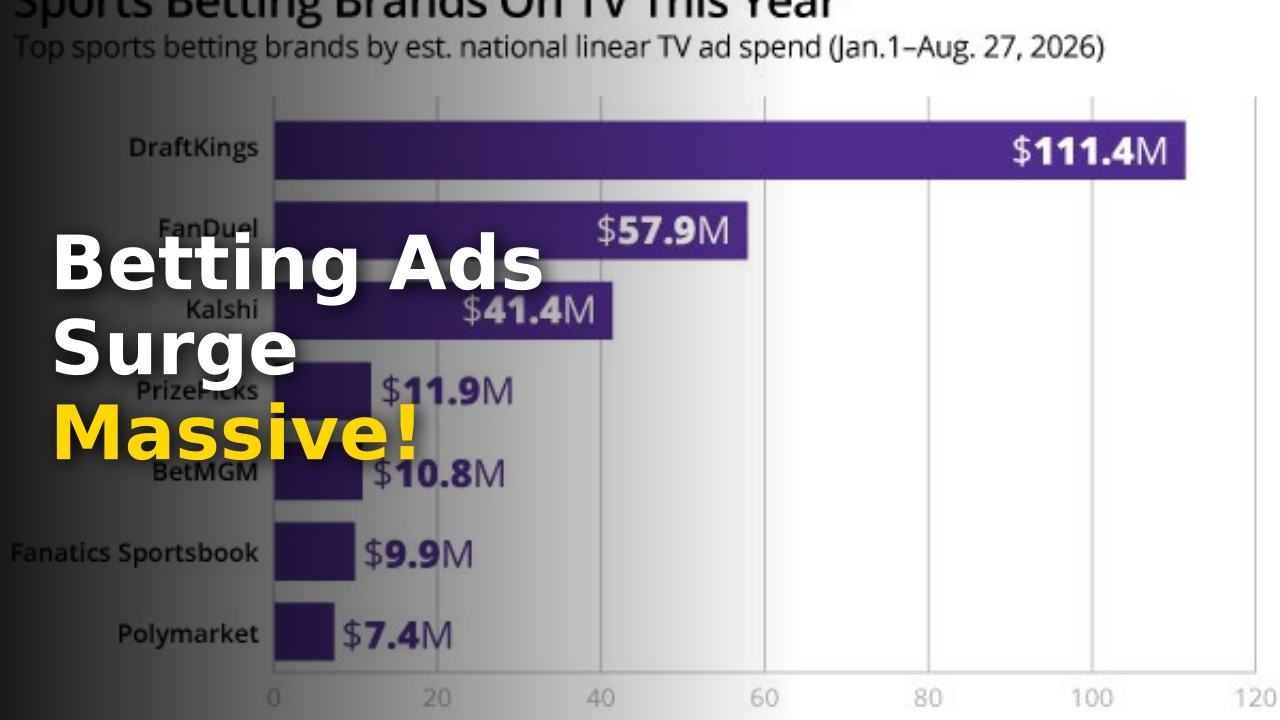
DraftKings, specifically, has increased its investment nearly threefold to $111.4 million compared to last year. This isn’t just a marginal increase; it is an aggressive land grab designed to squeeze out incumbents. The data clearly shows that those who spend the most during live broadcasts capture the largest share of voice, fundamentally altering the economics of televised sports.
The Data Behind The Gambling Media Blitz
When analyzing the current marketplace, the disparity between the dominant players and the rising challengers is striking. The following table provides a comprehensive breakdown of the current spending landscape based on the latest industry data.
| Brand | Ad Spend (YTD) | Total Impressions | Airings |
|---|---|---|---|
| DraftKings | $111.4M | 5.1B | 23,851 |
| FanDuel | $57.9M | 5.4B | 25,542 |
| Kalshi | $41.4M | 4.3B | 56,719 |
| Polymarket | $7.4M | 417.3M | 545 |
It is important to note the tactical difference between these players. FanDuel has managed to achieve a higher number of impressions (5.4 billion) with a lower total budget ($57.9 million) compared to DraftKings. This suggests a more efficient media buying strategy, likely focusing on higher-impact programming rather than raw volume of airings.
Kalshi, meanwhile, has emerged as a disruptive force, accounting for over 15% of the total wagering market despite being a relatively new entity in the advertising space. Their 56,719 airings reflect a ‘spray and pray’ approach to building awareness, essentially aiming to be everywhere at once. This strategy is clearly designed to normalize the concept of prediction markets for the average viewer who is accustomed to traditional sports betting.
Background And Industry Evolution
The explosion of wagering TV ad spending is rooted in the overturning of federal prohibitions, which opened the door for states to regulate their own betting industries. What began as a fragmented landscape of gray-market apps has transformed into a polished, high-finance corporate sector. You can explore further context on Forbes’ analysis of gambling industry growth to understand the regulatory tailwinds.
By the numbers, the jump from $193.2 million to $269.8 million in just one year is unsustainable in the long term, yet currently necessary for market share retention. Experts suggest that we are in the ‘land grab’ phase of the industry. Once a user signs up for an app, the cost to switch is high, which incentivizes these companies to spend nearly any amount of money to acquire a first-time depositor today.
This environment has created a unique dynamic for media networks, which are now more reliant than ever on gambling revenue to offset the decline of traditional cable. The symbiotic relationship between sports leagues and betting operators has never been closer. We are seeing a complete integration where betting odds are now standard overlays on live scoreboards, further entrenching the behavior.

The rise of platforms like Polymarket adds an extra layer of complexity to this narrative. Unlike traditional sportsbooks, these platforms focus on political or event-based predictions, broadening the scope of what the public considers ‘wagering.’ As these platforms gain more media exposure, they challenge the traditional sports-only monopoly on gambling advertising, potentially drawing in non-sports fans who want to speculate on real-world events.
People Also Ask
Why is wagering TV ad spending increasing so rapidly?
The increase is driven by the legalization of sports betting in 39 states and the intense competition between major platforms like DraftKings and FanDuel. These companies are engaging in a land-grab to acquire customers before competitors solidify their market presence.
How much have DraftKings and FanDuel spent this year?
DraftKings has invested $111.4 million in national TV ads, while FanDuel has invested $57.9 million. These two brands combined represent over 62% of the total industry spending.
What is Kalshi’s role in the current advertising landscape?
Kalshi is a rapidly growing prediction market platform that now holds a 15.3% share of total wagering ad spending. It is aggressively using airtime to differentiate itself from traditional sportsbooks.
Are there legal restrictions still limiting ad growth?
While 39 states have legalized some form of betting, regulatory environments vary. Products like ‘DraftKings Predictions’ have successfully expanded into all 50 states by operating as sweepstakes-based products rather than pure-play gambling.
Final Thoughts On The Wagering Industry
The trajectory of wagering TV ad spending suggests that we are witnessing the institutionalization of sports betting as a core component of American media. With nearly $270 million already committed this year, the industry is no longer an outlier; it is a pillar of the advertising economy. As consumer behavior shifts and legal barriers continue to fall, we can expect this spending to evolve toward more targeted, data-driven campaigns rather than just raw volume.
For the average viewer, the message is clear: the integration of betting into the fabric of sports is complete. While the current 40% surge in ad spend is a massive headline-grabbing figure, the real story lies in how these companies are reshaping the way we consume live events. Keep an eye on how upcoming sports seasons influence the next wave of advertising metrics, as the impact on sports media is likely to ripple outward for years to come.
More Like This
For more updates, check out our latest entertainment and sports news.