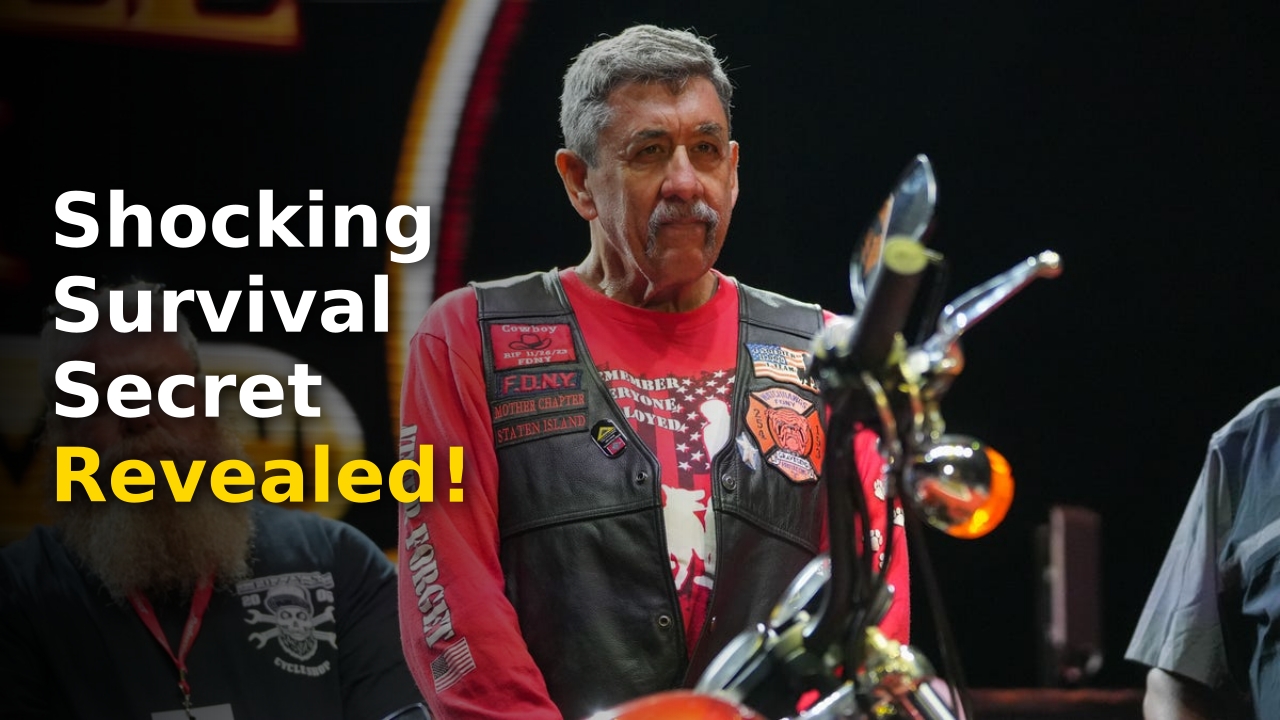
Would you have the courage to run into a collapsing skyscraper when everyone else is running out? Tim Duffy did exactly that twenty-five years ago, and his survival story remains one of the most chilling accounts from the tragic events of September 11, 2001. You might think you know the details of that day, but the specific thought that kept this firefighter breathing under tons of rubble is something you will never forget.
The atmosphere at the 86th annual Sturgis Motorcycle Rally in South Dakota shifted from high-octane rock to pin-drop silence when this story was shared. While thousands of bikers gathered to celebrate freedom and speed, the presence of a humble hero reminded everyone of the cost of that freedom. You could feel the weight of history as the crowd honored a man who was simply ‘doing his job’ on a day that changed the world forever.
This is not just a story about tragedy; it is a masterclass in psychological resilience and the power of family as a survival anchor. As we look at the legacy of those who served, exploring the lives of icons at brightcelebrity.com helps us understand the human spirit behind the headlines. Tim Duffy represents the thousands of first responders whose lives were split into ‘before’ and ‘after’ that clear September morning.
Tim Duffy: Courage Under Pressure
When the first plane struck the North Tower, Tim Duffy was not even on the clock. You have to imagine the scene: a quiet morning in Staten Island, the sun is shining, and you are performing routine maintenance on your beloved Harley-Davidson. He was pulling a spark plug when the world fractured. Most people would have turned on the television; Duffy heard the sirens and knew he had to move.
The instinct of a first responder is a physiological trigger that bypasses fear. For Tim Duffy, the realization was instant that this was no accident. He understood the geography of New York City too well to believe a pilot could simply get lost on such a pristine day. He knew Manhattan was a no-fly zone, and that guttural ‘boom’ signaled a call to duty he couldn’t ignore, even on his day off.
The Coney Island Connection
Because his truck was in the shop, he hopped on his 2000 Super Glide Sport and raced toward his firehouse in Coney Island. You can almost hear the roar of the engine as he navigated the streets, driven by a singular purpose. When he arrived, the look on his captain’s face told him everything he needed to know. The prediction was grim: they were going to lose hundreds of men that day.
- He ignored his scheduled day off to join his brothers in service.
- The motorcycle became his primary transport into the heart of the disaster.
- His boss’s haunted expression served as a permanent memory of the day’s stakes.
- He parked his bike in a hotel lobby, fully expecting never to see it again.
The transition from a suburban morning to a war zone happened in less than an hour. Duffy’s commitment to his team and his city highlights the selflessness that defines the FDNY culture. He didn’t wait for a phone call or an official mobilization. He saw the smoke, heard the sirens, and understood that every second wasted was a life potentially lost.
As he crossed into Manhattan, the scale of the devastation became apparent. The streets were filled with debris, panicked civilians, and the heavy scent of jet fuel. Yet, Tim Duffy pushed forward, eventually reaching the North Tower just as the situation escalated into a nightmare of dust and falling steel. It was here that his survival instincts would be tested to their absolute breaking point.

The Staten Island Response
Living in Staten Island provided a unique perspective on the World Trade Center. For residents there, the Twin Towers were a constant North Star. Tim Duffy lived in a community packed with police officers and firefighters, a place where the sirens are the heartbeat of the neighborhood. When those sirens didn’t stop, the community knew the ‘big one’ had finally happened.
The drive from Staten Island to Coney Island and then into Lower Manhattan is usually a commute of traffic and routine. On 9/11, it was a race against time. Duffy’s decision to take his bike was tactical as much as it was out of necessity. The agility of the Harley-Davidson allowed him to weave through the gridlock that was already paralyzing the city’s arteries.
Answering the Guttural Call
There is a specific type of ‘sullen look’ that veteran firefighters recognize. It is the look of a leader who knows the math of the situation is impossible. Duffy saw this in his superior’s eyes. The gravity of the September 11 attacks was being calculated in real-time by those on the ground, even before the towers fell.
Duffy’s experience as a seasoned veteran allowed him to process the trauma in fragments. You don’t look at the whole building; you look at the next person who needs help. This compartmentalization is what allowed him to park his bike, walk into a vibrating hotel lobby, and then head straight into the North Tower. He was not thinking about survival; he was thinking about the mission.
- The ‘no-fly zone’ realization was his first clue of a terrorist act.
- He bypassed traditional logistics to reach his firehouse faster.
- The bond between the Rollin Fire MC members today traces back to this brotherhood.
- He witnessed the collapse of the towers from the inside, a rare perspective for survivors.
The physical sensation of the air changing is something Duffy describes with haunting clarity. It wasn’t just smoke; it was a toxic, thick slurry that sucked the moisture out of his body. He describes the sensation of ‘coagulating’ like cat litter in his mouth. This was the environment in which he had to find the will to live.
In those moments of suffocation, your brain starts to shut down. The ‘cloud’ was a wall of pulverized concrete and steel. Tim Duffy was buried, his lungs failing, his body trapped. This is where the psychological trigger kicked in, a thought so sharp and so punishing that it acted like a shot of adrenaline to his heart.
Psychology of Survival Tactics
What keeps a man alive when he is literally being buried alive? For Tim Duffy, it wasn’t a hero’s mantra or a prayer for safety. It was a brutal self-critique. He called himself a ‘selfish bastard.’ This thought was fueled by the image of his four children, all under the age of eight, and his wife. He realized that his choice to be a hero might leave them without a father and a husband.
This ‘selfish’ thought was the catalyst for his escape. You see, guilt can be a more powerful motivator than fear. The prospect of leaving his family behind was more terrifying than the falling building. This cognitive shift forced him to crawl, to find air, and to fight through the debris. It was a raw, primal drive to return to the people who needed him most.
The Oxygen of Responsibility
Duffy’s survival wasn’t just luck; it was the result of a mindset that refused to accept defeat. Even as he struggled for breath, his training as a firefighter kicked in. He knew he had to find a pocket of air or a way out before the toxicity of the cloud finished him off. The thought of his kids’ faces provided the ‘oxygen’ his soul needed when his lungs were failing.
Once he emerged from the immediate wreckage, the ‘fireman’ took over again. Despite his own injuries, he didn’t run for safety. He found two men who were incapacitated—one in shock and one with a horrific compound leg fracture. Tim Duffy secured an abandoned truck and drove them eight blocks to safety at the Beekman Hotel before turning around to head back into the void.
- Guilt served as the primary motivator for his survival.
- He rescued two civilians while he was still suffering from lung trauma.
- He returned to Ground Zero even after escaping the initial collapse.
- He lost over 30 fellow firemen in the first hour of the disaster.
The sheer magnitude of the trauma is something he carries to this day. His friend Dave Mackie notes that when you see trauma of that scale, it never truly leaves you. It becomes a part of your DNA. For Duffy, that trauma has been channeled into a lifetime of service, helping other veterans and first responders navigate the same dark waters of PTSD.
His return to the site that morning revealed a devastating truth: there was nobody left to rescue. The silence of Ground Zero in the aftermath was the loudest thing he had ever heard. It was a silence he would encounter again 25 years later on a concert stage in Sturgis, proving that the echoes of that day are still resonating across the country.
Tim Duffy Legacy and Impact
Today, Tim Duffy is much more than a survivor; he is a beacon for those struggling with the invisible wounds of war and service. Through his nonprofit, 1 Dog, 1 Soldier, 1 Team, he provides rescue dogs to veterans and first responders. You can see the poetry in this: a man saved by a thought of home now helps others find their way back to a sense of peace through the companionship of an animal.
The Rollin Fire MC, a motorcycle club of New York City firefighters, provides him with a community that understands his history without him having to say a word. They ride to honor the fallen, ensuring that the names of the 343 first responders who died that day are never forgotten. Tim Duffy might not be able to ride as he once did, but his presence in the club is a testament to the enduring strength of the FDNY.
A Treasure for the Community
At the Sturgis Motorcycle Rally, Jesse James Dupree of the band Jackyl called Duffy an ‘American treasure.’ This wasn’t just stage banter. The bond between the rock star and the firefighter is built on mutual respect. Dupree understands that the freedom to play loud music and rev chainsaws on stage is protected by men like Duffy who are willing to face the fire.
The induction of Tim Duffy into the Sturgis Motorcycle Museum Hall of Fame was a full-circle moment. Harley-Davidson even surprised him by restoring his original 2000 Super Glide Sport. That bike, which was once covered in the grey ash of the North Tower, now stands as a polished symbol of resilience. It is a physical bridge between the horror of 2001 and the tribute of 2026.
- His nonprofit focuses on PTSD recovery for heroes.
- The Rollin Fire MC hosts charity events for line-of-duty families.
- He was the Grand Marshal of the Sturgis parade this year.
- His restored bike is a permanent piece of American motorcycle history.
When you look at Duffy’s life, you see a man who refused to let one day define him in a negative way. Instead, he used the trauma to fuel a different kind of rescue mission. His work with dogs and veterans shows that the ‘selfish bastard’ thought was actually the most selfless thing he could have processed—it kept a protector in the world.
The impact of his story on the Sturgis crowd was profound. In a place known for noise—the thumping of engines and the screaming of lyrics—the eight seconds of silence he requested was the most powerful moment of the rally. It proved that even 25 years later, the memory of 9/11 has the power to stop the world, if only for a moment of reflection.
Essential First Responder Data
To understand the weight of what Tim Duffy lived through, you have to look at the cold, hard numbers. The casualty rates for first responders on 9/11 were unlike anything seen in modern history. The following table provides a breakdown of the losses and the milestones of Duffy’s journey from that day to his recent honors in Sturgis.
| Category | Statistical Detail | Significance |
|---|---|---|
| Total 9/11 Victims | 2,743 | Lives lost at World Trade Center |
| FDNY Fatalities | 343 | First responders lost in action |
| Duffy’s Immediate Loss | 30+ Firefighters | Lost within the first hour of response |
| Sturgis Rally Anniversary | 86th Annual | 2026 Milestone for motorcycle culture |
| Post-9/11 Service | 9 Years | Duffy continued FDNY service until 2010 |
The Lasting Legacy
The numbers only tell part of the story. For every one of those 343 firefighters, there was a family left behind. Tim Duffy escaped that fate by a narrow margin, and he has spent the last quarter-century trying to earn that survival. His humility on the Sturgis stage—saying that nine out of ten people in the crowd would have done the same—shows his character.
While he may believe anyone would have done it, the reality is that very few would have ridden a motorcycle into a burning city on their day off. His legacy is etched not just in the Hall of Fame, but in the lives of the people he rescued and the veterans he continues to support. He remains a living testament to the phrase ‘Never Forget.’
Final Reflections on Heroism
As the sun sets on the Sturgis Motorcycle Rally and the roar of the engines fades into the South Dakota night, the story of Tim Duffy lingers. You realize that a hero isn’t someone without fear; it’s someone who uses their fear—and even their guilt—to find a way through the impossible. His life is a reminder that the thoughts we have in our darkest moments can either bury us or save us.
The 25th anniversary of 9/11 brings a mix of sorrow and pride. Seeing Duffy honored by figures like Jesse James Dupree shows that the bond of the American spirit is unbreakable. Whether you are a biker in the Midwest or a firefighter in New York City, the values of service and sacrifice are the common threads that bind the nation together.
In the end, Tim Duffy survived because he chose his family over the void. He chose to be a father and a husband, and in doing so, he became a hero to millions. His story serves as a powerful nudge to all of us: what is the thought that would save your life? If you ever find yourself in the ‘toxic cloud’ of your own life’s challenges, remember the man on the Harley-Davidson who refused to let the dust have the last word.
More Like This
For more updates, check out our latest entertainment and sports news.