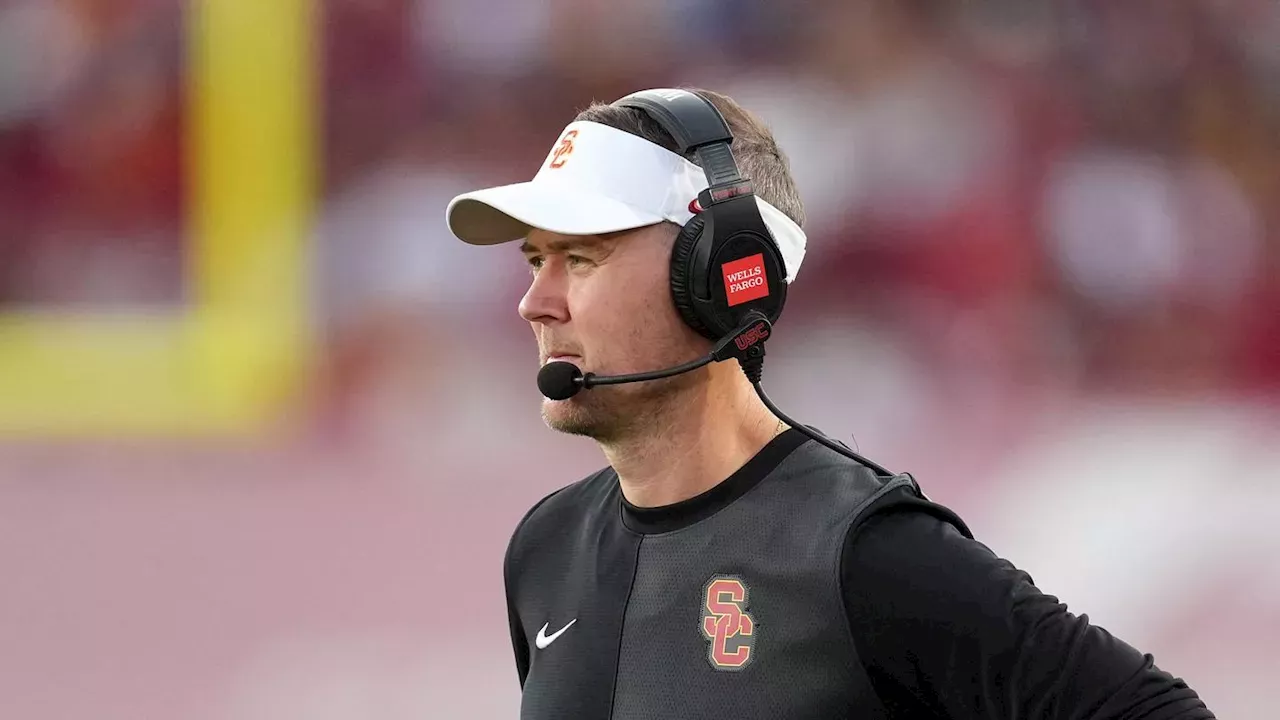
Do you think Lincoln Riley is finally feeling the heat in Los Angeles? Playoff Expansion is the only thing that might save his legacy as the head of the USC Trojans as the landscape of college sports shifts underneath his feet. You have seen the headlines, but the reality of a 16-team bracket changes the math for every blue-blood program in the country.
Riley recently sat down with Colin Cowherd on ‘The Herd’ to dish out some harsh truths about where the game is headed. After a roller coaster 35-18 record over four seasons, the pressure to deliver a championship at the Los Angeles Memorial Coliseum has never been higher. You can feel the tension in his words as he navigates the move to the Big Ten and the death of traditional regionalism.
The coach didn’t hold back when discussing the current 12-team format that just launched in 2024. He believes the system is already outdated because of how the SEC and Big Ten have cannibalized the rest of the market. If you are a fan of the USC Trojans, his perspective on the future of the schedule is both a warning and a glimmer of hope for a program desperate to return to its glory days.
Riley’s 16-Team Playoff Expansion Vision
Riley is officially calling for a jump to 16 teams, and his reasoning is tied directly to the formation of super conferences. He told Colin Cowherd that 16 is the natural next step now that the power is concentrated in two major leagues. You have to realize that when the College Football Playoff was just four teams, the margin for error was non-existent.
Under the new 12-team model, a two-loss team can still make the dance, but Riley argues that isn’t enough for the current era. The Playoff Expansion debate isn’t just about inclusion; it is about survival for teams playing a gauntlet schedule. If you are facing three top-five teams in a single month, a 16-team field provides the safety net needed to keep the regular season meaningful without being overly punitive.
The coach noted that the current system puts immense pressure on the “middle class” of the power conferences. He mentioned that while the Big 12 and ACC are still competitive, they are clearly operating on a different tier than the big two. Riley’s Playoff Expansion proposal would theoretically allow more teams from those conferences to participate while ensuring the best teams from the Big Ten aren’t left out due to a single bad Saturday.
Critics often argue that 16 teams would devalue the regular season, but Riley sees it differently. He believes it would actually encourage teams to take more risks in their non-conference scheduling. You wouldn’t have to worry about one loss to a powerhouse like Alabama or Georgia ruining your entire year before October even begins. It’s about creating a product that rewards the toughest paths, not just the cleanest records.
He also touched on the logistical side of a 16-team bracket, which would likely involve home-field advantage for the higher seeds. Imagine a snowy December night in Ann Arbor or Columbus with a trip to the quarterfinals on the line. That is the kind of atmosphere Riley believes the sport needs to embrace to compete with the NFL‘s dominance in the winter months.
The shift from 4 to 12 was a decade in the making, but Riley expects the jump to 16 to happen much faster. With television contracts ballooning and the demand for high-stakes content rising, the Playoff Expansion is almost an inevitability. He wants USC to be at the forefront of that conversation, ensuring they have a seat at the table when the final decisions are made by conference commissioners.

The Logic of 16 Teams
- Ensures that the top four teams from the SEC and Big Ten always have a clear path to the title.
- Provides automatic bids for all Power 4 conference champions to maintain some level of tradition.
- Creates a massive revenue boost for schools dealing with the rising costs of NIL and player revenue sharing.
- Allows for home-site playoff games, which would be a massive financial windfall for local economies like Los Angeles.
Super Conference Power Grab Realities
The move to the Big Ten has completely rewired how USC operates on a daily basis. Riley admitted that the talent gap between the two super conferences and everyone else is widening at an alarming rate. You can see it in the recruiting rankings and the sheer volume of NFL talent coming out of these programs every April. The Big Ten and SEC are now the primary engines of the sport.
Riley pointed out that the Big 12 and ACC are fighting an uphill battle just to get more than one representative into the bracket. Meanwhile, the super conferences are consistently projected to land three or four teams each. This imbalance is exactly why Playoff Expansion is being discussed at such a high level in Chicago and Birmingham. The money follows the big brands, and the big brands are consolidating.
The coach’s honesty about the “two tiers” of college football might ruffle some feathers in Dallas or Charlotte, but he isn’t wrong. If you look at the resources being poured into Ohio State, Oregon, and Texas, it is a different world. Riley believes the playoff needs to reflect this reality by giving the powerhouse conferences more room to breathe during the selection process.
For USC, this means every single game in the Big Ten is essentially a playoff eliminator. The competition level has increased so much that the old Pac-12 days feel like a distant memory. Riley knows that his record of 35-18 won’t cut it in this new environment where every loss is magnified by the national media and a hungry fan base.
He also discussed the physical toll this new era takes on the players. With more high-intensity games on the schedule, depth is more important than ever. You can’t just rely on a handful of superstars; you need a 100-man roster that can survive the Big Ten gauntlet. This is where exclusive celebrity sports insights from sources like brightcelebrity.com show how the top coaches are pivoting their recruiting strategies to focus on size and durability over raw speed.
Ultimately, the super conference era is about leverage. The Big Ten and SEC hold all the cards in television negotiations, and they are using that power to reshape the postseason. Riley’s comments suggest that the coaches are starting to align with the executives on the need for a larger, more inclusive playoff that protects the interests of the highest-revenue programs.
Rivalry Games At Risk Today
One of the most heartbreaking aspects of the current alignment is the threat to traditional rivalries. Riley specifically mentioned the USC and Notre Dame Fighting Irish series, which has been played 96 times since 1926. Because of the grueling conference schedule, this annual battle will be on hiatus from 2026 to 2029. You lose a piece of the sport’s soul when games like this are sidelined.
However, Riley believes further Playoff Expansion could actually save these matchups. If a team like USC knows they can afford a loss and still make a 16-team field, they are much more likely to keep Notre Dame on the schedule. Right now, the risk of a non-conference loss is too high when you still have to face Michigan and Penn State in the same season.
The logic is simple: more playoff spots equal more room for adventurous scheduling. If you are a coach on the hot seat, you aren’t going to schedule a tough out-of-conference game if it means you might miss the playoffs and get fired. Riley is advocating for a system that rewards teams for playing the Fighting Irish rather than punishing them for it. He wants to see those Gold Helmets in Los Angeles every other year without fail.
The hiatus is a direct result of the USC move to the Big Ten and the increased conference game count. Fans in South Bend and Southern California are understandably upset, but the financial realities of the modern game often override sentiment. Riley is trying to find a middle ground where the history of the sport can coexist with the new corporate structure of the NCAA.
He also touched on the UCLA rivalry, which remains a staple but feels different in the Big Ten context. The stakes are no longer just about city bragging rights; they are about positioning within a massive national conference. Riley’s loss to the UCLA Bruins in 2025 was a bitter pill to swallow, and it serves as a reminder of how quickly things can turn south in a rivalry game.
If the Playoff Expansion moves to 16, Riley envisions a world where USC can play Notre Dame, UCLA, and a full Big Ten slate without fearing for their postseason lives. It is a vision of a more robust and exciting college football calendar that prioritizes the games fans actually want to see. You deserve a schedule that features the best against the best, not just a collection of cupcake games designed to protect a record.

Performance Under Pressure Analysis
The clock is ticking for Lincoln Riley at USC. Despite his high-profile arrival and early success, the lack of a playoff appearance is starting to grate on the boosters. Riley’s overall record of 35-18 is respectable, but at a place like USC, respectable is just the first step toward the exit door. You have to win championships to be considered a legend in this town.
The 2022 season remains the biggest “what if” of his tenure. Entering the Pac-12 Championship game against the Utah Utes with an 11-1 record, USC was one win away from the four-team playoff. The subsequent loss didn’t just end their season; it shifted the narrative around Riley’s ability to win the big one. Since then, the road has only gotten tougher as the competition level has spiked.
The table below highlights the pressure points in Riley’s career at USC so far. You can see how the win totals have fluctuated and where the program has fallen short in key moments. This data is why the 2026 season is being viewed as a make-or-break campaign for the head coach. If he fails to make the expanded playoff this year, the “hot seat” talk will become a deafening roar.
| Year | Record | Postseason Result | Status |
|---|---|---|---|
| 2022 | 11-3 | Cotton Bowl Loss | Missed Playoff (Rank #10) |
| 2023 | 8-5 | Holiday Bowl Win | Unranked Final AP |
| 2024 | 9-4 | Citrus Bowl Loss | Missed 12-Team Playoff |
| 2025 | 7-6 | Sun Bowl Win | Massive Disappointment |
As you can see, the trend hasn’t been Riley’s friend. The drop from 11 wins to 7 wins in just three years has many wondering if his high-octane offensive system can survive the physical style of the Big Ten. The defense has been a perennial problem, and while Riley has made coaching changes, the results on the field have yet to catch up to the hype of his $110 million contract.
Riley is also dealing with the departure of several key staff members to the NFL. This turnover makes it harder to maintain a consistent culture and recruiting pipeline. You have to wonder if the Playoff Expansion is Riley’s only hope of staying relevant in a world where Dan Lanning and Ryan Day are consistently outperforming him on the national stage.
The 2026 Gauntlet Schedule
If Riley thought the last few years were tough, the 2026 schedule is going to be a wake-up call. USC is set to face the three toughest teams in the conference: the Indiana Hoosiers, Ohio State Buckeyes, and Oregon Ducks. You might be surprised to see Indiana on that list, but after their national championship run in 2025, they are the new kings of the Big Ten.
Facing the defending champions alongside perennial powerhouses like Ohio State and Oregon is a nightmare scenario for a coach on the hot seat. This is exactly why Riley is pushing so hard for Playoff Expansion. In a 12-team world, losing to all three of these teams would likely end USC‘s season by early November. In a 16-team world, they might still have a fighting chance if they can pull off one upset.
The Indiana Hoosiers‘ rise under their current leadership has been nothing short of a miracle. They have combined an elite NIL program with brilliant tactical coaching to leapfrog traditional powers. Riley will have to travel to Bloomington for a game that will likely be the most-watched event of the weekend. You can expect the atmosphere to be hostile as the Hoosiers look to prove their title wasn’t a fluke.
Then there are the Ducks. Oregon has become the gold standard for West Coast recruiting, often stealing players right out of USC‘s backyard in Southern California. The matchup between Riley and Oregon is more than just a game; it is a battle for the soul of the region. If Riley can’t beat Oregon, he can’t win the Big Ten, and he certainly can’t make the playoff.
The Ohio State game remains the ultimate benchmark. The Buckeyes have a roster loaded with five-star talent and an expectation of nothing less than a national title every year. For USC to compete at that level, they need to find a way to stop the run and protect their quarterback—two areas where they have struggled under Riley’s leadership. It is a tall order for a team that has been inconsistent at best over the last 24 months.
Key 2026 Matchups
- At Indiana: A date with the defending national champions in a hostile environment.
- Vs Ohio State: A home game that will define the mid-season narrative for the Trojans.
- Vs Oregon: A late-season clash with huge implications for the Big Ten standings.
- At Michigan: A trip to the Big House to face a team that always plays physical football.
Future Of Expansion Impact
What does the future hold for USC and the rest of college football? Riley’s honest perspective suggests that we are headed toward a professionalized model that looks more like the NFL than the traditional NCAA. Playoff Expansion is the catalyst for this change, driving everything from conference realignment to player compensation models.
Riley is right to be concerned about the current system. It is a transitional phase that feels clunky and often unfair to the athletes and fans. By moving to 16 teams, the sport can finally find some stability. It would create a clear path to the title that everyone understands, while still maintaining the regular season drama that makes college football the best sport in America.
For you, the fan, this means more high-quality games and more opportunities to see your team on the big stage. You won’t have to spend your Saturday nights worrying about a single officiating error ruining a 12-game season. Instead, you can focus on the spectacle and the rivalries that make this sport unique. Riley’s vision for Playoff Expansion is ultimately a vision for a more sustainable and exciting future for everyone involved.
As Lincoln Riley continues to navigate the pressure of Los Angeles, his voice will remain one of the most influential in the room. Whether he can lead USC to the promised land remains to be seen, but his honesty about the state of the game is a breath of fresh air. Keep an eye on the 2026 season; it might just be the year that everything changes for the Trojans and the Playoff Expansion movement once and for all.
More Like This
For more updates, check out our latest entertainment and sports news.