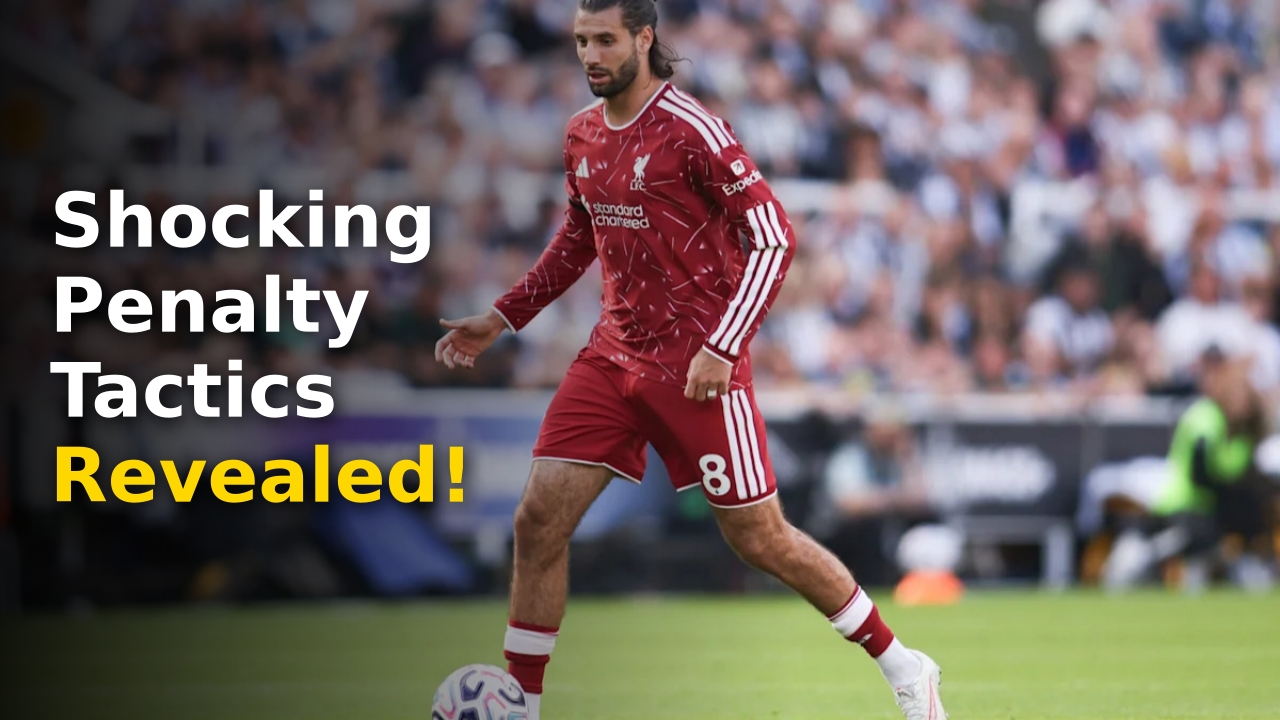
Penalty tactics have arguably become the most debated aspect of modern football, and the recent events at St James’ Park confirm that nerves of steel are more valuable than pure status. You might be surprised to learn that when Liverpool faced a crucial late-game spot-kick, the decision to look away from their star striker was a calculated masterclass in psychological management. While fans clamored for the high-profile forward to step up, the reality of top-flight elite competition dictates that results will always trump sentimentality.
Andoni Iraola, the sharp tactician behind the scenes, was forced to address why penalty tactics shifted in favor of Dominik Szoboszlai during that volatile encounter. The atmosphere in Newcastle was electric and overtly hostile, placing immense pressure on Alexander Isak, who had struggled to find his rhythm throughout the afternoon. By entrusting the ball to the calm composure of the Hungarian international, Liverpool ensured that the technical execution was prioritized over the player’s market valuation or reputation.
The Psychology Behind Penalty Tactics
When you watch a penalty unfold, you are witnessing a battle of attrition that starts long before the referee blows the whistle. The modern professional game is obsessed with data-driven decision-making, and managers like Iraola are now incorporating emotional regulation into their game plans. A player who has been subjected to relentless jeering from a crowd is statistically less likely to deliver under pressure compared to a teammate who has remained slightly detached from the chaos.
Dominik Szoboszlai has cultivated a reputation as a dead-ball specialist, a trait that makes him an invaluable asset for a club navigating the high-stakes environment of the Premier League. His previous successes from the spot provide him with a level of internal confidence that simply cannot be replicated by sheer desire alone. In contrast, Alexander Isak’s difficult afternoon served as a reminder that even the most talented players are subject to the volatility of crowd reception and form.
This shift in the hierarchy was not necessarily a permanent demotion for anyone involved but rather a tactical adaptation to a specific set of circumstances. Coaches across the Premier League are increasingly utilizing this flexible approach, refusing to pigeonhole themselves into rigid penalty-taking duties. By maintaining a pool of qualified specialists, Liverpool keeps their opponents guessing, forcing goalkeepers to study multiple potential kick-takers rather than focusing on a singular threat.
The fans may view this as a slight against a marquee signing, but within the locker room, it is viewed as a pragmatic necessity. Winning a point in a hostile environment requires the courage to make unpopular decisions that ultimately secure the objective. When the pressure is at its peak, the manager must act as a firewall between the volatile emotions of the supporters and the clinical execution required on the grass.
Furthermore, the role of leadership in these moments cannot be overstated. A captain or senior player must recognize when a teammate is not in the ideal headspace to take such a vital responsibility. This silent communication between peers often dictates the outcome of seasons, as one single goal can represent the difference between European qualification and mid-table anonymity. 
As we analyze the long-term implications, it is clear that the club’s penalty-taking strategy will remain a fluid situation. Consistency is the goal, but the ability to pivot when the circumstances demand is what defines an elite organization. For those looking for more behind-the-scenes insights into such tactical evolutions, sources like Bright Celebrity frequently explore the pressures faced by modern sports icons.
Defining the Modern Penalty Specialist
- Calculated composure under extreme physical and mental pressure.
- A proven track record of converting from the spot in high-stakes matches.
- The ability to block out external noise from a hostile away crowd.
- Technical precision that renders a goalkeeper’s guess irrelevant.
- Strategic flexibility to rotate takers based on match-day conditions.
Comparative Analysis of Penalty Data
| Player | Penalty Experience | Match Day Pressure | Role Suitability |
|---|---|---|---|
| Dominik Szoboszlai | High/Proven | Managed/Steady | Primary Candidate |
| Alexander Isak | Moderate/Developing | High/Fluctuating | Secondary Candidate |
| Alexis Mac Allister | Very High/Elite | Exceptional | Emergency/Lead |
The statistical table above highlights why the decision was made. While Isak holds immense value as a striker, the specific metrics of match-day pressure and prior conversion rates suggest that Szoboszlai represents a lower-risk option. In the ruthless world of professional football, minimizing risk is the fastest way to maximize points accumulation.
Managers are increasingly aware that every penalty is a brand asset in itself. A missed spot-kick in front of a global television audience can impact marketability and psychological momentum for weeks. Iraola, ever the cautious manager, recognizes that his role is to protect the team’s interests above all else. He has successfully created a culture where the goal is the objective, not the individual glory of the taker.
We must also consider the role of the goalkeeper in these calculations. Modern goalkeepers utilize extensive scouting reports to predict where a player prefers to place their shots. By constantly rotating their designated penalty taker, teams like Liverpool force the opposition to spread their research across multiple players. This creates an information disadvantage for the opponent, which can be the margin of victory in tight contests.
Does this impact the transfer market valuation of these players? Possibly. Clubs often pay a premium for players who demonstrate the mental fortitude to take responsibility in the final minutes of a game. If Isak wants to claim the primary spot in the future, he will need to prove his consistency regardless of the atmosphere. 
As the season progresses, we will likely see more data surfacing regarding these specialized roles. Analytics departments are no longer just looking at pass completion or distance covered; they are tracking pulse rates and emotional responses during high-pressure scenarios. This scientific approach to the game is changing how we view every single touch of the ball.
Finally, we cannot ignore the human element of frustration. Players are competitive animals, and they naturally want to lead from the front. Managing these egos is a significant part of the job for any top-tier coach. Iraola’s non-committal response to the media was a brilliant display of protecting his players’ morale while maintaining his own strategic flexibility.
The Evolution of Elite Penalty Tactics
The era of having a single “designated” penalty taker for every match is slowly vanishing. Modern squads are built with depth in every position, including the specialist skill of the penalty kick. This evolution forces us to redefine what it means to be a “star” player in the modern era of the game.
In the past, a team’s top goalscorer almost automatically claimed the penalty spot. Today, that decision is dissected by data scientists, psychologists, and coaching staff working in tandem. They are looking for the “calmness factor,” which is often more predictive of success than the player’s total goal tally for the season.
Consider the impact on the fans. They want to see their star striker score, but they want the points even more. When the ball hits the back of the net, the tactical nuance of the decision becomes secondary to the result. That is the reality of the game; results are the only currency that matters in the Premier League.
The debate will undoubtedly continue as the season progresses. Every time Liverpool is awarded a penalty, social media will light up with speculation regarding who should step up. This constant engagement is part of what makes the Premier League the most watched sports league in the world.
We should also note that the training ground environment is where these hierarchies are truly established. Hours of work go into practicing these specific scenarios, often simulating the noise and pressure of a match-day stadium. Those who excel in these practice sessions are the ones who earn the trust of the manager.
In the end, it is about the collective success of the squad. If the manager decides that a rotation of specialists is the best path to success, then that is the strategy that must be followed. It requires a high level of professionalism from all players involved to accept their roles, whether they are the primary, secondary, or tertiary option.
Final Thoughts on Penalty Tactics
The situation regarding Liverpool’s penalty taker is a fascinating microcosm of modern football management. It perfectly illustrates how coaching decisions are dictated by a combination of form, psychology, and tactical necessity rather than historical status. Whether or not Szoboszlai holds onto this responsibility remains to be seen, but for now, it is clear that his calm presence is exactly what the team needs. The debate surrounding penalty tactics will surely persist, but as long as the ball continues to find the net, the club remains on the right path toward its season objectives.
More Like This
For more updates, check out our latest entertainment and sports news.