Key Takeaways
| Unified Corporate Moniker: The combined entertainment conglomerate resulting from the transaction will officially operate under the corporate banner of Skydance, retiring the corporate holding name Warner Bros. Discovery while preserving both standalone historic studio operational brands. |
| Historic $111 Billion Scale: David Ellison seals the historic $111 billion transaction after securing legal clearance from U.S. District Judge Araceli Martínez-Olguín, resolving antitrust litigation brought by California Attorney General Rob Bonta and 11 partner states. |
| Executive Overhaul: Mattel chief executive Ynon Kreiz steps in as day-to-day operating chief with a $41.4 million initial compensation package, while HBO chief Casey Bloys assumes leadership over unified streaming programming following Cindy Holland’s departure. |
| Historic Severance Terms: Outgoing Warner Bros. Discovery chief executive David Zaslav exits with an unprecedented severance package valued at approximately $887 million, inclusive of $330 million in company-funded tax disbursements. |
| Financial Headwinds: The merged empire assumes roughly $80 billion in long-term debt, obligating board partner Gerry Cardinale of RedBird Capital Partners to orchestrate $6 billion in corporate overhead synergies and platform tech integrations within three years. |
If you thought Hollywood consolidation had finally reached its absolute ceiling, the landscape just underwent its most seismic transformation in modern entertainment history. The Paramount Warner Bros merger has formally resolved its corporate identity, crowning David Ellison’s independent production powerhouse, Skydance, as the singular banner governing two of cinema’s oldest, most revered studios. Finalized as an earth-shattering $111 billion business consolidation, the acquisition dissolves the standalone corporate framework of Warner Bros. Discovery while positioning Ellison at the helm of an unrivaled entertainment colossus.
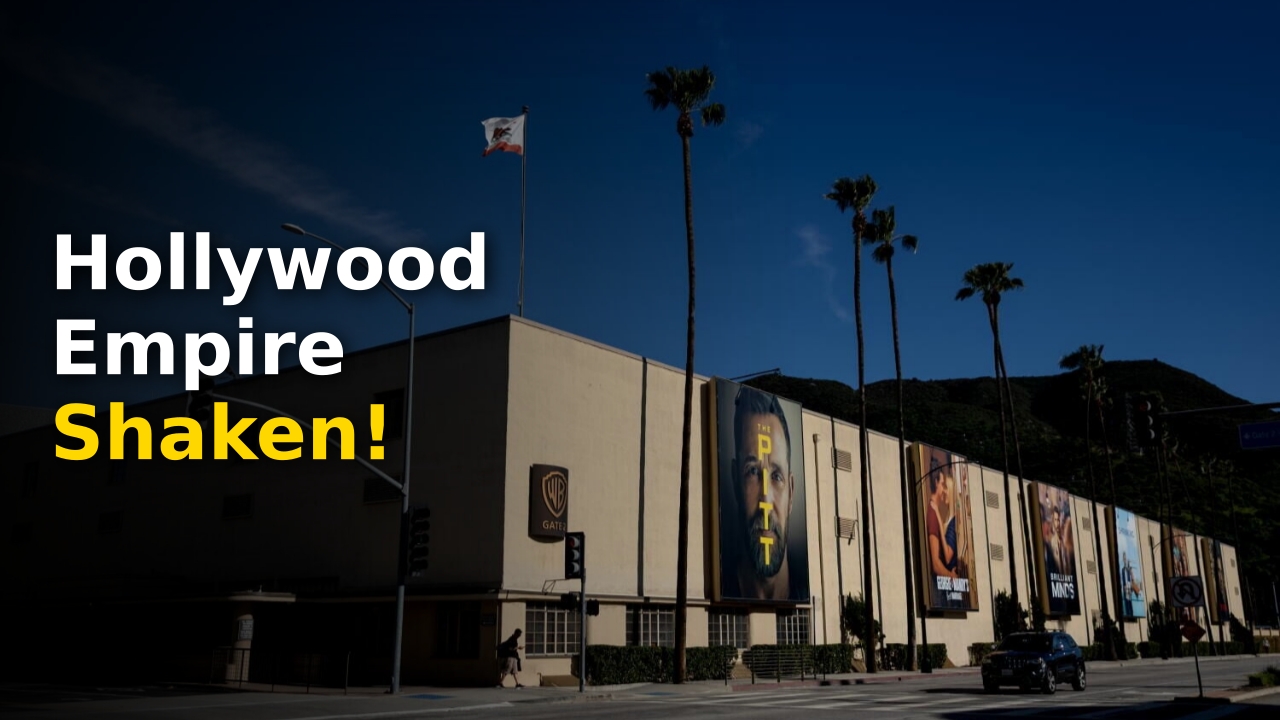
Rather than defaulting to awkward corporate portmanteaus like “WarnerMount” or hyphens that diluted generational pedigree, Ellison chose to elevate his own enterprise’s name to the supreme parent designation. The tech scion and film producer, who founded Skydance nearly twenty years ago, made the surprise revelation public as legal barriers dissolved in federal court. By adopting the Skydance label at the corporate holding tier, both the historic Melrose Avenue lot of Paramount and the legendary Burbank gates of Warner Bros. will preserve their operational identities, distinct heritage cultures, and creative production integrity without identity dilution.
The consummation of the deal establishes a new world order for theatrical exhibition, legacy linear broadcasting, and global subscription video platforms. As legacy media companies scramble to counteract declining cable carriage revenues and ballooning technological overhead, this united entity instantly reorders the competitive hierarchy of global show business. For audiences, industry creatives, and Wall Street investors alike, the sheer magnitude of this corporate unification marks the definitive beginning of an unprecedented media era, built atop massive franchise catalogs and aggressive financial rationalization.
Paramount Warner Bros Merger Reshapes Hollywood Under Skydance
The definitive decision to brand the unified enterprise under the Skydance name represents a defining personal and professional vindication for David Ellison. In a formal communication shared across social channels, Ellison outlined the deliberate philosophical logic governing the rebrand. Ellison emphasized that forcing Paramount and Warner Bros. into a composite corporate name would compromise century-old studio identities. By electing Skydance as the parent holding entity, the executive structure establishes an independent umbrella capable of housing divergent legacy properties without stripping either historic brand of its unique theatrical cultural footprint.
The announcement immediately put to rest months of speculative trade chatter that predicted unwieldy hybrid trademarks such as Paramount-Warner or Warner-Paramount Global. Insiders close to the negotiations noted that preserving external brand equity was vital to sustaining morale on creative talent rosters. Under the corporate canopy of Skydance, both studios will maintain their trademark theatrical opening logos, their storied distribution divisions, and their distinct soundstages, while central business functions, administrative back-ends, and financial reporting converge directly under Ellison’s leadership hierarchy.
The structural rebrand also crystallizes Ellison’s shift from a prolific Silicon Valley-backed independent financier into the singular supreme power broker in Hollywood. Having founded Skydance Media in 2006, Ellison methodically built an enviable track record by co-financing enduring global blockbusters alongside Paramount, including seminal entries in the Mission: Impossible series and Top Gun: Maverick. His deliberate ascent to acquiring Paramount outright, followed immediately by orchestrating the staggering buyout of Warner Bros. Discovery, positions his company alongside tech-fueled powerhouses like Apple and Amazon, as detailed in recent Los Angeles Times industry reporting on media consolidation.

Safeguarding Historic Melrose and Burbank Studio Lots
A linchpin requirement that paved the ultimate runway for regulatory approval centered on the operational survival of the companies’ historic production real estate. In July, California Attorney General Rob Bonta, backed by an aggressive coalition of eleven state attorneys general, initiated formal antitrust proceedings alleging that combining the studios would dangerously concentrate commercial soundstage access, suppress trade labor compensation, and jeopardize regional creative employment throughout Southern California.
To permanently resolve the antitrust dispute, U.S. District Judge Araceli Martínez-Olguín entered a binding federal consent decree on Wednesday. Under the stringent conditions of this court-enforced settlement, the merged Skydance entity legally pledged never to shutter, carve off, or liquidate Paramount’s historic studio lot on Melrose Avenue in Hollywood or the sprawling Warner Bros. facility situated in Burbank. The regulatory agreement explicitly mandates that Ellison’s corporate umbrella must continue operating both physical lots “in a manner consistent with past practices,” ensuring access for third-party independent film and television productions.
Beyond physical infrastructure protections, the court decree culminated an exhaustive global review cycle that saw the transaction clear statutory scrutiny across nearly 70 domestic and international regulatory jurisdictions. Antitrust regulators in Brussels, London, and Tokyo probed horizontal market overlap across feature theatrical distribution, international sports broadcast sub-licensing, and intellectual property monetization. The final consent decree in California provided the necessary legal domino, eliminating the final obstacle to the transaction’s closing.
Executive Shakeup: Kreiz, Bloys, and the $887M Zaslav Exit
With corporate mechanics aligned, Ellison moved aggressively to install a seasoned executive leadership cadre capable of navigating the sprawling operating footprint. To helm daily corporate management across consumer products, studio facilities, and global business units, Ellison recruited Ynon Kreiz, the 61-year-old executive credited with orchestrating the dramatic corporate renaissance of toy giant Mattel over the past eight years. Kreiz’s proven ability to commercialize static toy intellectual property into cross-medium cinematic phenomena made him the premier target for Skydance’s expansive mandate.
Regulatory filings made public in tandem with the merger clearance disclosed the lucrative terms of Kreiz’s executive employment contract. The newly minted operating chief will command a base annual salary of $5 million, coupled with a target performance incentive bonus of $4.9 million. Furthermore, to induce his departure from Mattel, Skydance furnished Kreiz with a massive $31.5 million signing bonus structured entirely in restricted stock units (RSUs), cementing his long-term alignment with the holding company’s public enterprise equity.
Concurrently, the programming infrastructure for the combined streaming apparatus underwent an immediate consolidation. Casey Bloys, the celebrated Chairman and Chief Executive of HBO and Max content, is widely tapped to helm the overall streaming programming strategy for the united digital ecosystem. The succession was telegraphed internally when Paramount’s sitting streaming chief, Cindy Holland, formally vacated her executive post, establishing a frictionless corporate runway for Bloys to wield total creative oversight across premium television, documentaries, and direct-to-consumer scripted productions.
Streaming Strategy: HBO Max and Paramount+ Bundle Dynamics
Addressing industry executives at the Bloomberg Screentime conference in Hollywood, Bloys carefully sidestepped questions regarding his newly expanded corporate jurisdiction while delivering pointed strategic insights into streaming distribution philosophy. Rather than instantaneously tearing down consumer infrastructures to force a single, chaotic mega-application onto current subscribers, Ellison and Bloys favor an aggressive commercial bundling architecture. The initial phase will offer cross-promotional subscription packages uniting HBO Max and Paramount+, mitigating subscriber friction and reducing involuntary user churn.
This dual-service operating strategy borrows heavily from established playbook dynamics witnessed across competing entertainment empires. By maintaining distinct consumer front-ends in the medium term, Skydance preserves HBO Max’s reputation for prestige drama, documentary realism, and marquee cinema alongside Paramount’s robust broadcast ecosystem, which commands live sports, family-oriented animation, and dependable procedurals. The approach insulates the company from the catastrophic interface and brand confusion that previously afflicted legacy mergers, giving technicians runway to quietly merge engineering operations behind the scenes.
Nevertheless, internal efficiencies will occur swiftly within non-consumer-facing infrastructure. Gerry Cardinale publicly emphasized that software engineering, cloud hosting agreements, user authentication engines, and ad-tech monetization frameworks will be combined into a singular, proprietary software stack. By unifying backend codebases, Skydance intends to trim hundreds of millions of dollars in duplicate cloud server expenses without disrupting the frontend user interfaces familiar to millions of global households.
The $111 Billion Financial Architecture and Debt Reality
While David Ellison celebrates an extraordinary strategic triumph, Wall Street equity analysts remain sharply focused on the immense balance sheet leverage required to finance the buyout. The consolidated entity carries a monumental debt burden surpassing $80 billion, a considerable portion of which was assumed to systematically retire the outstanding equity shares of Warner Bros. Discovery stockholders at a negotiated valuation of $31.17 per share. Successfully servicing and amortizing this debt load represents the central existential test facing Skydance over the coming economic cycle.
To assure sovereign wealth investors, institutional debt holders, and credit rating agencies of long-term solvency, Skydance management committed to securing $6 billion in audited run-rate cost synergies within the initial three years of consolidated operations. Speaking on financial panels at the Bloomberg Screentime conference, RedBird Capital Partners founder and Skydance board member Gerry Cardinale projected calm confidence, maintaining that achieving the target cost reductions would prove manageable given the vast redundancies across corporate real estate, enterprise software licenses, and fragmented direct-to-consumer delivery pipelines.
The financial architecture supporting the merged entertainment giant illustrates both the unprecedented capital allocation and the immediate corporate hurdles facing the leadership team, as shown in the comprehensive structural breakdown below:
| Transaction Metric | Consolidated Valuation & Terms | Strategic Implication |
|---|---|---|
| Enterprise Deal Value | $111 Billion | Creates the largest standalone studio and media powerhouse in North America. |
| Total Debt Load | Exceeds $80 Billion | Demands disciplined free cash flow conversion to maintain investment-grade credit ratings. |
| WBD Shareholder Buyout | $31.17 per Share | Represents a significant premium over historical standalone trading lows for Warner equity. |
| Targeted Cost Synergies | $6 Billion within 36 Months | Achieved via administrative consolidation, backend ad-tech unification, and operational layoffs. |
| Zaslav Golden Parachute | Estimated $887 Million | Encompasses $550M+ in cash/equity compensation plus $330M in contractual board-paid tax liabilities. |
| Ynon Kreiz Starting Package | $41.4 Million Initial Year | Base salary of $5M, $4.9M incentive target bonus, and $31.5M in RSU sign-on equity. |
Despite assurances that overhead rationalization will target duplicate tech stacks, Cardinale conceded that workforce reductions will inevitably form a component of the targeted cuts. This acknowledgment prompted sharp anxiety across Hollywood guilds, coming on the heels of successive industry-wide labor disputes, production contractions, and post-merger layoffs executed during previous management cycles at both legacy organizations.

By The Numbers: The Zaslav Departure and Severance Economics
Perhaps no single aspect of the transactional filings has generated more public scrutiny than the staggering compensation package negotiated for outgoing Warner Bros. Discovery chief executive David Zaslav. According to regulatory disclosures filed with securities authorities, Zaslav’s negotiated exit arrangements yield a gross value hovering near $887 million. This gargantuan golden parachute includes over $550 million in accelerated cash settlements, vested stock awards, and long-term equity options accrued during his tenure leading Discovery and WarnerMedia.
Even more contentious among industry observers and labor representatives is a secondary contractual stipulation approved by Warner board members. Under the severance covenants, the governing board explicitly agreed to remit Zaslav’s personal income tax liabilities generated by the transactional windfall, an obligation estimated to approach $330 million. The magnitude of this severance distribution represents one of the largest single executive exit packages ever recorded in corporate American history, rivaling historic corporate payouts documented by leading financial institutions and tracked via exhaustive financial disclosures in Bloomberg News business analysis.
When juxtaposed against the aggressive $6 billion synergy mandate that promises widespread corporate workforce layoffs, Zaslav’s exit windfall underscores the stark economic disparities that continue to ignite tensions across the entertainment labor landscape. As hundreds of administrative, distribution, and creative development roles face elimination to balance the combined company’s ledger, the payout will remain a prominent touchstone in future Hollywood labor negotiations and corporate governance debates.
Franchise Powerhouse: Uniting DC, Harry Potter, and Star Trek
Looking past immediate balance sheet concerns, the industrial rationale supporting the creation of Skydance centers on unmitigated, multi-generational franchise ownership. By binding Paramount’s intellectual property vault with Warner Bros. Discovery’s commercial crown jewels, the unified corporate catalog commands an unmatched collection of global popular culture brands. For additional background on executive deal structures and high-profile acquisitions across entertainment, readers can explore in-depth profiles on brightcelebrity.com entertainment coverage, tracking how leadership transitions reshape Hollywood output.
Under the Skydance umbrella, Ellison now controls the entirety of the DC Universe, J.K. Rowling’s Wizarding World of Harry Potter, J.R.R. Tolkien’s The Lord of the Rings, and classic cinematic animation vaults encompassing Looney Tunes and Hanna-Barbera. These Warner assets converge directly with Paramount’s cultural cornerstones: the enduring sci-fi tapestry of Star Trek, Tom Cruise’s Mission: Impossible franchise, Taylor Sheridan’s omnipresent Yellowstone television universe, Nickelodeon’s SpongeBob SquarePants, and decades of comedy intellectual property stemming from Comedy Central.
The creative mandate falls squarely upon the strategic vision of Ellison, whose lifetime affinity for high-concept science fiction, aviation, and blockbuster world-building is well known throughout the creative community. Unlike corporate conglomerates led by pure balance-sheet managers, Ellison views cinematic franchises through an expansive, transmedia lens. The company aims to develop tightly integrated creative pipelines that concurrently generate theatrical motion pictures, high-budget episodic streaming television, interactive video games, and immersive location-based entertainment experiences.
Expert Take: The Silicon Valley and Studio Synthesis
What differentiates this corporate unification from troubled historical media tie-ups—such as the ill-fated AOL Time Warner combination in 2000 or AT&T’s costly and brief stewardship of WarnerMedia—is the operational heritage of the Ellison family. Backed by the immense technical acumen and financial capital of Oracle co-founder Larry Ellison, David Ellison does not view media assets purely as legacy distribution conduits. Instead, he perceives the unified enterprise as an agile, technology-first storytelling engine engineered to leverage artificial intelligence, virtual production environments, and unified proprietary data infrastructure.
Hollywood has spent two decades attempting to defend its traditional business models against the incursions of Northern California technology giants. With Skydance assuming control of Warner Bros. and Paramount, Silicon Valley capital has essentially acquired Hollywood from within. This hybrid operational paradigm provides the creative community with a leadership team that understands both the irreplaceable value of traditional theatrical exhibition and the algorithmic mechanics required to monetize intellectual property across modern digital landscapes.
Crucially, Ellison has maintained exceptional working relationships with premier directors, showrunners, and on-screen talent. By reassuring filmmakers that theatrical integrity will be defended—and backing that pledge by legally protecting the historic Melrose and Burbank studio gates—Skydance is actively positioning itself as an artist-friendly sanctuary capable of competing with the deep checkbooks of Silicon Valley while preserving the romantic legacy of classic American cinema.
People Also Ask
What happened with the Paramount Warner Bros merger today?
David Ellison announced that the newly combined entertainment company formed through the $111 billion merger of Paramount and Warner Bros. Discovery will officially be named Skydance. Although the corporate parent assumes the Skydance moniker, both Paramount and Warner Bros. will preserve their independent names, logos, and historic studio lots.
Why is the merged company called Skydance instead of WarnerMount?
David Ellison chose the Skydance corporate banner to avoid clunky corporate hybrids that would dilute the heritage of either historic studio. The name Skydance serves as an independent holding identity, allowing both Paramount and Warner Bros. to maintain their century-old brands, studio lots, and consumer-facing creative output without operational identity compromise.
How much money will David Zaslav receive after stepping down?
Outgoing Warner Bros. Discovery chief executive David Zaslav will depart with a golden parachute package estimated at roughly $887 million. This comprehensive exit sum includes over $550 million in accelerated cash, stock, and equity options, alongside approximately $330 million in personal income tax liabilities paid directly by the corporate board.
Will HBO Max and Paramount+ combine into a single streaming app?
Incoming streaming programming head Casey Bloys indicated that the company plans to bundle HBO Max and Paramount+ as complementary standalone services initially rather than immediately forcing them into one combined app. However, the internal technology and cloud infrastructure powering both platforms will be merged into a single proprietary software stack.
Who will run day-to-day operations at the new Skydance?
Former Mattel chief executive Ynon Kreiz has been appointed to oversee day-to-day corporate operations as operating chief of the merged entity. Kreiz secured an executive compensation package featuring a $5 million base salary, a $4.9 million annual performance target bonus, and a $31.5 million signing bonus awarded in restricted stock units.
The Future Horizon for the Paramount Warner Bros Merger
As the legal documentation receives its final signatures, the commercial reality of the Paramount Warner Bros merger under the unified Skydance corporate banner will test Hollywood’s resilience in an era of economic reinvention. Merging two global distribution operations, reconciling competing executive teams, and managing a daunting $80 billion debt balance sheet while pursuing $6 billion in cost synergies demands extraordinary operational discipline. Discover more detailed executive breakdowns and corporate transitions by visiting brightcelebrity.com financial insights.
However, the combined strategic assets offer an unprecedented creative arsenal. By consolidating the visionary programming capabilities of Casey Bloys, the merchandising and commercial acumen of Ynon Kreiz, and the tech-forward ambition of David Ellison, Skydance enters the media arena equipped to challenge the hegemony of Big Tech disruptors. Fans can monitor ongoing Hollywood developments through dedicated reporting on brightcelebrity.com entertainment news, tracking every phase of studio production updates.
The era of fragmented legacy media defense has ended. Under the singular identity of Skydance, Hollywood’s newest titan has emerged, carrying century-old legacies into an uncharted cinematic and digital tomorrow. Whether this massive gamble succeeds will depend on Ellison’s capacity to balance creative respect with cold fiscal reality, preserving the magic of cinema while building a sustainable entertainment powerhouse for decades to come.
More Like This
For more updates, check out our latest entertainment and sports news.