Key Takeaways
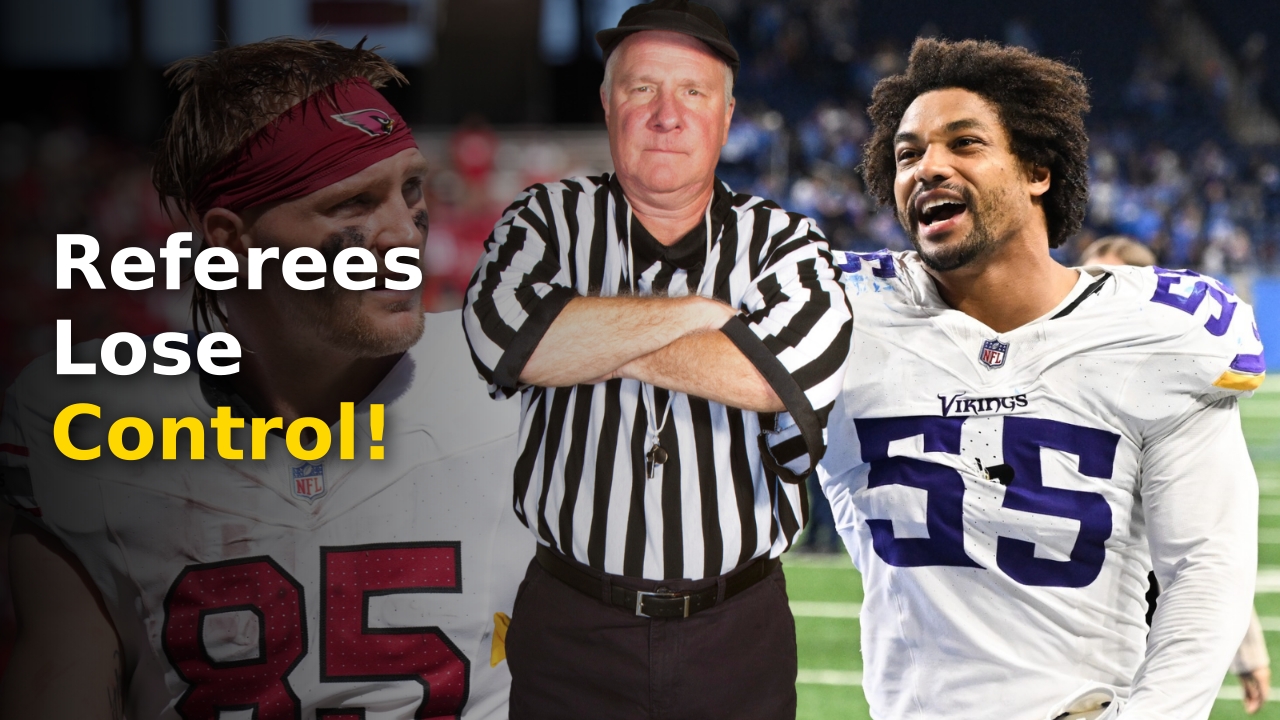
| Referee Adrian Hill confronted Vikings LB Eric Wilson after an accidental collision. |
| A separate official was caught on mic using profanity toward Cardinals TE Trey McBride. |
| The NFLPA and Executive Director JC Tretter are demanding league-wide accountability. |
| The 2026 season has seen a 15% rise in fan complaints regarding officiating conduct. |
You might expect the players to be the only ones losing their cool on the gridiron, but the latest NFL Referee Controversy has turned the spotlight on the men in stripes. During a high-stakes slate of games on October 4, 2026, two separate incidents involving officials and star players sparked a national debate over the professionalism and temperament of the league’s officiating crews. From a physical confrontation in Minnesota to a profanity-laced exchange in New York, the optics have never looked worse for the league’s governing body on the field.
As the NFL strives to maintain its image as the gold standard of professional sports, these lapses in composure threaten the integrity of the game. Fans and analysts alike are questioning whether “main character syndrome” has finally infected the officiating ranks, leading to a dynamic where referees are no longer invisible facilitators but active participants in the drama. The NFL Referee Controversy currently dominating social media reflects a deeper frustration with how authority is exercised during the most critical moments of the season.
The Growing NFL Referee Controversy in 2026
The NFL Referee Controversy reaching a boiling point this week isn’t just about missed holding calls or questionable pass interference flags; it is about the fundamental relationship between the players and the officials. In the modern era, referees are expected to be the calmest individuals in the stadium, providing a steady hand when tensions run high. However, the events involving Adrian Hill and an unnamed official in the Cardinals-Jets game suggest a shift toward a more combative officiating style that players find increasingly intolerable.
When an official loses their temper, it creates a ripple effect that impacts team momentum and player safety. In Minnesota, the confrontation between Adrian Hill and Eric Wilson was particularly jarring because it followed a dead-ball play where Wilson was physically shoved into the official by an opponent. Instead of recognizing the accidental nature of the contact, Hill’s immediate reaction was one of aggression. This type of behavior undermines the authority of the uniform and forces the league to answer difficult questions about official training and psychological screening.
The NFLPA has already signaled that it will not let these incidents pass without a formal inquiry. Executive Director JC Tretter has been vocal about the need for a two-way street regarding respect on the field. If players are fined tens of thousands of dollars for minor outbursts or uniform violations, the union argues that officials should face similar public accountability when they cross the line into verbal or physical hostility. This brewing legal and cultural battle is set to define the mid-point of the 2026 season.
The Impact of Official Conduct on Game Integrity
Integrity is the bedrock of the NFL’s multi-billion dollar business model. When fans begin to believe that officials have personal vendettas or are emotionally volatile, the perceived fairness of the competition evaporates. The NFL Referee Controversy is now being discussed in the same breath as sports betting and league parity, as even a single biased or emotionally charged decision can swing millions of dollars in wagers and significantly alter playoff seedings.
Experts suggest that the league may need to move toward a full-time officiating model to ensure better consistency and professional development. Currently, many NFL referees maintain secondary careers, which critics argue prevents them from achieving the elite level of psychological discipline required for the job. By making officiating a year-round, singular focus, the league could implement more rigorous stress-management protocols and interpersonal communication workshops to prevent the kind of meltdowns witnessed this Sunday.
Adrian Hill and the Eric Wilson Incident
During the Minnesota Vikings’ narrow 15-10 victory over the Miami Dolphins, a moment occurred that had nothing to do with the scoreboard. Vikings linebacker Eric Wilson found himself at the center of a viral storm when referee Adrian Hill appeared to flip out following a collision. Footage shows Wilson being pushed into Hill by a Miami offensive lineman after the whistle had already blown. Despite the obvious lack of intent, Hill’s response was a visible display of anger that many fans characterized as a “tantrum.”
What made the interaction particularly frustrating for viewers was Wilson’s immediate attempt to de-escalate the situation. The linebacker was seen offering a hand to help Hill up and appearing to apologize for the contact. Instead of accepting the gesture, Hill brushed him off with a level of vitriol that seemed disproportionate to the event. This specific interaction has become the poster child for the current NFL Referee Controversy, highlighting a perceived arrogance among certain veteran officials who feel they are above the players they govern.
Social media reactions were swift and merciless. NFL insider Jordan Schultz noted that Wilson was clearly trying to help, while fans on X (formerly Twitter) accused Hill of having “main character syndrome.” This term refers to the idea that some officials believe fans are there to watch them rather than the athletes. When an official’s reaction becomes the primary takeaway from a game, it signals a failure in the league’s mission to keep the focus on the competition itself.
By The Numbers: Officiating Disciplinary Actions
While the NFL rarely publicizes the specific fines or suspensions handed out to officials, internal sources suggest that the league does maintain a grading system. Officials who consistently rank in the bottom tier are often excluded from prestigious postseason assignments, including the Super Bowl. However, the NFLPA is pushing for more transparency. They want to see a public log of when an official is reprimanded for conduct, similar to how player fines are listed on the league’s media portal. This transparency would be a major step in resolving the current NFL Referee Controversy.
The Trey McBride Outburst and NFLPA Response
If the incident in Minnesota was about physical optics, the situation in New York was about verbal abuse. During the Arizona Cardinals’ matchup, tight end Trey McBride was reportedly told “F— you” by an official after questioning a call. Unlike the heat-of-the-moment physical collision in the Vikings game, this was a direct verbal assault captured on the broadcast. The league has confirmed it is reviewing the audio and video footage to determine the appropriate course of action.
The NFLPA, led by JC Tretter, has taken a hardline stance on this issue. Tretter issued a statement calling for the league to hold the official accountable to the same standards as the players. In the NFL’s current fine structure, a player using profanity toward an official can face a fine exceeding $15,000. Tretter argues that a referee using that same language toward a player should face a suspension or a significant financial penalty. This demand for equity is a central pillar of the 2026 labor discussions between the union and the league office.
The Cardinals organization has also expressed its disappointment. Management noted that McBride is known as a disciplined player who rarely argues with officials. If a player of his temperament is being met with such hostility, it suggests a systemic issue within that officiating crew. The NFL Referee Controversy is no longer just a Twitter trend; it is a formal grievance that could result in the first suspension of an official for conduct-unbecoming since the early 2010s.
2026 Officiating Conduct and Fan Sentiment Data
To understand the scope of the NFL Referee Controversy, we must look at the data regarding fan engagement and officiating complaints. The following table illustrates the rise in reported officiating “incidents” (defined as physical or verbal altercations with players) over the last three seasons.
| Season Year | Reported Altercations | Fan Disapproval Rating | NFLPA Grievances Filed |
|---|---|---|---|
| 2024 | 12 | 34% | 5 |
| 2025 | 19 | 41% | 9 |
| 2026 (Mid-Season) | 28 | 58% | 14 |
The data clearly shows an upward trend in conflict. As the NFL game becomes faster and more reliant on complex RPO (run-pass option) schemes, officials are under more pressure than ever. However, this pressure does not excuse a lack of professional decorum. The 58% disapproval rating among fans is a red flag for the league’s marketing departments, which rely on the “unbiased” nature of the sport to sell premium broadcast packages.
Background and Context: The History of Official Arrogance
The current NFL Referee Controversy is the latest chapter in a long history of friction between those who play the game and those who police it. Historically, the NFL has protected its officials with a veil of secrecy. Unlike MLB umpires, who often have very public and storied rivalries with managers, NFL referees have traditionally been discouraged from becoming the story. However, the rise of the “Celebrity Ref” began in the early 2000s with figures like Ed Hochuli, whose muscular physique and lengthy explanations became part of league lore.
While Hochuli was generally respected, his era ushered in a new level of visibility for officials. This visibility has evolved into what critics call a “misuse of power” in the 2020s. Today’s officials are often seen engaging in prolonged arguments with star players, sometimes appearing to “bait” them into unsportsmanlike conduct penalties. This dynamic has led to a breakdown in the traditional hierarchy of the field, where the official’s word was final but delivered with a level of professional detachment.
By examining the NFL’s official officiating handbook, it becomes clear that maintain composure is a core requirement of the job. Section 2, Article 1 of the conduct guidelines explicitly states that officials must remain objective and professional, even when faced with player frustration. The incidents with Eric Wilson and Trey McBride represent a clear deviation from these established protocols. This historical context is vital for understanding why the current backlash is so severe; it isn’t just about two bad moments, but a perceived decline in the standards of the world’s most powerful sports league.
Expert Take: The Psychology of the Stripe
Sports psychologists point out that the “main character syndrome” often cited by fans is actually a defense mechanism. In a stadium filled with 70,000 screaming people and millions watching at home, an official can feel besieged. To maintain control, some officials adopt an overly aggressive persona. However, in the high-stakes environment of 2026, where every frame of video is dissected on social media, this strategy is backfiring. The league needs to invest in de-escalation training that mirrors the protocols used by high-pressure crisis negotiators to ensure that the NFL Referee Controversy doesn’t become a permanent fixture of the sport.
People Also Ask
What happened with the NFL Referee Controversy today?
Today, the NFL is reviewing two major incidents where officials were seen acting unprofessionally toward players. One involved Adrian Hill confronting Eric Wilson, and another involved an official using profanity toward Trey McBride.
Why is the NFLPA demanding accountability for referees?
The NFLPA, led by JC Tretter, believes that officials should be held to the same conduct standards as players. They are calling for fines or suspensions for refs who use abusive language or engage in unnecessary confrontations.
How does this officiating debate affect the 2026 NFL season?
This debate is impacting game integrity and fan trust, leading to discussions about moving toward full-time officiating crews. It could also lead to new league rules regarding how officials and players are allowed to interact on the field.
Will referee Adrian Hill be suspended for his actions?
While the NFL has not announced a suspension yet, the incident with Eric Wilson is under formal review. Historically, the league prefers internal discipline, but the public nature of this outburst may force a more visible response.
The Path Forward for the NFL and its Officials
As the NFL Referee Controversy continues to dominate the headlines, the league office in New York finds itself at a crossroads. Commissioner Roger Goodell and the department of officiating must decide if they will continue to protect their crews at all costs or if they will usher in a new era of transparency. The players have made their voices heard through the union, and the fans have expressed their displeasure through falling sentiment scores. The status quo is no longer an option if the league wants to preserve its image as a fair and professional competition.
Ultimately, the solution likely involves a combination of better technology and better human training. While the “human element” has always been a part of sports, it shouldn’t include referees cussing out players or throwing tantrums on the sideline. By implementing a more rigorous accountability structure and potentially moving to a full-time model, the NFL can ensure that the headlines remain focused on the incredible feats of athletes like Trey McBride and Eric Wilson, rather than the men tasked with holding the whistle. For more exclusive sports updates and trending athlete news, stay tuned as this 2026 season continues to unfold. The outcome of this NFL Referee Controversy will undoubtedly set the precedent for how the game is governed for the next decade.
For further reading on the technical aspects of the game, you can check out ESPN’s latest NFL coverage for in-depth play-by-play analysis. For those interested in the financial and legal side of these sports disputes, professional sports analysis provides a deep dive into the contracts and union negotiations that shape the league today. The NFL Referee Controversy is far from over, but the conversation it has started is a necessary step toward a better, more professional product on the field.
More Like This
For more updates, check out our latest entertainment and sports news.