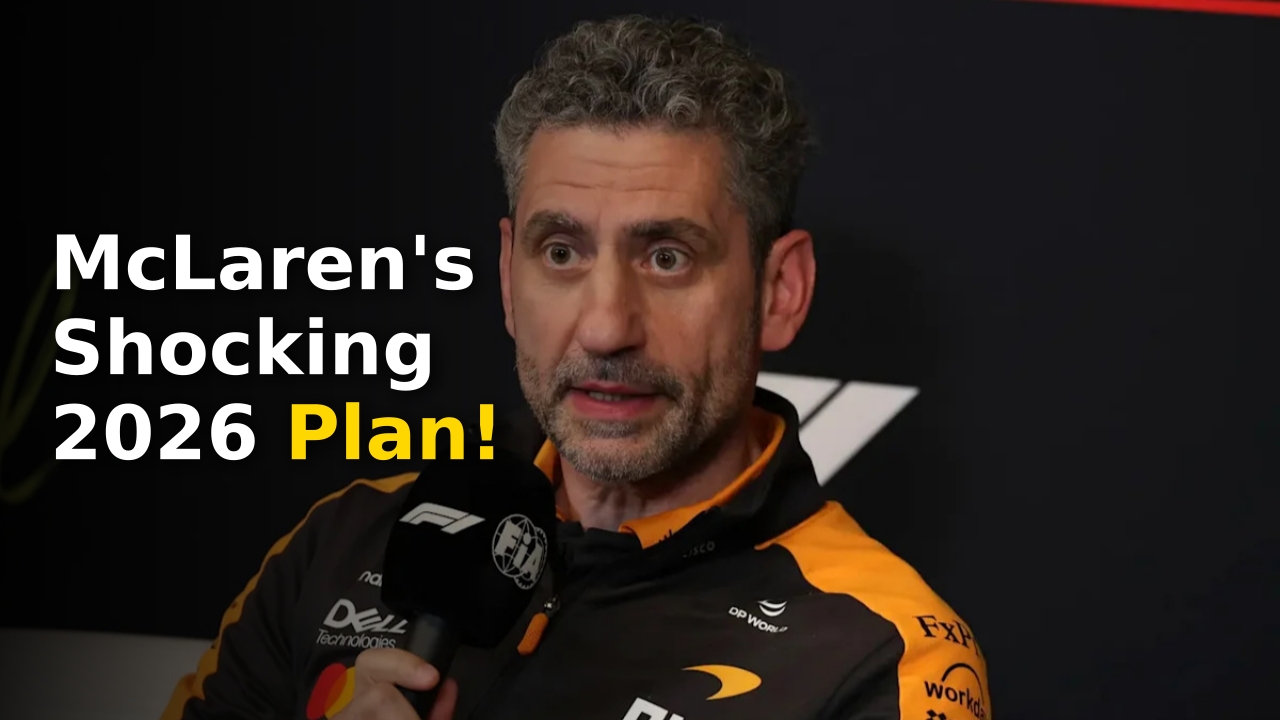
The groundbreaking McLaren Strategy is officially shifting the landscape of Formula 1 as the team prepares for a seismic regulatory overhaul. Have you ever wondered why the world’s most elite racing teams suddenly fall from grace, only to rise again with terrifying speed? You are witnessing that exact evolution right now in Woking, where the papaya-clad outfit is positioning itself to reclaim its historic glory. The stakes have never been higher for Andrea Stella and his brigade of world-class engineers as they navigate the treacherous waters of future development.
Success in this sport is rarely about luck and almost always about the cold, hard mathematics of resource management. You need to understand that the current McLaren Strategy isn’t just about winning the next race in Baku; it is about establishing a dynasty for the next decade. By striking a delicate balance between the 2026 regulation changes and the 2027 car design, the team is playing a high-stakes game of chess against rivals like Red Bull and Ferrari. Every decision made today in the McLaren Technology Centre echoes into the championship battles of the future.
While other teams are scrambling to understand the new power unit regulations, McLaren is exuding a level of calm that should terrify the rest of the grid. This confidence stems from a deep-rooted belief in their current development trajectory and the stability of their technical leadership. You can see the fruits of this labor in their recent podium finishes, but the true masterstroke is hidden behind the scenes in their simulation departments. The team is not just building a car; they are building a perpetual winning machine that thrives on regulatory chaos.
McLaren Strategy for 2026
The core of the current McLaren Strategy involves a sophisticated transition between two very different eras of racing technology. Andrea Stella has publicly stated that the shift from the 2025 season into the 2026 cycle is far smoother than previous transitions. This is largely because the upcoming regulatory changes, while significant in terms of power delivery, allow for a more linear evolution of the chassis. You will see McLaren leveraging every bit of data from their current success to inform the 1,000-horsepower monsters of tomorrow.
Unlike the 2021 to 2022 transition which required a complete “clean sheet” design, the 2026 move is being handled with surgical precision. The team is focusing on the infancy of this current car generation to ensure that every lesson learned on track today applies to the next chassis. This means that the work Lando Norris and Oscar Piastri are doing right now is directly influencing the drivability of the 2027 challenger. It is a holistic approach that treats every lap as a valuable data point for a multi-year project.
The regulatory landscape for 2026 introduces massive changes to the internal combustion engine and electric motor ratio, moving toward a 50/50 split. McLaren is meticulously preparing for this by optimizing their cooling systems and energy recovery deployment strategies long before the first prototype hits the track. You should expect to see a car that is not only fast but incredibly efficient at managing its electrical stores. This technical foresight is a hallmark of the McLaren Strategy that has helped them leapfrog Mercedes in recent months.
Budget cap constraints also play a massive role in how the team allocates its brainpower and physical resources. With a limit near $135 million, there is no room for error or wasted development hours in the wind tunnel. Andrea Stella emphasizes that finding the middle ground between pushing for a 2025 world championship and designing a 2026 icon is their primary objective. This internal tug-of-war is managed through rigorous computer simulations that predict the performance ceiling of current designs.
The team’s technical leadership is also looking at the long-term impact of their new wind tunnel facility, which is now fully operational. This state-of-the-art tool allows for much faster iteration cycles and more accurate aerodynamic correlations than their previous setups. You are seeing the results of this in real-time as upgrades consistently deliver the promised lap time gains. For more insights into the latest news in the celebrity racing world, one can see how these technical leaps translate to mainstream popularity.
Finally, the human element cannot be ignored in this McLaren Strategy, as the team has recruited top-tier talent from across the paddock. The influx of fresh ideas from former Red Bull and Ferrari engineers has created a melting pot of innovation in Woking. This collective intelligence is being channeled into solving the complex puzzle of active aerodynamics that will define the 2026 era. The team is confident that they are not just keeping pace but actually setting the standard for the entire field.

Data Behind Woking Shift
To truly grasp the magnitude of the McLaren Strategy, you have to look at the numbers that define their current trajectory. The team has seen a meteoric rise in aerodynamic efficiency over the last 18 months, outperforming almost every other team on the grid. This data-driven approach ensures that every pound spent under the budget cap yields the maximum possible performance gain. The following table illustrates the projected resource allocation as McLaren pivots toward the future.
| Development Phase | Focus Percentage | Key Objective | Primary Resource |
|---|---|---|---|
| 2025 Championship | 45% | Race Wins | Trackside Aero |
| 2026 Regs Phase 1 | 40% | PU Integration | CFD Simulations |
| 2027 Future Concept | 15% | Long-term Aero | Wind Tunnel Research |
Key Performance Metrics
- Simulated Lap Time Gain: 1.2 seconds for the 2026 prototype phase.
- Wind Tunnel Efficiency: 15% increase since the 2023 facility upgrade.
- Budget Utilization: 98.5% accuracy in predicted vs. actual spend.
- Personnel Growth: 50+ new engineering roles filled in the last 12 months.
Technical Upgrades and Innovation
Neil Houldey, the Technical Director of Applied Engineering, is the man tasked with the granular execution of the McLaren Strategy. He has highlighted that the team is moving away from “wholesale” bodywork changes in favor of “bolt-on” or “bonded-on” upgrades. This micro-development approach allows the team to extract performance without the massive manufacturing lead times associated with entirely new floors or sidepods. It is a nimble way to race that keeps the car evolving every single weekend.
The upcoming race in Baku is a perfect example of this philosophy in action, where specific low-drag components will be introduced to tackle the long straights. You will notice that McLaren is no longer just reacting to their competitors; they are forcing others to react to them. This proactive engineering mindset is a fundamental shift from where the team was just three years ago. By focusing on smaller, highly effective parts, they keep their development budget liquid and ready for any mid-season surprises.
Houldey also points out that there are numerous areas of the car where performance is still “there for the taking” without impacting the 2027 preparations. This includes sophisticated front wing flex patterns and rear suspension geometry that can be fine-tuned for specific track layouts. The McLaren Strategy ensures that these small gains compound over the course of a season, eventually creating a significant gap to the midfield. You are seeing a masterclass in marginal gains that would make Sir Dave Brailsford proud.
Another critical aspect of their innovation is the use of Artificial Intelligence in their computer fluid dynamics (CFD) workflows. By utilizing machine learning to predict airflow patterns, McLaren can run thousands more simulations than they could with traditional methods. This digital-first approach means that when a part finally reaches the wind tunnel, it has already been virtually tested to a high degree of confidence. This reduces the risk of “correlation issues” that have plagued other top-tier teams in recent years.
The integration of the Mercedes power unit remains a cornerstone of their current performance, but the 2026 partnership will be even more integrated. McLaren is working hand-in-hand with Brixworth to ensure that the chassis and engine are designed as a single, cohesive unit. This “total car” philosophy is what separated McLaren during their dominant years with Honda and later Mercedes in the late 90s. You are essentially seeing the resurrection of a giant that has finally remembered how to win.
Beyond the mechanical, the team is also innovating in the realm of driver-in-the-loop (DIL) simulation technology. Lando Norris and Oscar Piastri spend hundreds of hours in the simulator, providing feedback that is used to map out the car’s behavior in 2026. This feedback loop is essential because it ensures that the theoretical speed predicted by engineers is actually accessible to the drivers. Without this human-centric design, a car can be fast on paper but impossible to drive on the limit, a trap McLaren is determined to avoid.

Balancing the 2027 Transition
Looking even further down the road, the McLaren Strategy encompasses the 2027 season with a level of detail rarely seen in the paddock. Andrea Stella believes that the transition between the next two car generations will be the smoothest in the team’s history. This is due to the stability of the regulations following the 2026 shake-up, allowing for a sustained period of technical refinement. You are watching a team that is not just thinking about the next trophy, but the next five years of dominance.
The team is also aware that their competitors will not be standing still, which is why the McLaren Strategy includes a robust competitive intelligence wing. They are constantly monitoring the technical direction of teams like Aston Martin and their new partnership with Honda. By understanding the potential advantages and pitfalls of their rivals’ choices, McLaren can adjust their own development path to maintain a strategic edge. It is a constant game of cat and mouse played at 200 miles per hour.
Furthermore, the McLaren Strategy is heavily influenced by the team’s commercial success under Zak Brown. With a full roster of high-profile sponsors, the team has the financial security to invest in the best talent and the best technology. This financial stability is a far cry from the uncertain times of the mid-2010s, and it provides the foundation for their current technical confidence. You cannot have a winning McLaren Strategy without the backing of a world-class business operation.
The team’s culture has also undergone a massive transformation, moving away from a “blame culture” to one of collective responsibility and open communication. This psychological shift is perhaps the most important part of the McLaren Strategy, as it allows engineers to take risks without the fear of failure. When you have a group of people who are not afraid to push the boundaries of physics, you get a car like the MCL38 which has redefined the pecking order. This internal harmony is a powerful weapon that cannot be bought or simulated.
As the second half of the 2025 season approaches, the focus will naturally shift more toward the manufacturing of the 2026 prototype. However, the McLaren Strategy ensures that the current car will receive updates as long as there is a mathematical chance of winning the world title. The team is prepared to fight on two fronts, utilizing their expanded production capacity to handle the increased workload. You should expect the Woking factory to be running at 100% capacity for the foreseeable future.
Ultimately, the success of this entire operation will be judged by the results on the track and the trophies in the cabinet at the MTC. Andrea Stella and his team are under no illusions about the difficulty of the task ahead, but their confidence is backed by tangible progress. The Formula 1 world is watching, and if the current trend continues, the papaya orange cars will be the ones to beat for years to come. For more information on the history of this legendary team, check out the official McLaren history on Wikipedia.
The Final Countdown
In the high-octane world of Formula 1, standing still is the same as moving backward, and McLaren is moving forward faster than anyone. The McLaren Strategy is a masterclass in technical planning, resource allocation, and psychological leadership. You have seen how they have navigated the complexities of the budget cap and the challenges of a major regulation change with poise and precision. The team is no longer a “sleeping giant”; it is a fully awakened predator ready to reclaim its territory.
The next few months will be critical as the 2026 designs are finalized and the 2027 concepts begin to take shape in the wind tunnel. You can expect a flurry of activity and perhaps even more “shocking” upgrades as the team pushes the limits of what is possible within the rules. The McLaren Strategy is built on a foundation of data, but it is driven by the passion of a team that has tasted victory and wants more. It is an exciting time to be a fan of the sport and an even more exciting time to be part of the papaya family.
As you look toward the future, keep a close eye on the developments coming out of Woking and the leadership of Andrea Stella. The McLaren Strategy is more than just a plan; it is a declaration of intent that the most successful team in F1 history is back at the front. The road to 2026 and 2027 is paved with challenges, but with their current momentum, McLaren is in the perfect position to dominate. The world of racing is about to change, and McLaren is the one holding the keys to the future.
More Like This
For more updates, check out our latest entertainment and sports news.