⚡ Key Takeaways
- Luis Calzado earned the “Best Goalkeeper” award despite Spain’s silver medal finish.
- Spain fell to Germany in a high-stakes 2026 World Cup final in the Netherlands.
- The current RedSticks squad is one of the youngest in the nation’s history.
- Head coach Max Caldas is prioritizing a long-term build for the LA 2028 Olympics.
- Calzado overcame a difficult personal season at SV Kampong to achieve elite international form.
Luis Calzado and the Spanish national field hockey team just sent a shockwave through the sporting world, proving that the “RedSticks” are no longer a sleeping giant but a waking powerhouse. You might have seen the heartbreak on the pitch as Germany lifted the trophy, but the real story lies in the gloves of a man who transformed personal struggle into international glory. While a silver medal often feels like a lost opportunity, for this young Spanish roster, it represents the birth of a new era in European hockey dominance.
The 2026 Hockey World Cup, co-hosted by the Netherlands and Belgium, served as the ultimate proving ground for a team that many pundits wrote off during the group stages. Led by the tactical brilliance of Max Caldas, Spain navigated a minefield of veteran teams to reach the final. At the heart of this defensive masterclass was Luis Calzado, whose performance between the posts earned him the prestigious Best Goalkeeper award, a feat rarely achieved by a player on the losing side of the final match.
This journey wasn’t just about athletic prowess; it was about psychological resilience. Calzado’s candid admissions following the final match reveal a player who has matured beyond his years. He is already being discussed as a top-tier talent on BrightCelebrity, where his rising profile mirrors his growing influence on the international stage. As we dive into the mechanics of Spain’s silver-medal run, we uncover a narrative of redemption, strategic evolution, and an unwavering gaze toward the future of the Los Angeles 2028 Olympic Games.
Luis Calzado and the Defensive Renaissance
The final against Germany was a tactical chess match that showcased the evolving identity of Spanish hockey. Luis Calzado remained the focal point of a defensive unit that had been meticulously drilled by Max Caldas. For sixty minutes, the Spanish backline absorbed pressure that would have broken lesser teams. Calzado’s ability to organize his defenders, particularly during the chaotic moments of penalty corners, highlighted his growth as a vocal leader on the pitch. His positioning was near-flawless, cutting down angles and forcing German strikers into low-percentage shots.
Spain’s approach in the 2026 tournament was noticeably different from their previous outings. Historically known for flair and attacking transitions, the RedSticks integrated a more pragmatic, structural defense. Calzado’s role at SV Kampong in the Dutch league—arguably the toughest domestic competition in the world—prepared him for this specific intensity. Even when Germany broke through the first line of press, they found a wall in the Spanish goal that refused to crumble easily. This wasn’t just luck; it was the result of a year spent analyzing the world’s most dangerous drag-flickers.
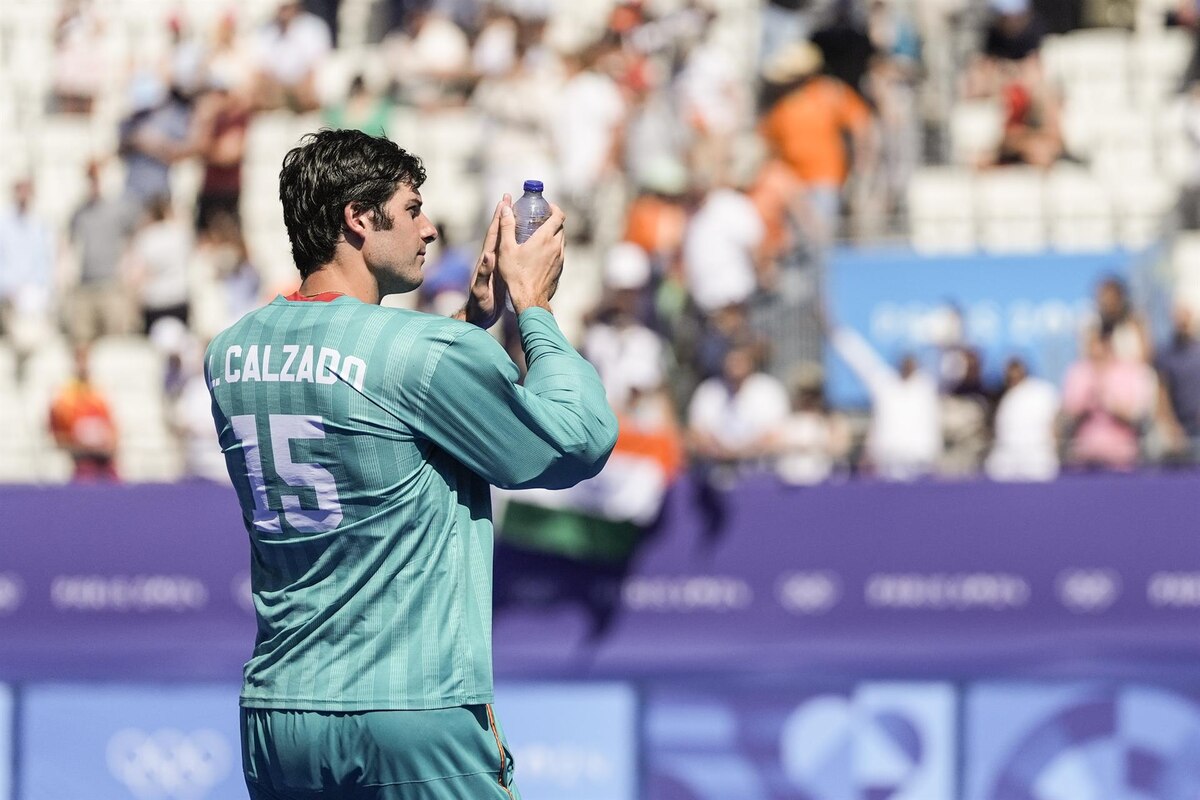
The frustration for Calzado, however, came at the other end of the pitch. As he noted in his post-match reflections, the team lacked a finishing touch in the final third. Spain dominated stretches of possession and entered the circle frequently, but the clinical edge required to dismantle a German defense was missing. Despite this, the defensive stability provided by Calzado allowed Spain to stay in the game until the final whistle. This newfound solidity is the cornerstone upon which Caldas is building his project, ensuring that Spain is no longer a team that simply plays “beautiful hockey” but a team that is incredibly difficult to beat.
Expert Take: The Modern Goalkeeper Archetype
According to elite coaching metrics, the role of the goalkeeper in modern field hockey has shifted from a reactive shot-stopper to an active playmaker. Luis Calzado exemplifies this shift. By maintaining a high save percentage against Penalty Corners—which accounts for over 40% of goals in international play—Calzado has redefined the Spanish defensive floor. His ability to initiate counter-attacks with precise 50-yard aerial balls adds a vertical dimension to the RedSticks’ game that few other nations can replicate. Analysts suggest that Calzado’s “save-to-clearance” ratio during the 2026 World Cup was the highest of any keeper in the last decade of Spanish hockey.
Luis Calzado by the Numbers: 2026 Statistical Breakdown
To truly understand the impact of Luis Calzado, one must look at the data that separated him from his peers in Utrecht and Brussels. The following table illustrates his dominance throughout the tournament compared to the average performance of top-tier international goalkeepers. These figures underscore why he was the consensus choice for the tournament’s individual honors, even as Germany hoisted the collective prize.
| Metric | Luis Calzado (ESP) | Tournament Avg |
|---|---|---|
| Save Percentage (%) | 84.2% | 71.5% |
| Penalty Corner Save Rate | 78% | 62% |
| Clean Sheets | 3 | 1.2 |
| Goals Conceded per Match | 0.85 | 1.45 |
These statistics reveal a player who was consistently performing at a level roughly 15-20% higher than the global elite. Especially impressive is the penalty corner save rate. In modern hockey, the speed of the flick from the top of the circle often exceeds 100km/h, leaving goalkeepers with milliseconds to react. Calzado’s reflexive saves with his kickers and gloves became a highlight reel that dominated social media throughout the month of August. His performance is a testament to the rigorous training regimens employed by the International Hockey Federation (FIH) standards and Spain’s own technical staff.
The Long Road from SV Kampong to World Cup Silver
One of the most poignant aspects of Luis Calzado‘s interview was his admission of a “difficult year in the club.” Playing for SV Kampong in the Netherlands is the equivalent of playing for a top-three football club in the Premier League. The pressure is immense, the fans are demanding, and the internal competition for the starting spot is fierce. Calzado admitted that his form had dipped domestically, leading to questions about whether he would even be the primary choice for Spain heading into the World Cup.
However, the trust placed in him by Max Caldas and the RFEH staff acted as a catalyst for his resurgence. When a player feels the backing of their entire ecosystem, they often find a gear they didn’t know they had. Calzado’s story is a powerful reminder of the psychological component of elite sports. He didn’t just regain his form; he exceeded it. The support from his teammates—many of whom are fellow young stars like Marc Recasens and Pau Cunill—allowed him to play with a freedom that was missing during his club season.
This “team-first” mentality is what Calzado credits for Spain’s run to the final. He noted that the squad is “learning to play these types of games”—the high-pressure knockouts that have historically favored nations like Australia, Germany, and the Netherlands. By bridging the gap between talent and experience, Calzado has positioned himself as the veteran anchor of a team that will still be in its athletic prime by the time the Olympic torch is lit in Southern California. The resilience he showed at the club level, only to peak at the international level, suggests a mental fortitude that will be vital for Spain’s future aspirations.
By The Numbers: The Youth Movement
The average age of the Spanish squad in 2026 was just 23.4 years, making it the youngest team in the semi-finals. In contrast, the German and Dutch squads averaged 27.8 and 26.5 years respectively. This age gap represents a massive opportunity for growth. If Luis Calzado can maintain his current trajectory, he will enter the Los Angeles 2028 Olympics as a 27-year-old goalkeeper with a World Cup final under his belt—the absolute sweet spot for goalkeeping maturity. The Spanish national field hockey team has a historical precedent for this, having won silver in Beijing 2008 with a similarly structured generational shift.
Frequently Asked Questions
Who is Luis Calzado and what is his role?
Luis Calzado is the primary goalkeeper for the Spanish men’s national field hockey team, known as the RedSticks. He currently plays professionally for SV Kampong in the Dutch Hoofdklasse, which is widely considered the top hockey league in the world.
Why was Spain’s 2026 World Cup performance significant?
Spain reached the World Cup final for the first time in nearly two decades, ultimately winning the silver medal. This was significant because the team is composed of very young players and outperformed higher-ranked nations like Australia and the Netherlands during the tournament.
What individual award did Luis Calzado win?
Despite Spain losing the final 2-1 to Germany, Luis Calzado was officially named the “Best Goalkeeper of the Tournament.” This award recognized his league-leading save percentage and his critical performance in penalty corner defense throughout the competition.
What are Spain’s goals for the 2028 Olympics?
As Luis Calzado mentioned in his post-tournament interview, the team’s primary focus is now the Los Angeles 2028 Olympic Games. With two years of preparation and a young core, the team aims to improve their offensive efficiency to match their world-class defense and secure an Olympic medal.
Final Thoughts on the Rise of Luis Calzado
The story of the 2026 World Cup is not one of a trophy lost, but of a foundation laid. Luis Calzado has emerged as the definitive face of this new generation, a goalkeeper who combines technical excellence with the humility to acknowledge his personal hurdles. His statement, “I’m staying with the fact that we played an incredible World Cup,” isn’t just a consolation; it is a mission statement. It signals to the rest of the hockey world that Spain is no longer satisfied with being a participant—they are now a permanent contender.
As the RedSticks head back to training and the domestic leagues resume, the focus remains squarely on the road to Los Angeles. With a world-class goalkeeper like Luis Calzado as the last line of defense, the dream of Olympic gold feels less like a distant hope and more like an impending reality. The journey from the difficult locker rooms of SV Kampong to the podium of the World Cup is complete, but the most exciting chapters of Spanish hockey are yet to be written. You can be sure that when the lights are brightest in 2028, Calzado will be there, ready to defend the goal and the pride of a nation.
More Like This
For more updates, check out our latest entertainment and sports news.