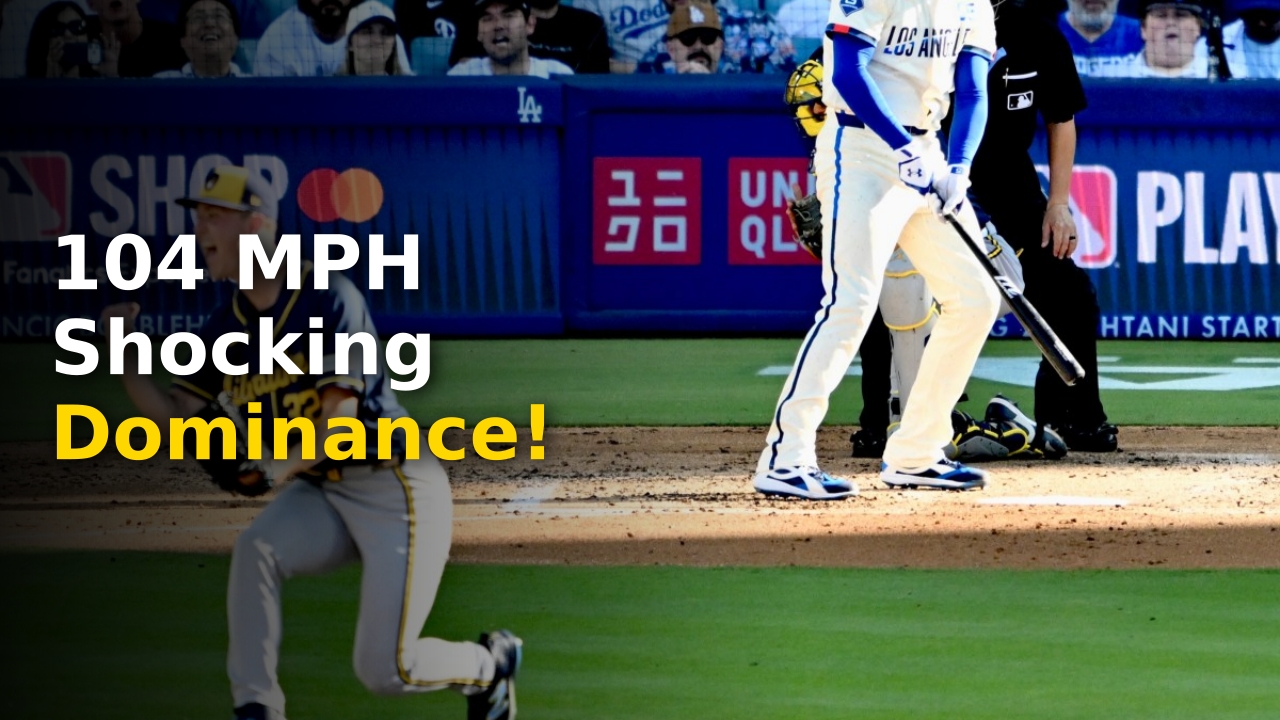
Jacob Misiorowski officially dismantled the Los Angeles Dodgers on Saturday evening, proving that raw velocity remains the ultimate equalizer in Major League Baseball. Have you ever wondered what it feels like to stand 60 feet away from a 104 mph projectile while thousands of fans scream in anticipation? For the Dodgers’ star-studded lineup, it felt less like a game and more like a high-speed collision they simply couldn’t avoid.
You could see the frustration on the faces of future Hall of Famers as the Milwaukee Brewers’ young ace turned the mound into a launching pad. It wasn’t just a loss for Los Angeles; it was a psychological statement from a Brewers squad that looks increasingly like a World Series favorite. The atmosphere at the stadium shifted from hopeful to helpless as the radar gun repeatedly flashed triple digits, leaving the home crowd in a stunned silence.
Jacob Misiorowski Silences Dodgers
The game began with a sequence that will likely haunt the Dodgers’ video room for weeks. Leading off the first inning, Shohei Ohtani stepped into the box expecting a challenge, but he didn’t expect a firing squad. Jacob Misiorowski uncorked a series of pitches that defied conventional physics, with the slowest ball of the encounter clocking in at a blistering 102.9 mph. You rarely see a player of Ohtani’s caliber look genuinely surprised by velocity, yet the Milwaukee right-hander achieved exactly that.
Manager Dave Roberts could only marvel at the sheer power displayed by the opposing starter. He noted that seeing 104 mph on the scoreboard for the first four pitches of a game is nearly unprecedented in the modern era. The Dodgers entered the contest knowing they faced a tall task, but the reality was far more imposing than any scouting report could suggest. Misiorowski’s presence on the mound forced the Dodgers to abandon their usual aggressive slugging strategy in favor of a survivalist mindset.
Throughout six innings, the Brewers’ phenom held the Dodgers to a single run on five scattered hits. This wasn’t just luck; it was a systematic dismantling of one of the most expensive offenses in sports history. You have to appreciate the irony of a team that has spent billions being shut down by a pitcher who relies on the most basic element of the game: speed. The Brewers (76-48) now sit two full games ahead of the Dodgers (74-50) in the race for the National League’s best record.
The victory was a testament to the Brewers’ ability to develop homegrown talent that can compete on the biggest stages. While the Dodgers often look to the trade market or free agency for solutions, Milwaukee has cultivated a monster in the form of their 22-year-old starter. It is this organic growth that makes the Brewers a “team to be reckoned with,” as the young pitcher himself claimed during his post-game interview. The confidence in the Milwaukee clubhouse is at an all-time high, and it is easy to see why.
Despite the high velocity, the most impressive part of the performance was the efficiency. Misiorowski didn’t just throw hard; he threw strikes, leading the league with 210 strikeouts this season. He managed to navigate high-leverage situations with the poise of a ten-year veteran. When the Dodgers finally managed to load the bases in the fifth inning, the young right-hander didn’t blink, relying on his devastating arsenal to escape the jam unscathed.
The psychological toll of this game cannot be overstated for the Los Angeles clubhouse. They have been “bullied” by fastballs for six straight weeks, and this performance was the pinnacle of that trend. If the Dodgers cannot find a way to catch up to elite heat, their postseason aspirations may be cut short by the very arms they’ll have to face in October. For now, the narrative in the National League has a new protagonist, and his name is synonymous with high-speed dominance.

Key Game Highlights
- 104.0 mph: The peak velocity reached by the Brewers’ starter in the opening frame.
- 210 Strikeouts: The season total for the league-leading Milwaukee ace.
- 15 Sliders: The secondary pitch that induced a 90% whiff or weak contact rate.
- 76-48: The Brewers’ dominant record, solidifying their lead in the National League.
Decoding the 104 MPH Heat
To understand the dominance of Jacob Misiorowski, you have to look beyond the radar gun and into the mechanics of his delivery. His average fastball on Saturday was 101.4 mph, a figure that most relief pitchers struggle to reach for a single inning. Maintaining that level of intensity over six innings is a feat of modern athletic training. It requires a perfect synergy of lower-body drive, core rotation, and arm whip that few humans possess.
The Dodgers’ hitters were clearly caught off guard by the late life on the ball. Even when they managed to time the 103 mph heaters, the ball seemed to rise or run away at the last millisecond. This “active spin” is what separates a good fastball from a legendary one. You can follow more of the latest sports celebrity updates to stay updated on how these power players are performing off the field and in the gym. This level of physical performance doesn’t happen by accident; it’s the result of rigorous scientific preparation.
The slider served as the perfect foil to the high-octane heater. While he only used it 15 times, it was arguably his most effective tool for generating swings and misses. Imagine trying to adjust your eyes to a 104 mph fastball only to be met with an 89 mph slider that disappears toward the dirt. It is a cruel game of cat and mouse where the batter is almost always the prey. Even Freddie Freeman, known for his elite hand-eye coordination, looked overmatched by the sequence.
Dave Roberts mentioned that you simply cannot try to “slug” a pitcher like this. The focus must shift to shortening the swing and trying to put the ball in play, but even that strategy failed for the Dodgers. When your opponent is hitting the corners at triple digits, the margin for error becomes non-existent. The Brewers have successfully built a pitching philosophy around this overwhelming power, and it is paying dividends in the standings.
Interestingly, the Brewers have utilized data to optimize Misiorowski’s release point, making his pitches appear even faster to the hitter. This concept, known as “perceived velocity,” suggests that because of his long extension, the ball is released closer to the plate. This subtracts precious milliseconds from the hitter’s reaction time. In a game of inches and fractions of seconds, Jacob Misiorowski has essentially rigged the clock in his favor.
The Dodgers’ struggles are part of a larger trend in 2026. Pitching technology has advanced to the point where human reaction time is being tested to its absolute limit. While fans love the excitement of a 100+ mph pitch, the league is seeing a decrease in offensive production against these elite arms. Milwaukee is at the forefront of this revolution, and Saturday’s game was a masterclass in how to weaponize modern pitching metrics.
Dodgers Hitters Suffer Bullying
For a team with the payroll and prestige of the Los Angeles Dodgers, being described as “bullied” is a bitter pill to swallow. Yet, that is exactly the term Dave Roberts used to describe his team’s recent struggles against the fastball. Over the past six weeks, no team in the league has seen more high-velocity pitches, and few have produced less. It seems the word is out: if you want to beat the Dodgers, you have to bring the heat.
The fifth inning was the perfect microcosm of this struggle. The Dodgers managed to load the bases through sheer grit, bringing the top of their order to the plate with only one out. This is the exact scenario Los Angeles pays millions for. However, the Brewers’ starter responded by striking out Shohei Ohtani on three pitches—a combination of two sliders and a 102.4 mph heater. He followed that up by punching out Freddie Freeman, effectively ending the threat and crushing the Dodgers’ momentum.
When your best players can’t cash in during high-leverage moments, the entire dugout feels the weight of the game. You could see the air leave the stadium as Freeman walked back to the bench. It wasn’t just about one missed opportunity; it was the realization that even their best wasn’t enough to overcome the raw power of the Milwaukee ace. This lack of “clutch” hitting has become a recurring theme for the Dodgers during the second half of the season.
The bottom of the order actually provided more spark than the superstars. Players like Alex Call and Hunter Feduccia accounted for four of the team’s five hits. This disparity highlights a worrying trend where the Dodgers’ core is failing to adapt to elite pitching. While the role players are doing their jobs by creating stress and getting on base, the “big guns” are failing to pull the trigger when it matters most.
Baseball is a game of adjustments, and the Dodgers are currently failing to make them. If they continue to see a steady diet of fastballs, they must find a way to flatten their swing paths and improve their timing. Otherwise, the 2026 season could end in a familiar fashion: a dominant regular-season run followed by a quick exit at the hands of a power-pitching opponent. The Brewers have provided the blueprint for every other team in the National League.
The frustration in the clubhouse is palpable. Justin Wrobleski, who started for the Dodgers, expressed his own annoyance after giving up two critical home runs. While he pitched well in spurts, his inability to keep the ball in the yard proved fatal. In a game where your offense only gives you one run of support, every mistake is magnified. The Dodgers are currently a team searching for an identity in the face of overwhelming adversity.
Brewers Dominate Pitching Stats
The statistical gap between the Milwaukee Brewers and the rest of the league is widening. Their rotation, led by young stars, is setting records for velocity and strikeout rates. Saturday’s game was just another chapter in a season defined by mound dominance. To put their success in perspective, let’s look at how their top starters compare to the rest of the elite arms in the National League.
| Pitcher | Avg Fastball (MPH) | Total Strikeouts | ERA | Wins |
|---|---|---|---|---|
| Jacob Misiorowski | 101.4 | 210 | 2.45 | 14 |
| Tarik Skubal | 97.8 | 185 | 2.68 | 15 |
| Justin Wrobleski | 94.2 | 142 | 4.12 | 9 |
| Corbin Burnes | 96.5 | 178 | 2.95 | 12 |
As you can see from the data, the Brewers are operating on a different level of power. While veterans like Corbin Burnes rely on precision and movement, the new wave of Milwaukee pitching is simply overpowering the opposition. The 2.45 ERA posted by the Brewers’ ace is even more impressive when you consider he plays half his games in hitter-friendly parks. This is a historic run that has the potential to redefine how teams approach pitching development.
The Dodgers’ Justin Wrobleski presents a stark contrast. While he gave up fewer hits than his counterpart on Saturday, he suffered from the “long ball” plague. Giving up 11 home runs in his last 19 innings is a unsustainable trend for a major league starter. It doesn’t matter how well you throw for five innings if one or two “belt-high” sliders end up in the left-field pavilion. The Brewers were able to capitalize on these mistakes, with Joey Ortiz and William Contreras providing the necessary fireworks.
Contreras, specifically, had been struggling since the All-Star break, hitting only .168. However, even a struggling hitter can do damage when a pitcher leaves a cutter hanging near the ankles. This ability to exploit weaknesses is what makes the Brewers a dangerous postseason threat. They don’t need a dozen hits to win a game; they just need one or two well-timed swings to supplement their dominant pitching.

Justin Wrobleski Facing Crisis
The situation for Justin Wrobleski has reached a critical juncture. Once considered a reliable arm for the Dodgers’ rotation, his second-half collapse has raised serious questions about his longevity in the starting five. The disparity between his early-season performance and his recent starts is jarring. In his first 106 innings, he gave up only eight home runs; in his last four starts, he has already surrendered 11. This spike in home run rate suggests either a mechanical flaw or a fatigue issue that the Dodgers need to address immediately.
During his post-game comments, Wrobleski sounded like a man searching for answers. He noted that he felt he “threw the ball really well” and that the home runs were simply the result of good swings on decent pitches. While that may be true in some instances, the frequency of these “good swings” suggests that hitters are seeing his pitches much better than they were in April and May. If he cannot regain his deceptiveness, the Dodgers may be forced to move him to the bullpen or the injured list to reset.
The pressure of playing in Los Angeles only adds to the stress. Every start is a high-stakes audition for a playoff roster spot. With the Brewers pulling away in the standings, the Dodgers cannot afford many more “frustrating” outings from their young left-hander. You have to wonder if the mental toll of giving up lead-changing home runs is starting to affect his pitch selection. On Saturday, he hit the inside corner with a slider to Ortiz, but the vertical location was a disaster.
The Dodgers’ coaching staff has their work cut out for them. They need to find a way to help Wrobleski keep the ball in the park without sacrificing the aggression that made him successful early on. It may involve a change in his pitch mix or a slight adjustment to his release point to create more downward tilt. According to reports on Milwaukee Brewers history, many great pitchers have overcome similar mid-season slumps by refining their secondary offerings.
For the Dodgers to have any chance of reclaiming the best record in the National League, they need Wrobleski—or whoever fills his spot—to provide more than just “flashes” of brilliance. Consistency is the hallmark of a championship rotation. Currently, the Brewers have it, and the Dodgers don’t. The series finale on Sunday will be a major test of character for the entire Los Angeles pitching staff as they face a must-win situation to split the series.
The Dodgers’ manager remained optimistic, focusing on the team’s ability to create opportunities. He pointed out that they got the “guys they wanted” to the plate in the fifth inning. However, professional sports is a result-oriented business, and “almost” winning doesn’t count in the standings. As the calendar flips toward September, the time for moral victories is over. The Dodgers must find a way to turn their potential into production before the Brewers leave them in the dust.
Future of Jacob Misiorowski
The trajectory of Jacob Misiorowski is currently pointing toward superstardom. If he continues at this pace, he won’t just be the Brewers’ ace; he’ll be the face of Major League pitching. His combination of height, extension, and pure velocity is something the game hasn’t seen since the early days of Randy Johnson. For baseball fans, watching his development is like watching a once-in-a-generation talent realize its full potential in real-time.
The Brewers have handled him with care, ensuring his arm health is prioritized while allowing him to dominate the competition. This strategy is paying off, as he looks stronger in August than he did in April. The rest of the league is now on notice: Milwaukee has a weapon that can neutralize even the most potent offenses. If the Brewers can pair this elite pitching with a healthy lineup, they will be the team no one wants to face in a short playoff series.
As for the Dodgers, the “Miz-ery” of Saturday serves as a wake-up call. They are no longer the undisputed kings of the National League. A new power has risen in the North, and it is built on a foundation of 104 mph fastballs and a “fired up” clubhouse. The race for the best record is far from over, but the momentum has clearly shifted. You can expect both teams to be active as the season reaches its climax, but for now, the advantage belongs to the Brew Crew.
The final word belongs to the man of the hour. Being a Brewer is “fun” right now, and winning makes everything easier. When you have the best fastball in the game and a team that believes they can beat anyone, the sky is the limit. Jacob Misiorowski has arrived, and the baseball world will never be the same. Whether he’s facing Shohei Ohtani or a bottom-of-the-order hitter, the approach remains the same: pure, unadulterated power.
In the grand scheme of the 2026 season, this game may be remembered as the moment the torch was passed. The Dodgers are still a great team, but the Brewers are currently a better one. As we look forward to the postseason, the rivalry between these two titans will likely define the narrative of the year. One thing is certain: as long as Jacob Misiorowski is on the mound, the Brewers have a chance to make history.
More Like This
For more updates, check out our latest entertainment and sports news.