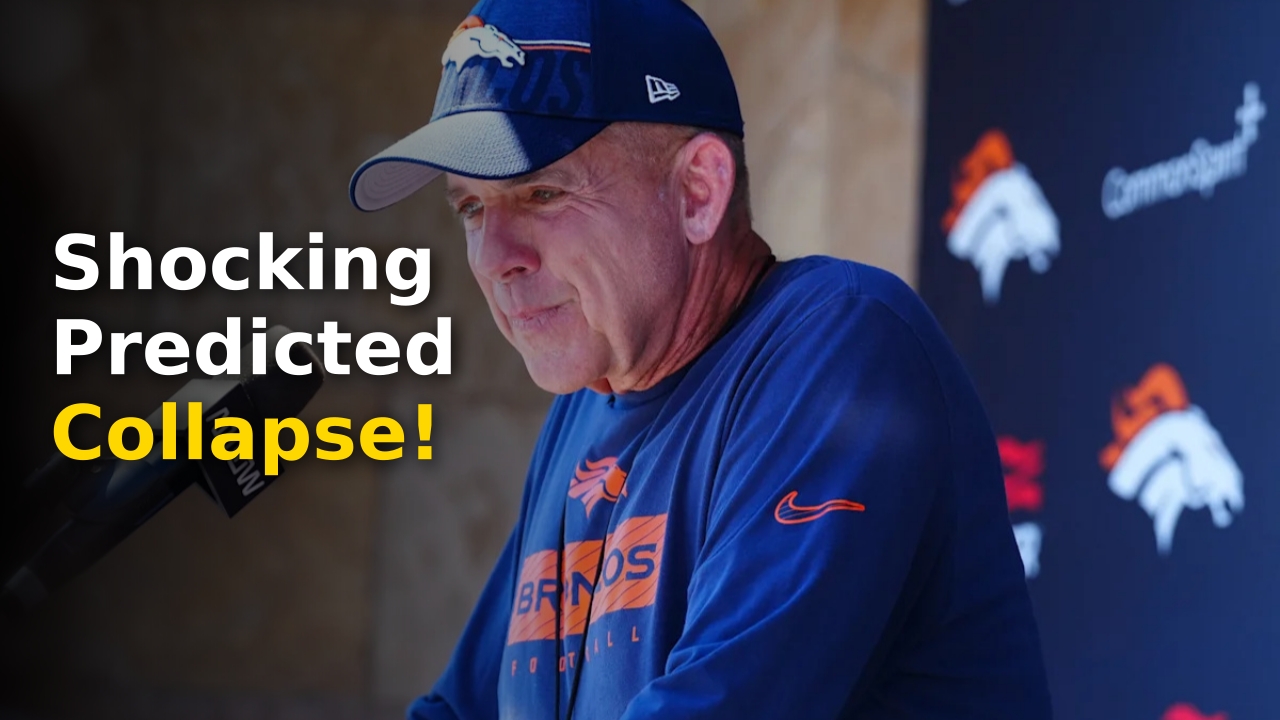
The possibility of a Broncos regression has sent shockwaves through the Mile High City, especially after the team dominated the AFC just a year ago.
You might find it hard to believe that a team coming off a 14-3 season could suddenly be labeled a playoff longshot, but the latest data from league insiders suggests a cold front is moving into Denver. If you are a fan of the Orange and Blue, these predictions from the experts at NFL.com might feel like a punch to the gut after years of waiting for a return to glory.
Can Sean Payton really keep the momentum going, or was the 2025 season a beautiful mirage that is about to evaporate under the pressure of a brutal 2026 schedule? Let’s break down why the national media is suddenly so bearish on a team that looked unstoppable only months ago.
Broncos regression: The Shocking NFL Forecast
When Ali Bhanpuri and Tom Blair released their latest projections, the mood in Denver shifted from celebration to concern regarding a potential Broncos regression. Bhanpuri has the team clinging to the No. 7 seed by their fingernails, while Blair expects them to miss the dance entirely, representing a massive fall from their No. 1 seed status in 2025.
This isn’t just about losing a few games; it’s about a fundamental shift in how the league views the roster’s sustainability in a high-octane division. You have to look back at the 2024 season to see where this journey started, when Sean Payton finally ended the playoff drought that had haunted the franchise since Super Bowl 50. That Wild Card loss to the Buffalo Bills was supposed to be a stepping stone, not a peak.
In 2025, the team looked like a juggernaut, steamrolling opponents behind a resurgent defense and the emergence of a franchise quarterback. But the NFL is a league of “what have you done for me lately,” and the experts believe the 14-3 record inflated expectations beyond reality. The parity in the NFL often forces elite teams back to the middle of the pack, and Denver seems to be the primary candidate for this trend.
Why Analysts Are Skeptical
- The loss of key veteran leadership in the locker room during the late offseason.
- A lack of significant depth behind the starting offensive line.
- Historical trends showing 14-win teams often drop 3-4 games the following year.
- The psychological toll of a devastating injury to the starting quarterback.
- Over-reliance on young players who haven’t faced a first-place schedule.
- Increasing coaching stability in rival organizations like the Chargers.
The 2026 season presents a gauntlet that few teams are equipped to handle, let alone one dealing with internal recovery. You see, the schedule makers haven’t done Denver any favors, pitting them against every heavy hitter in the AFC. This level of competition exposes every minor flaw that a team might have hidden during a luckier run the previous year.
Furthermore, the defensive statistics from last year suggest they were playing above their talent level, benefiting from an unusually high turnover margin. If that luck dries up, the Broncos regression becomes an inevitability rather than a theory. Fans are hoping the “Payton Effect” is enough to override the math, but the numbers are rarely that kind.

The Bo Nix Health Crisis
At the center of any potential Broncos regression is the health and stability of quarterback Bo Nix. The young signal-caller was the engine behind the 2025 success, providing a dual-threat capability that kept defensive coordinators awake at night. However, a broken ankle suffered late in the year has completely changed the trajectory of his career development.
Recovering from a major lower-body injury is never easy, especially for a quarterback who relies on mobility to extend plays. You have to wonder if Nix will have the same escapability when Maxx Crosby or Joey Bosa is bearing down on him in a crucial divisional matchup. If he is a stationary target, the entire Sean Payton playbook has to be rewritten, likely becoming more predictable and easier to defend.
The team is also facing the reality that a broken ankle often leads to secondary injuries as players compensate for their lack of balance. If Nix misses even three or four games, the backup situation in Denver is questionable at best. In the hyper-competitive AFC, a month of mediocre quarterback play is the difference between a first-round bye and watching the playoffs from a couch in Cherry Creek.
Critical Factors for Nix
- The speed of his lateral movement in the pocket during training camp.
- Trust in his offensive line to protect his blind side during recovery.
- The chemistry with new receivers while limited in full-speed practice reps.
- Mental toughness to stay aggressive after a traumatic physical setback.
When you look at the history of the Denver Broncos, quarterback health has always been the dividing line between championship runs and losing seasons. From the John Elway era to the Peyton Manning years, the team has always been one hit away from disaster. In 2026, that hit has already happened, and the fallout is just beginning to be measured.
Even with the addition of elite talent, the quarterback is the sun that the rest of the roster revolves around. If Bo Nix is only 80% of his former self, the team’s ceiling drops from Super Bowl contender to a desperate scramble for the seventh seed. It is a harsh reality that the coaching staff is trying to mitigate with a more conservative game plan.
The Jaylen Waddle Acquisition Trap
On paper, trading for Jaylen Waddle was a masterstroke by the front office to help prevent a Broncos regression. Adding a world-class burner to an offense that already had solid pieces should have made them the favorites in the AFC West. However, some analysts worry that the cost of the trade stripped the team of draft capital needed to bolster a thinning defensive secondary.
Waddle brings elite speed and the ability to turn a five-yard slant into a seventy-yard touchdown, which is exactly what a recovering Bo Nix needs. But if the defense can’t stop the Kansas City Chiefs or the Los Angeles Chargers, it won’t matter how many points the offense puts up. The trade represents a “win now” mentality that could backfire if the immediate results aren’t spectacular.
You also have to consider the salary cap implications of such a massive move for a star wideout. Denver is now heavily invested in a few top-tier stars, leaving them vulnerable to injuries across the rest of the roster. This top-heavy approach is exactly what leads to mid-season collapses when the grind of the 17-game schedule begins to take its toll on the veterans.
Waddle vs. The Field
- How he fits into the short-passing game designed for a limited Nix.
- The pressure to perform as the highest-paid player in the receiving room.
- Compensating for the loss of draft picks used to acquire his services.
- Navigating the luxury world of celebrity athlete lifestyle in a new city.
Integrating a high-volume receiver into a new system takes time, and time is a luxury the Broncos don’t have. With a first-place schedule, they face elite cornerbacks nearly every week. If Jaylen Waddle and Bo Nix don’t find an instant rhythm, the offense could stagnate early in the season, putting immense pressure on the defense to be perfect.
The media circus surrounding the trade also adds a layer of distraction that Sean Payton usually hates. Every dropped pass or missed route will be scrutinized under the microscope of the Denver press. For a team trying to prove the 2025 season wasn’t a fluke, this added noise might be the catalyst for the very Broncos regression they are trying to avoid.

Data Analysis: 2025 vs 2026 Outlook
To understand the depth of the Broncos regression fears, you have to look at the statistical shift expected between their dominant 2025 campaign and the projected 2026 hurdles. The numbers tell a story of a team that caught lightning in a bottle and is now facing the inevitable storm of regression to the mean.
| Metric Category | 2025 Performance | 2026 Projection |
|---|---|---|
| Overall Record | 14-3 (No. 1 Seed) | 9-8 / 10-7 |
| Turnover Margin | +12 (League High) | +2 (Projected) |
| Schedule Strength | 22nd Easiest | 4th Toughest |
| QB Passing Yards | 4,150 (Bo Nix) | 3,600 (Projected) |
| Points Per Game | 28.4 | 23.1 |
As you can see, the projected drop in nearly every major category is startling. The strength of schedule jump from 22nd to 4th is perhaps the most damning piece of evidence for the Broncos regression. In the NFL, playing a “first-place schedule” means you don’t get the easy wins against struggling divisions that padded the 14-3 record last year.
Instead, every single game is a fight for survival against playoff-caliber opponents. When you combine that with a projected decrease in turnover luck, the margin for error disappears. The defense will have to work twice as hard to get half the results, which often leads to burnout and late-game fatigue in the final stretch of the season.
The scoring projection is also a major red flag. If Denver drops five points per game, they transform from an elite offense to a league-average unit. In a division with Patrick Mahomes and Justin Herbert, being average on offense is a recipe for a third-place finish. Fans in Denver are used to high-flying football, but 2026 might be a year of grinding out ugly wins—or even uglier losses.
The AFC West Arms Race
You can’t talk about a Broncos regression without mentioning the terrifying growth of their divisional rivals. The Kansas City Chiefs are never going away as long as Andy Reid is on the sideline, and the Los Angeles Chargers have finally found their identity under new leadership. The AFC West has officially become the toughest neighborhood in professional football.
Last year, the Broncos benefited from the Chargers being in a state of flux and the Raiders struggling with consistency. In 2026, both of those teams have significantly improved their rosters and coaching staffs. This means Denver no longer has “guaranteed” wins on their schedule, even at home in the thin air of Mile High. Every divisional game is now a coin flip that could decide their playoff fate.
The Raiders have also bolstered their defensive front, specifically targeting the mobility of Bo Nix. They’ve built a unit designed to exploit his recovery and force him into making quick, pressured decisions. If the Broncos can’t sweep at least one of their rivals, their path to the postseason becomes nearly impossible given the difficulty of their non-divisional matchups.
Rivalry Threats in 2026
- Chiefs’ revamped receiving corps providing deeper threats for Mahomes.
- Chargers’ improved offensive line protecting Herbert more effectively.
- Raiders’ aggressive defensive schemes specifically countering the Payton system.
- The hostile environment in road games against improving fanbases.
The psychological pressure of playing in the AFC West is unlike any other division. You are constantly compared to the gold standard of the Chiefs, and any slip-up is magnified tenfold. For a Broncos team trying to prove they belong at the top, the constant threat of these rivals creates a high-stress environment that can easily lead to a mid-season spiral.
Ultimately, the Broncos regression might not be about Denver getting worse, but about everyone else getting much better. In a zero-sum game like the NFL, standing still is the same as falling behind. If Sean Payton hasn’t evolved his tactics to account for the improvements in Kansas City and LA, his team will be left in the dust of the AFC West race.
Final Verdict on Broncos regression
Is the predicted Broncos regression a mathematical certainty or just offseason chatter? While the analysts at NFL.com make a compelling case based on schedule difficulty and injury concerns, you can never count out a coach with the pedigree of Sean Payton. He has built winners before and knows how to navigate a crisis better than most in the business.
However, the 14-3 high of 2025 was always going to be difficult to repeat. The combination of a hobbled Bo Nix and the brutal first-place schedule creates a perfect storm for a reality check. If the team can manage to finish 10-7 and sneak into the playoffs, it should be considered a successful navigation of a very difficult year, rather than a failure to meet the 14-win standard.
Expectations are a dangerous thing in sports. For the Broncos, the goal in 2026 isn’t just to match last year’s record, but to ensure they are healthy and peaking by the time January rolls around. Whether they slide to the No. 7 seed or miss out entirely, the Broncos regression will be the most talked-about story in the AFC this season. Only time will tell if the Mile High magic has enough left in the tank to defy the experts one more time.
More Like This
For more updates, check out our latest entertainment and sports news.