⚡ Key Takeaways
- Portuguese star Pedro Neto has successfully transitioned from a traditional winger to a dynamic right wing-back under Chelsea boss Xabi Alonso.
- Chelsea’s tactical shift mirrored the legendary 2016-17 system of Antonio Conte, who famously converted Victor Moses into a title-winning wing-back.
- Advanced data from Chelsea’s 4-3 victory over Brighton reveals how Neto dominated both defensive recoveries and final-third creation.
- With a £100 million price tag hovering over him, Neto’s newly found tactical versatility makes him one of the most unique profiles in elite European football.
You probably did not expect to see Pedro Neto tearing up the Stamford Bridge touchline as a defensive-minded wing-back, but Xabi Alonso’s latest tactical gamble has completely rewritten the Chelsea playbook. In a thrilling 4-3 victory over Brighton, the Portuguese international was deployed in this hybrid role, locking down the defensive flank while simultaneously acting as Chelsea’s primary attacking outlet. This tactical masterstroke mirrors historical transformations in Premier League history, offering the Blues a devastating weapon that blends elite defensive tracking with world-class wing play.
The sheer flexibility of Pedro Neto allows Chelsea to transition seamlessly between defensive resilience and high-octane attacking transition phases. By occupying this specialized role, he provides an elite tactical solution that traditional full-backs simply cannot match in modern systems. Let’s dive deep into how this defensive shift occurred and why it could define Chelsea’s campaign under their new tactical mastermind.
The Pedro Neto Tactical Revolution Explained
The profile needed to play wing-back in elite modern football is exceptionally rare and highly demanding. It requires a perfect physical equilibrium between the tracking duties of a full-back and the explosive creativity of an elite winger. Converting a traditional winger into a wing-back is easier said than done, as players often lack the positional awareness required to defend deep zones. However, Xabi Alonso has unlocked a new dimension in the Portuguese attacker, utilizing his raw acceleration to control the entire right flank.
During the intense home clash against Brighton, Chelsea operated in a fluid tactical system that shifted based on the phase of play. When defending deep, the Portuguese star dropped next to French defender Wesley Fofana, forming a compact back five that denied Brighton space in the channels. When Chelsea established possession near the halfway line, the shape transformed into a balanced 4-4-2, allowing him to occupy advanced positions. His disciplined tracking back stopped Brighton from exploiting the switch of play, freeing Fofana to dominate his central zone.
This defensive awareness prevented Brighton from overloading Chelsea’s right-hand side during critical transitional moments. Yet, it was his offensive contribution that truly electrified the Stamford Bridge crowd from the opening whistle. His relentless threat down the right flank forced the corner sequence that allowed Belgian midfielder Romeo Lavia to open the scoring. By combining defensive grit with world-class attacking instincts, he proved that he is far more than a simple emergency defensive option.
Expert Take: The Wing-back Paradox
Tactical analysts point out that Xabi Alonso is replicating his Bundesliga blueprint at Stamford Bridge. At Bayer Leverkusen, Alonso turned Jeremie Frimpong and Alejandro Grimaldo into the most dangerous wing-back pairing in Europe by giving them structural freedom. Deploying a natural winger like the Portuguese star on the right side allows Chelsea to manipulate opposition defensive blocks, creating massive numerical overloads that are virtually impossible to track over ninety minutes.

Analyzing the Brighton Masterclass on Film
A close inspection of the match footage reveals how effectively the new wing-back system dismantled Brighton’s defensive structure. In the fourth minute of the match, the Portuguese international received possession and played a crisp pass to Morgan Rogers. Instead of making a traditional run down the line, he dummied a move toward the byline and instantly exploded into the half-space. This intelligent off-ball movement completely tricked Brighton’s left-back, Ferdi Kadioglu, creating enough separation for a dangerous cross that Lewis Dunk had to block out for a corner.
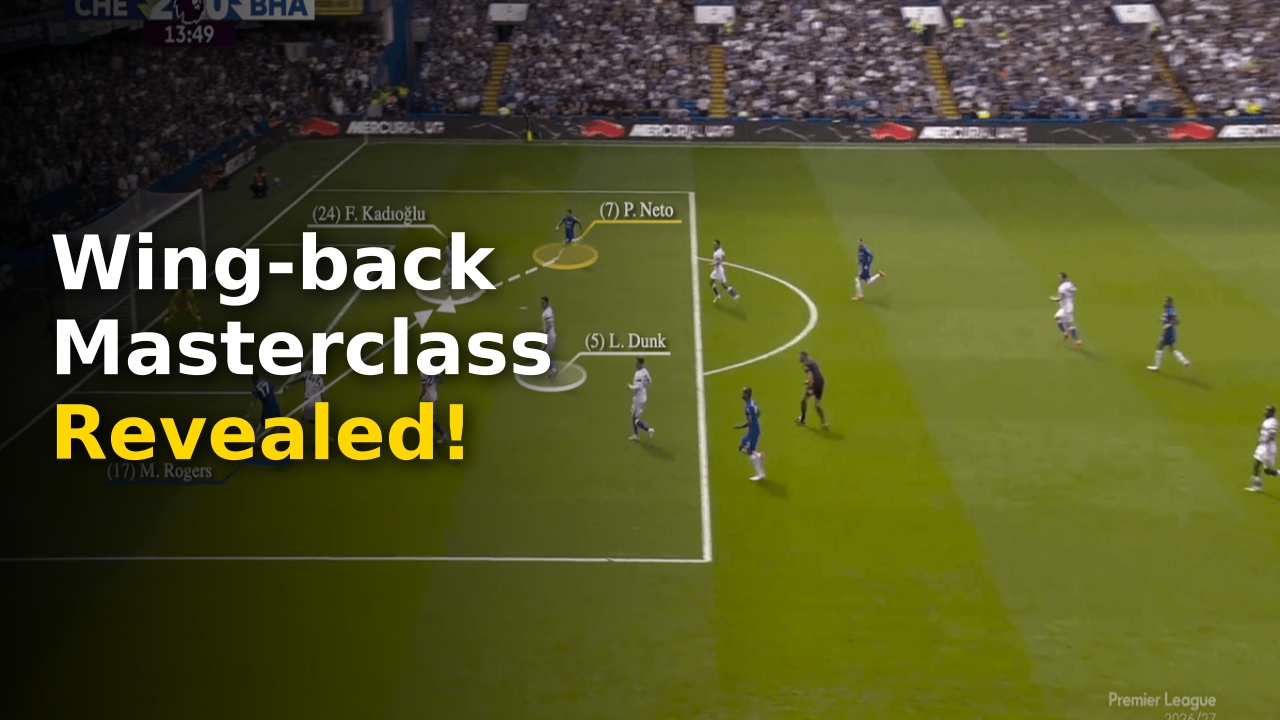
The tactical intelligence of the Portuguese attacker was even more apparent during Chelsea’s second goal in the fourteenth minute of play. The sequence began with Jorrel Hato taking a quick throw-in toward Joao Pedro, who flicked the ball into the path of the advancing Rogers. Recognizing that Dunk had stepped out of position to challenge the flick-on, Chelsea’s new wing-back initiated a devastating run from Kadioglu’s blind side. As Rogers dribbled past Luka Vuskovic, the winger-turned-wing-back sliced into the central penalty box, changing direction perfectly to latch onto a cutback and double Chelsea’s lead.
His electric pace also made Chelsea incredibly dangerous during rapid counter-attacking situations. In the build-up to the third goal, he started his recovery run deep in his own half as Hato carried the ball forward. Despite starting several yards behind Kadioglu, his incredible acceleration allowed him to bypass his marker at the back post. While Joao Pedro ultimately finished the chance himself, Chelsea’s right wing-back was perfectly positioned to tap the ball home had a pass been played.
This constant offensive threat kept Brighton’s defensive line pinned back, preventing their full-backs from joining the attack. In the twenty-fifth and fifty-eighth minutes, he again used his physical superiority to isolate Kadioglu in one-on-one situations. These sequences nearly resulted in two more goals, showcasing how a wing-back with elite winger qualities can completely dominate an entire side of the pitch.
Historical Precedents and Tactical Comparisons
This tactical transformation inevitably draws comparisons to one of the most famous positional shifts in Premier League history. During the 2016-17 season, Chelsea’s then-head coach Antonio Conte produced a stroke of genius by converting Nigerian winger Victor Moses into a right wing-back. Moses, who had previously struggled to find regular game time at Stamford Bridge, became the cornerstone of a historic title-winning campaign. Like Moses, the Portuguese star possesses the incredible stamina and direct running power required to control an entire flank alone.
However, the modern game demands a higher level of technical security in tight spaces than it did a decade ago. While Moses relied primarily on physical power and linear running, Chelsea’s current wing-back offers elite playmaking, sophisticated passing, and supreme ball retention. This allows Xabi Alonso to build play directly through his wing-backs, rather than using them solely as outlet options. While many fans look to the glitz and glamour of sports stars on portals like BrightCelebrity, the real magic happens in the tactical trenches of Cobham.
The shift also highlights the tactical evolution of Chelsea’s overall squad assembly over the last several transfer windows. Previous managers struggled to balance the team’s immense attacking talent with defensive solidity. Alonso’s use of an asymmetrical wing-back system solves this issue, allowing Chelsea to field multiple creative players without sacrificing defensive coverage. It is a modern solution to a classic tactical puzzle, and it is already yielding massive dividends on the pitch.
Statistical Breakdown of the New Wing-back Role
To fully appreciate the physical and tactical demands of this role, we must examine the numbers behind the transition. The Portuguese star’s performance against Brighton highlighted a massive spike in defensive interventions compared to his traditional winger metrics. His high-intensity sprint count also saw a significant increase, reflecting the box-to-box nature of the modern wing-back role under Xabi Alonso.
| Player Metric (Per 90 Minutes) | As Traditional Winger (Wolves) | As Chelsea Wing-back (vs Brighton) |
|---|---|---|
| Tackles & Interceptions | 0.8 | 3.4 |
| Touches in Opposition Box | 5.2 | 4.1 |
| Key Passes & Crosses | 2.1 | 3.8 |
| Distance Covered (KM) | 9.4 | 11.8 |
The statistical data illustrates that while his touches in the box decreased slightly, his overall creative output increased. This is because playing deeper allows him to face the game, giving him a clearer view of the pitch to pick out dangerous passes. His defensive output quadrupled, proving that he has fully embraced the physical sacrifices required to play under Alonso’s demanding tactical regime.

Frequently Asked Questions
Why did Xabi Alonso play Pedro Neto at wing-back?
Alonso deployed him at wing-back to exploit his world-class speed in transition while providing defensive coverage against Brighton’s dangerous wide players. The role allowed Chelsea to morph from a solid back five in defense to an expansive attacking system in possession.
How does Pedro Neto compare to Victor Moses?
While both players transitioned from wingers to wing-backs under Chelsea managers, the Portuguese star offers superior technical playmaking and creative passing. Moses relied more on raw physical endurance, whereas Alonso’s wing-back operates as an advanced tactical playmaker.
Is Pedro Neto leaving Chelsea this summer?
Despite heavy transfer interest from elite European clubs and a valuation of around £100 million, Chelsea boss Xabi Alonso has emphasized his importance to the squad. Alonso praised his unique qualities, energy, and competitive spirit, signaling he will remain a crucial piece of the puzzle.
The Future of Pedro Neto at Stamford Bridge
As the transfer window closes, Chelsea’s astronomical £100 million valuation of their Portuguese star looks completely justified. Major sports networks like ESPN have highlighted how rare these multi-functional profiles are in the modern market. Xabi Alonso’s post-match comments reflected immense satisfaction with the player’s energy, competitiveness, and tactical discipline during the Brighton victory. By proving he can defend at an elite level, he has elevated his status from a luxury winger to an indispensable tactical weapon.
Chelsea’s other wing-back options, such as Malo Gusto or Reece James, offer fantastic defensive stability but lack the explosive one-v-one dribbling ability of a natural winger. Deploying Pedro Neto in this role gives Alonso the tactical flexibility to break down deep defensive blocks that have historically frustrated Chelsea. If this transition continues to yield positive results, the Blues might have just unlocked the most devastating tactical masterstroke of the Premier League season.
More Like This
For more updates, check out our latest entertainment and sports news.