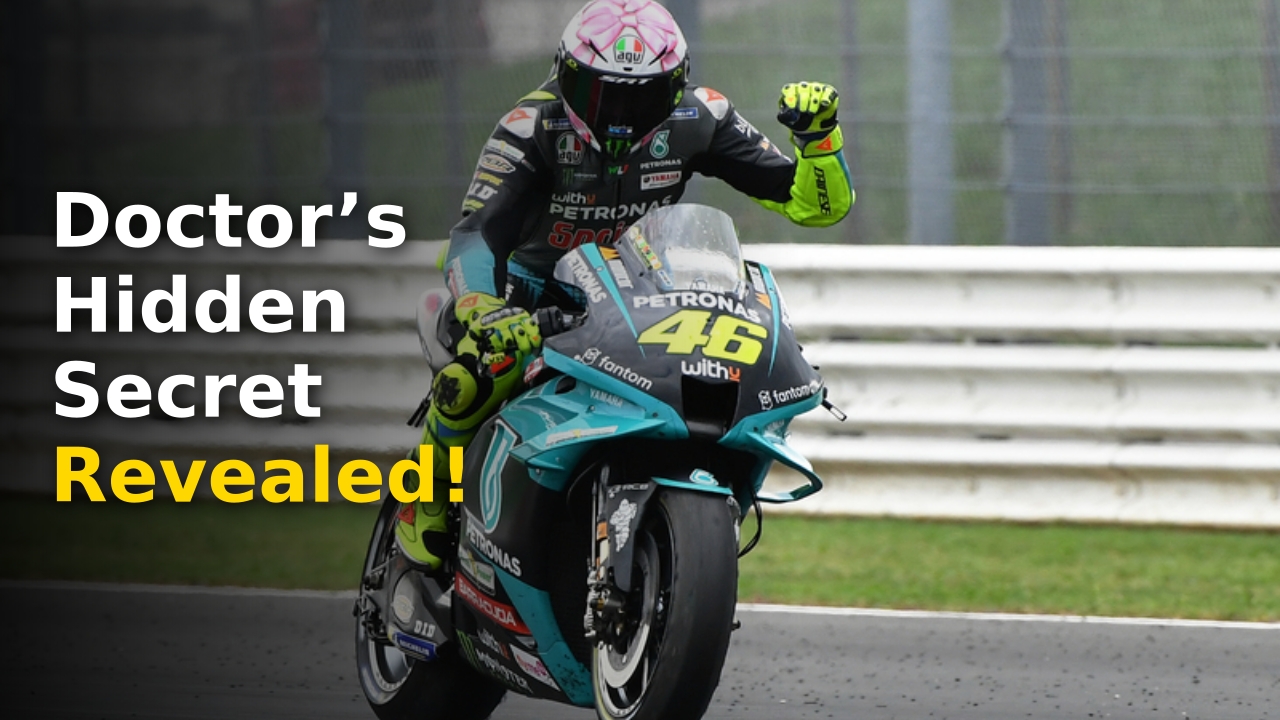
⚡ Key Takeaways
- Valentino Rossi possesses a rare ‘mechanical empathy’ that allows him to interpret bike feedback as a literal conversation.
- Jonas Torstensson of Öhlins reveals that Rossi’s technical feedback was more accurate than digital sensors during his peak years.
- The Italian legend’s ability to translate vibrations into engineering solutions revolutionized the development of the Yamaha YZR-M1.
- Despite retiring years ago, Rossi’s influence on suspension technology and rider-to-engineer communication remains the gold standard in MotoGP.
Valentino Rossi is a name that resonates through the canyons of history as more than just a nine-time World Champion; he is a mechanical whisperer who bridged the gap between man and machine. You might think you know everything about the ‘The Doctor,’ but the true secret to his longevity and dominance lies in a supernatural sensitivity to the metal and rubber beneath him.
Recent revelations from the upper echelons of MotoGP engineering suggest that his success wasn’t just about bravery or late braking. It was about a dialogue that few human beings are capable of sustaining at speeds exceeding 200 miles per hour.
The Supernatural Legacy of Valentino Rossi
Valentino Rossi has left an indelible mark on the world of motorcycle racing, a footprint so large that even five years after his official retirement, his name dominates technical discussions. The aura surrounding the Italian icon was recently reignited by Jonas Torstensson, the racing manager for the prestigious Swedish suspension manufacturer, Öhlins.
Torstensson’s insights provide a rare glimpse into the internal workings of a racing genius who viewed his motorcycle not as a tool, but as a living entity. This perspective allowed Rossi to dominate various eras of the sport, from the raw power of the 500cc two-strokes to the sophisticated electronics of the modern 1000cc four-strokes.
The relationship between a rider and their suspension is perhaps the most critical element of a Grand Prix bike’s setup. According to Wikipedia, Rossi’s career spanned over two decades, allowing him to witness the total transformation of racing technology, yet his fundamental approach to ‘listening’ to the bike remained unchanged.
Engineering experts have long noted that while data loggers can record what a bike is doing, they cannot always explain why it is doing it in the context of a rider’s psychology. This is where the specific ‘magic’ of Valentino Rossi became the ultimate weapon for teams like Honda and Yamaha throughout the 2000s.

The Evolution of Mechanical Empathy
Mechanical empathy is a term often used in racing to describe a driver who knows exactly how much stress a component can take before it fails. For Rossi, this empathy went several levels deeper, into the realm of harmonic resonance and subtle weight transfers that even the most sensitive sensors of the time struggled to pick up.
His long-time crew chief, Jeremy Burgess, often spoke of Rossi’s ability to return to the pits and describe a specific chatter in the front fork that only occurred at a precise lean angle and throttle opening. This level of granular detail allowed the team to make adjustments that were often counter-intuitive to the data but resulted in significant lap-time improvements.
- Rossi could identify tire carcass deformation before it showed up as a temperature spike in the telemetry.
- He possessed the unique ability to ‘filter’ out environmental noise like track bumps to focus on the engine’s internal health.
- His feedback loops were so fast that he often adjusted his riding style mid-race to compensate for mechanical degradation.
How The Doctor Communicates with Machines
The core of the recent buzz surrounding Valentino Rossi involves the claim that the motor literally ‘talked’ to him. While this sounds like poetic license, in the high-stakes world of MotoGP, it refers to the sensory feedback transmitted through the handlebars, footpegs, and seat—a language of vibrations and resistance.
Torstensson explained to Marca.com that Rossi had something special: the ability to translate these mechanical signals into a human language that engineers could act upon. This translation layer is often the biggest hurdle in racing, as many fast riders are unable to articulate why they are fast or where the bike is failing them.
When Rossi rode, he wasn’t just managing the throttle; he was conducting an orchestra of mechanical components. If the suspension lacked the necessary ‘feel’ at the apex, he didn’t just say the bike was ‘bad’; he described the specific speed of the rebound and how it affected the bike’s ability to turn on a dime.
This ‘conversation’ allowed the Swedish experts at Öhlins to refine their products to a level of perfection that benefited every other rider on the grid. In many ways, the entire MotoGP field owes a debt of gratitude to Rossi’s sensory organs, which served as the ultimate R&D laboratory for decades.
Expert Take: The Human Sensor
From a technical standpoint, the human nervous system is capable of detecting frequencies that digital sensors sometimes miss due to sampling rates. An expert analysis of Rossi’s data suggests his ‘sampling rate’ of the bike’s behavior was effectively higher than the electronics of the early 2000s. By the time the data was downloaded, Rossi had already solved the problem in his head, proving that the human element remains the most vital component in elite motorsports.
Öhlins and the Science of Feeling
To understand the depth of Rossi’s contribution, one must look at the history of Öhlins. The company achieved its first 500cc world title with Eddie Lawson in 1984, and since then, they have collected data from the greatest legends of the sport. Yet, among all those titans, Valentino Rossi stands out as a unique contributor to their technical database.
The suspension on a MotoGP bike is a complex system of shims, oils, and valves that must respond to forces in milliseconds. Without accurate feedback from the rider, engineers are essentially throwing darts in the dark. Rossi’s ability to pinpoint the exact moment a fork would ‘tuck’ or a shock would ‘bottom out’ was legendary among the Swedish technicians.
This relationship was mutually beneficial. As Rossi pushed the boundaries of what a bike could do, Öhlins pushed the boundaries of what their hardware could handle. This symbiotic relationship helped Yamaha overcome the massive technical deficit they faced when Rossi joined them from Honda in 2004.
The transition from the Honda RC211V to the Yamaha YZR-M1 is a case study in how a rider’s intuition can outweigh a competitor’s budget. Rossi took a bike that was considered an ‘also-ran’ and turned it into a world-beater by systematically ‘talking’ the engineers through every flaw in the chassis and suspension.

By The Numbers: The Rossi Development Impact
To quantify the ‘Rossi Effect,’ we can look at the rapid development of the Yamaha M1 between 2003 and 2005. Before Rossi, Yamaha had gone years without a premier-class title. Within one season of his arrival, the bike’s win rate skyrocketed, a feat largely attributed to his technical feedback and the subsequent overhaul of their suspension and chassis geometry.
| Era | Team | Key Technical Contribution | Championships |
|---|---|---|---|
| 500cc 2-Stroke | Nastro Azzurro Honda | Mastering power delivery without electronics | 1 |
| 990cc 4-Stroke | Repsol Honda | Optimizing the V5 engine’s torque curve | 2 |
| 800cc/1000cc | Yamaha Factory | Developing the ‘Big Bang’ firing order and chassis feel | 4 |
| Late Career | Petronas/Yamaha | Refining Michelin tire longevity and braking stability | 0 (Top 10 focus) |
Mapping the Career of Valentino Rossi
To understand why the motor ‘talked’ to him, one must examine the environment in which Valentino Rossi was raised. As the son of Graziano Rossi, a former Grand Prix winner, Valentino was immersed in the language of motorcycles before he could even walk. This early exposure wired his brain to process mechanical information differently than riders who started later in life.
Throughout his career, Rossi was known for his ‘Sunday magic.’ He would often struggle during Friday and Saturday practice sessions, appearing to be off the pace. However, during these sessions, he was actually ‘interviewing’ the bike, gathering the data he needed to make a final, decisive setup change for the race.
His rivals, from Max Biaggi to Casey Stoner and Jorge Lorenzo, often expressed frustration at how Rossi could suddenly find half a second of pace on race morning. The answer was simple: he had finally convinced the bike to do what he wanted through a series of incremental mechanical conversations. For more insights into the lives of global icons, check out Bright Celebrity.
This deep-seated connection to the machine also explains why Rossi struggled during his two-year stint at Ducati. The Desmosedici of that era was famously ‘deaf’ to rider input, featuring a carbon-fiber chassis that provided very little feedback. Even for a whisperer like Rossi, the communication lines were cut, leading to the most difficult period of his illustrious career.
The Psychological Component of Racing
It is not just about the physics; it is about the belief. When Rossi felt the bike was talking to him, it built a level of confidence that allowed him to take risks others wouldn’t dare. He knew exactly where the limit was because the machine told him so. This psychological edge is what defined his ‘Doctor’ persona—he could diagnose a bike’s illness and prescribe the cure mid-race.
His ability to maintain this level of focus for over 400 Grand Prix starts is perhaps the greatest feat in sporting history. Most riders experience ‘burnout’ as the mental toll of interpreting high-speed data becomes too much. Rossi, however, seemed to gain energy from the process, treating every technical challenge as a puzzle to be solved.
Frequently Asked Questions
Did Valentino Rossi really talk to his bike?
While he didn’t use vocal cords, Rossi engaged in a sophisticated sensory dialogue with the machine. He used the vibrations, sounds, and resistance of the motorcycle to understand its limits, which engineers like Jonas Torstensson described as the bike ‘talking’ to him.
Who is Jonas Torstensson and why does his opinion matter?
Jonas Torstensson is a racing manager at Öhlins, the world’s leading manufacturer of high-performance suspension systems. His perspective is vital because he has access to the telemetry and feedback of almost every top rider in MotoGP history, making his praise of Rossi highly significant.
What made Rossi’s feedback unique compared to other riders?
Most riders can tell if a bike is fast or slow, but Rossi could identify the specific mechanical cause of a behavior. He could translate vague feelings into concrete engineering instructions, such as needing a specific change in shim stack configuration or chassis stiffness.
Is Rossi still involved in MotoGP today?
Yes, although he is retired from riding, he remains a massive figure in the paddock. He owns the VR46 Racing Team and runs the VR46 Riders Academy, where he passes on his ‘mechanical whispering’ secrets to the next generation of Italian champions like Francesco Bagnaia.
The Future of Motorcycle Racing Intuition
In an era where artificial intelligence and thousands of sensors dominate the paddock, the question arises: is there still room for a rider like Valentino Rossi? The consensus among experts like those at ESPN is a resounding yes. While data can tell you what happened, it still takes a human brain to decide what should happen next.
The ‘kesaktian’ or supernatural power of Rossi wasn’t actually magic; it was the result of a lifetime of dedication, an obsession with detail, and a brain that was uniquely tuned to the frequency of internal combustion. He proved that even in a world of cold logic and hard data, the human connection to the machine is the ultimate performance differentiator.
As we look to the future, the legacy of Valentino Rossi serves as a reminder that the best racers are not just pilots; they are translators. They are the bridge between the digital world of the engineer and the physical world of the racetrack. The Doctor may have hung up his leathers, but the conversation between man and machine that he perfected will continue to echo through the turns of Mugello and Misano for eternity.
Whether he was winning on a Honda, a Yamaha, or nurturing talent in his academy, Rossi’s ‘secret’ was always his ability to listen. In a sport that is often too loud, the man who could hear the whispers of the engine was always destined to be King.
More Like This
For more updates, check out our latest entertainment and sports news.