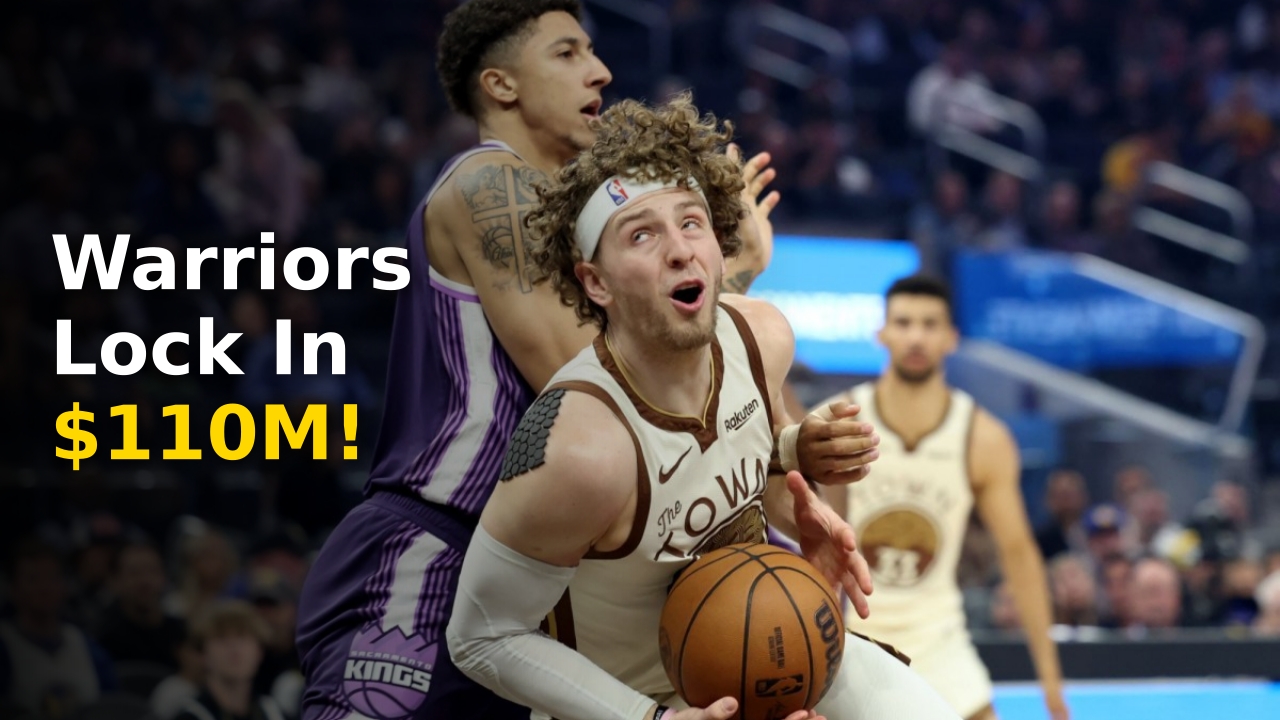
Key Takeaways
| Massive Commitment: Brandin Podziemski agreed to a five-year, $110 million rookie scale contract extension with the Golden State Warriors. |
| Financial Blueprint: The extension starts at $18.9 million for year one, consuming barely 10.7% of the projected 2026-27 salary cap. |
| Long-Term Bridge: Podziemski joins rookie Yaxel Lendeborg as the only Golden State players under contract through the 2030s decade. |
| Max Cap Flexibility: Golden State retains roughly $60 million in projected cap space next summer as the contracts of Draymond Green and Jimmy Butler expire. |
You are watching the Golden State Warriors construct their next dynasty bridge before your very eyes, as the Brandin Podziemski extension officially locks down the 23-year-old guard through the 2031-32 season on a landmark five-year, $110 million agreement. First reported by ESPN’s Shams Charania, the deal secures one of the NBA’s premier all-around hustle players while preserving massive operational flexibility for front-office architect Mike Dunleavy Jr.
The agreement avoids a messy restricted free-agency negotiation next summer, steering Golden State clear of the prolonged drama that shadowed Jonathan Kuminga a season ago. By securing the dynamic combo guard before the October 19 rookie deadline, Golden State stabilizes its backcourt rotation for the twilight years of Steph Curry while maintaining a clean payroll ledger.
With superstar contracts across the league skyrocketing into historic territory, this mid-tier commitment signals a calculated masterclass in modern collective bargaining agreement management. Discover how the latest sports business updates reveal the shifting landscape of professional athlete compensation and franchise building blocks.

Brandin Podziemski Extension Secures Warriors Roster
The financial architecture behind the Brandin Podziemski extension reveals a calculated victory for Golden State’s balance sheet. Podziemski was projected to carry a $17 million cap hold into restricted free agency, yet his new starting salary sits at an extremely digestible $18.9 million for the 2026-27 campaign.
That microscopic difference allows Golden State to preserve an estimated $60 million in clean salary cap room next summer. That financial cushion arrives precisely when Draymond Green and veteran wing Jimmy Butler see their substantial contracts expire. Golden State now possesses the financial ammunition to chase blue-chip free agents while keeping a proven, high-IQ starter firmly in tow.
The league environment under the second tax apron has punished rigid payroll structures, making team-friendly veteran and scale contracts invaluable. By locking in a starting two-guard at roughly 10.7% of the total cap, the Warriors established cost control over a vital rotation slot. You can track comparable market trends across entertainment net worth analysis to see how elite athletes maximize long-term financial security under restrictive salary caps.
By The Numbers: Financial Roster Breakdown
Golden State structured this contract to maximize competitive leverage rather than burden their core with exorbitant penalty taxes. Examining how the extension fits against standard positional peer markets exposes how manageable this $110 million figure truly is across the next half-decade.
| Player | Team | Average Annual Value (AAV) | Contract Length |
|---|---|---|---|
| Brandin Podziemski | Golden State Warriors | $22.0 Million | 5 Years |
| Devin Vassell | San Antonio Spurs | $27.0 Million | 5 Years |
| Josh Hart | New York Knicks | $20.2 Million | 4 Years |
| Luguentz Dort | Oklahoma City Thunder | $16.5 Million | 5 Years |
| Max Strus | Cleveland Cavaliers | $15.7 Million | 4 Years |
Statistical Impact and Evolution Under Steve Kerr
Podziemski’s trajectory from unheralded collegiate transfer to high-usage starting guard represents an analytical triumph for Golden State’s scouting department. Selected 19th overall out of Santa Clara in the 2023 NBA Draft, he immediately validated the selection by earning an NBA All-Rookie First Team nod while securing 5.8 rebounds per game and drilling 38.5% from deep.
While his sophomore campaign featured nagging injuries that slowed his mechanical development, his third-year resurgence solidified his standing among Steve Kerr’s most trusted ball-handlers. He appeared in all 82 regular-season contests, earning 43 starting assignments while recording 13.8 points, 5.1 rebounds, and 3.7 assists per game on a career-high 45.5% shooting from the floor.
Defensively, his physical anticipation makes him an elite floor-spacing weapon despite not possessing prototypical wing athleticism. He ranked second in the entire NBA by drawing 15 charges last season, while his relentless offensive rebounding creates easy extra possessions for high-efficiency lineups. Kerr has repeatedly highlighted how Podziemski’s processing speed enables him to orchestrate off-ball movement seamlessly alongside Curry.
His ability to generate 2.9 free throw attempts per game while maintaining a reliable 37.1% three-point stroke forces defenses to respect him as both an initiator and a secondary release valve. As documented on Basketball Reference, guards who pair a 5.0+ rebounding rate with a positive assist-to-turnover ratio represent the backbone of winning playoff rotations.

The Santa Clara Pipeline and Golden State’s Future
Hailing from the Milwaukee metro area, Podziemski began his college basketball odyssey at Illinois before transferring to Santa Clara University to jumpstart his professional prospects. Under Herb Sendek, he exploded into the West Coast Conference Co-Player of the Year, continuing a remarkable mid-major renaissance that began with Oklahoma City star Jalen Williams.
Santa Clara had suffered a grueling 25-year first-round draft drought following Hall of Famer Steve Nash before Williams and Podziemski rewrote campus history. That pipeline widened even further this past summer when Toronto drafted Santa Clara standout Allen Graves with the 19th overall pick, confirming the program as an elite incubator of pro talent.
Golden State owner Joe Lacob has continuously viewed Podziemski as an untouchable foundational pillar during volatile trade windows. When the front office explored blockbuster discussions for Utah Jazz forward Lauri Markkanen, reporting confirmed Lacob personally blocked Podziemski’s inclusion in any outgoing trade package. That organizational faith has now been etched into contract ink.
Podziemski has never lacked swagger, famously declaring his intention to take the franchise mantle directly from Curry when the future Hall of Famer hangs up his sneakers. While he later tempered those comments to honor veteran decorum, that competitive edge mirrors the unshakeable confidence Golden State requires to sustain championship expectations across consecutive eras.
Chasing Superstars in Free Agency: Cap Space Targets
Securing the Brandin Podziemski extension at $110 million represents only phase one of Golden State’s grand 2026-27 masterplan. Curry laid the financial groundwork earlier this offseason by voluntarily taking $10 million beneath his designated maximum slot, leaving room for an unprecedented summer shopping spree.
Golden State projects to command roughly $60 million in operational spending power once Green and Butler clear the books. High-profile megastars including Denver Nuggets center Nikola Jokic and New York Knicks big man Karl-Anthony Towns could technically test the open market if contract options remain unexercised. Check our ongoing analysis of celebrity sports investments to see how front offices balance superstar salaries with depth chart continuity.
Podziemski’s plug-and-play profile makes him an ideal partner alongside any incoming franchise centerpiece. Because he does not dominate possession time or demand isolation sets, he can easily share the court with ball-dominant creators while maintaining defensive intensity and elite passing vision.
Alongside rookie forward Yaxel Lendeborg, Podziemski stands as one of only two Warriors players currently under legal contract into the 2030s decade. That status speaks volumes about how the front office views his leadership, work ethic, and adaptability as the legendary core inevitably prepares for retirement.
People Also Ask
What are the terms of the Brandin Podziemski contract extension?
Brandin Podziemski agreed to a five-year, $110 million contract extension with the Golden State Warriors that runs through the 2031-32 season, featuring a player or team option in the final year.
How does Podziemski’s deal impact Warriors salary cap space?
The extension starts at $18.9 million in year one, representing only 10.7% of the cap and allowing Golden State to preserve approximately $60 million in projected cap space next summer.
Why did the Warriors sign Podziemski before the October 19 deadline?
Signing before the deadline prevents Podziemski from entering restricted free agency next summer, avoiding costly bidding wars and lengthy contract negotiations.
What were Brandin Podziemski’s stats last season?
Podziemski played all 82 games, averaging 13.8 points, 5.1 rebounds, and 3.7 assists per game while shooting 45.5% from the field and 37.1% from three-point range.
Final Outlook for the Brandin Podziemski Extension
By executing this Brandin Podziemski extension, Golden State successfully navigated the tricky balance between honoring past championship glory and preparing for an uncertain future. Podziemski represents the prototype of the modern NBA glue guy: resilient, statistically impactful, and financially sensible under strict salary constraints.
As training camp wraps up in Hawaii with Podziemski solidified as the starting two-guard, Steve Kerr enters the regular season with defined backcourt certainty. Whether Golden State uses its upcoming cap flexibility to land another superstar or elevates Podziemski into primary playmaking duties, this five-year investment cements the Santa Clara standout as the undeniable heartbeat of Golden State’s next generation.
More Like This
For more updates, check out our latest entertainment and sports news.