Key Takeaways
| Production Debut | Mfoniso Udofia’s new work opens at Lincoln Center’s Claire Tow Theater. |
| Thematic Core | The play explores IVF, caretaking, and the immense pressure of artistic creation. |
| Structural Style | Features heavy third-person narration and self-reflexive commentary on writing. |
| Critical Debate | Sparks a wider conversation on meta-theatre trends in post-COVID productions. |
You might think that writing a high-profile theatrical production is a dream come true, but the reality of the creative process is often a bruising, isolating battle. The newly staged Mfoniso Udofia Play is igniting a passionate discourse across the American theater landscape by putting that exact struggle directly on center stage. Running at the prestigious Claire Tow Theater at Lincoln Center through November 1, “creation stories and all the important importants” exposes the psychological toll of creative commissions. It is a work that strips away the glamour of the arts, leaving behind a raw, polarizing portrait of an artist at her breaking point.
Audiences seeking traditional narrative arcs may find themselves challenged by the production’s highly unconventional, self-reflexive structure. Directed by Tamilla Woodard, this Off-Broadway staging serves as a deeply personal window into the life of a high-achieving Nigerian-American playwright. For more context on contemporary performance arts, you can check out the latest entertainment news updates. This play does not merely tell a story; it performs a relentless exorcism of the doubts and institutional pressures that haunt modern creators.
Analyzing the Mfoniso Udofia Play Structure
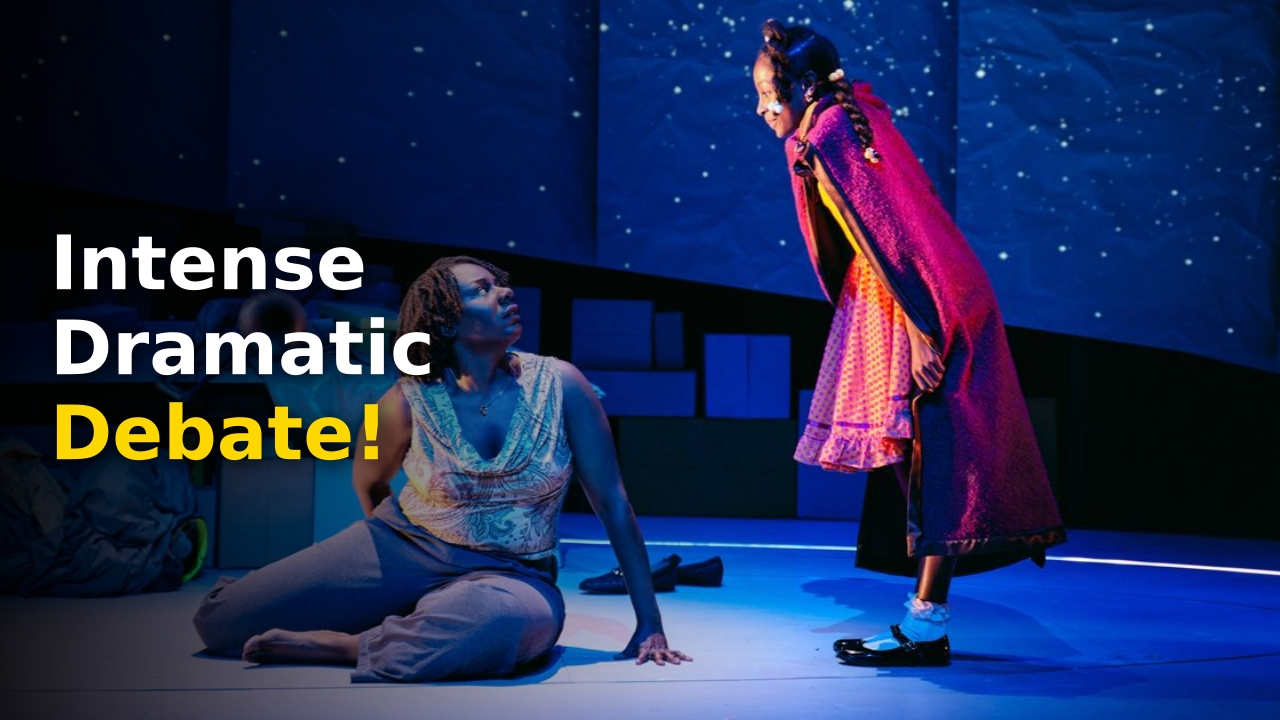
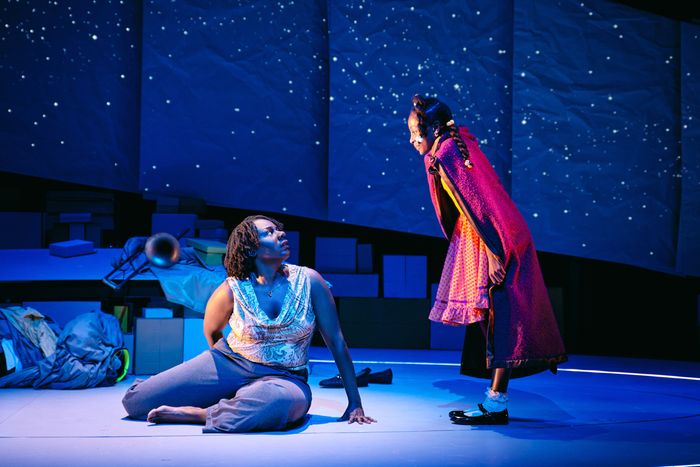
At the absolute heart of the Mfoniso Udofia Play is “thegrownwoman,” an onstage avatar portrayed with fierce physical commitment by Abigail C. Onwunali. The character is a highly successful forty-something playwright, teacher, and caretaker who mirrors Udofia’s real-life career trajectory and personal milestones. From the moment the lights rise, the audience is plunged directly into her fragmented subconscious. She is tormented by a recurring dream where a spirit creature, performed by Donetta Lavinia Grays, dances through her mind clad in traditional raffia. This spectral figure attempts to wake her to a deeper emotional truth that she is desperately trying to avoid.
Once awake, the protagonist attempts to control her chaotic life through a hyper-regimented, almost military routine. She barks orders to her smart-home devices and narrates her actions in the third person, repeating phrases like “thegrownwoman centers” and “thegrownwoman begins her day.” This repetitive, highly stylized vocal pattern dominates nearly two-thirds of the ninety-five-minute production. While this technique highlights her extreme psychological compartmentalization, it also presents a grueling challenge for the audience. The heavy-handed reiteration is designed to make the viewer feel the suffocating weight of her daily existence.
The Double-Edged Sword of Meta-Theater
This production belongs to a rapidly growing, highly visible post-COVID theatrical genre that critics describe as self-reflexive survival art. Rather than transforming personal pain into a fictionalized allegory, playwrights are increasingly choosing to write directly about the agonizing process of writing itself. This trend includes recent works like César Alvarez’s “The Potluck,” which spent significant runtime debating its own right to exist on a stage. While some theatergoers find this level of vulnerability deeply moving, others argue it borders on self-indulgence. It raises the essential question of whether a writer’s struggle to create is inherently compelling enough to sustain an entire theatrical production.
In the case of “creation stories,” this meta-theatrical framing is compounded by a complex web of heavy symbolism. As the protagonist balances her demanding teaching career, parental caretaking duties, and a high-stakes fifth round of IVF, she is constantly shadowed by a silent young girl. Played by Savannah Commodore, this child represents her younger self, full of uncorrupted optimism and artistic freedom. The contrast between the weary, mechanized adult and the playful, unburdened child serves as the play’s primary emotional engine. However, the symbolic delivery is highly conspicuous, leaving very little room for subtext or audience interpretation.
Behind the Scenes and By the Numbers
To truly understand the weight of this production, one must look at Udofia’s broader artistic footprint. She is the mastermind behind the monumental Ufot Cycle, a planned nine-play cycle tracing a Nigerian-American family across multiple generations. This ambitious cycle has garnered widespread critical acclaim, with major productions unfolding in theatrical hubs like Boston and New York. The sheer scale of such an artistic undertaking is practically unprecedented in contemporary American theater, putting immense pressure on each individual installment.
| Production Metric | Details & Figures |
|---|---|
| Playwright | Mfoniso Udofia |
| Venue | Claire Tow Theater at Lincoln Center |
| Running Time | 95 Minutes (No Intermission) |
| Ufot Cycle Scale | 9 Interconnected Plays |
| Key Themes | IVF, Creative Burnout, Diaspora Identity |
The Claire Tow Theater serves as the perfect incubator for these demanding, experimental works. As part of Lincoln Center Theater’s official website initiatives, the space is specifically designated for new, risk-taking voices. It offers a platform where playwrights can stretch the boundaries of traditional form without the commercial pressures of Broadway. This institutional backing is crucial for supporting diverse narratives and complex, non-linear storytelling styles in a changing cultural landscape.
For more insights on high-profile cultural events and the stars who bring them to life, explore our exclusive celebrity profiles. Understanding the financial and administrative structures behind these commissions helps contextualize why playwrights feel so deeply indebted to their institutions. A commission is not just an opportunity; it is a binding contract to extract one’s deepest emotions for public consumption. This constant cycle of emotional labor lies at the very heart of Udofia’s current dramatic inquiry.
Critical Reception and Creative Friction
The critical reception of “creation stories” has highlighted a profound division among modern theater critics and casual theatergoers alike. Some applaud the play for its radical transparency, praising its refusal to offer neat, comforting answers to complex emotional struggles. They view the protagonist’s circular, repetitive actions as a brilliant, realistic mimicry of clinical depression and creative block. By forcing the audience to endure the monotony of her routine, Udofia succeeds in conveying the paralyzing nature of trauma.
Conversely, more traditional critics argue that the production’s extreme self-consciousness ultimately alienates the viewer. In one controversial sequence, the audience is treated as the protagonist’s college playwriting class, receiving a lecture on dramatic theory. She contrasts the rigid structure of “Simon & Simon” with the non-linear, unpredictable plays of “Etienam Akpabio.” Both of these academic examples are fictional systems created by Udofia herself, complete with extensive footnotes in the published script. This choice has been criticized as overly didactic, shifting the play’s tone from a raw human drama to an intellectual defense of the playwright’s own style.
The Psychological Toll of the Commission
According to her own introductory program notes, this script was born out of a specific, open-ended commission. She was invited to write absolutely whatever she wanted, a rare and highly coveted opportunity in the theatrical world. Yet, this freedom quickly transformed into an agonizing psychological trap, demanding an intense level of personal vulnerability. In her notes, she writes that the writing process nearly broke her brain, her heart, and her body. This admission reveals the dark side of modern artistic sponsorship, where creators are expected to mine their deepest traumas for the stage.
To put this in perspective, you can read about the histories of other legendary dramatists on Mfoniso Udofia’s Wikipedia biography. Many of the world’s most celebrated theatrical cycles have required decades of intense emotional and financial sacrifice. The pressure to represent an entire community or demographic often exacerbates this strain, creating a heavy burden of responsibility. In “creation stories,” this burden is laid completely bare, offering a rare, unvarnished look at the pain behind the applause.
The Broader Landscape of Contemporary Playwriting
The themes of creative burnout and existential dread explored in this production are not unique to Udofia. The post-pandemic theater world has seen a massive surge in works reflecting on the ultimate value of storytelling in a fractured world. When global crises dominate the news, artists find themselves questioning whether writing for the stage holds any real significance. This collective crisis of faith has led to a major wave of introspective, boundary-pushing drama across New York City. To stay updated on these shifting trends, check out our trending theatrical spotlights.
This trend has sparked a lively debate regarding the proper role of the theater in times of widespread societal stress. Should the stage serve as a venue for pure, escapist entertainment, or should it remain a mirror for our deepest anxieties? By centering her struggle so explicitly, Udofia firmly aligns herself with the latter philosophy. Her work suggests that true healing can only begin once we acknowledge the exhaustion and grief that we carry daily. Whether this approach makes for satisfying entertainment remains a subject of intense debate, but its raw honesty is undeniable.
People Also Ask
What is the focus of the Mfoniso Udofia play ‘creation stories’?
The play focuses on ‘thegrownwoman,’ a Nigerian-American playwright who struggles to balance her writing career, teaching duties, caretaking responsibilities, and a grueling fifth round of IVF treatment.
Where is the Mfoniso Udofia play currently being performed?
The production is currently being performed at the Claire Tow Theater, which is located within the Lincoln Center complex in New York City.
How many plays are in Mfoniso Udofia’s Ufot Cycle?
There are a total of nine interconnected plays in Mfoniso Udofia’s ambitious Ufot Cycle, which explores the multigenerational saga of a Nigerian-American family.
Who stars in the production of creation stories at Lincoln Center?
The production stars Abigail C. Onwunali as the protagonist, with supporting performances by Donetta Lavinia Grays and Savannah Commodore under the direction of Tamilla Woodard.
Why the Mfoniso Udofia Play Divides Audiences
Ultimately, “creation stories and all the important importants” is a production that refuses to compromise its highly specific vision for mainstream comfort. It stands as a bold monument to artistic exhaustion, showing that the path to creation is often paved with deep personal suffering. For those who are willing to engage with its challenging, repetitive, and didactic form, it offers an incredibly rare, raw look at creative survival. It is a striking testament to the immense psychological cost of bringing new art into the world under the weight of modern capitalist pressures.
At the same time, the play serves as an important warning about the potential limits of self-reflexive drama. When a production focuses so heavily on the struggle of its own creation, it risks building an impenetrable wall between the actors and the audience. Whether this raw, uncompromising work strikes you as profound genius or a tedious exercise in self-analysis is something you must decide for yourself. For theater lovers looking to participate in one of the most intriguing cultural debates of the season, a trip to Lincoln Center is absolutely essential.
More Like This
For more updates, check out our latest entertainment and sports news.