Key Takeaways
| Studio Exit: Paramount Pictures has officially passed on financing a direct sequel following theatrical underperformance. |
| Shopping Phase: Hasbro Entertainment is actively pitching the fantasy sequel to rival theatrical studios and streaming giants. |
| The Box Office Hurdle: The 2023 original grossed $208 million worldwide against a massive $150 million production budget. |
| Budget Recalibration: Prospective studio suitors are evaluating a lower-budget production model between $85 million and $100 million. |
| Brand Momentum: Hasbro aims to capitalize on renewed franchise interest following the historic critical success of Baldur’s Gate 3. |
Dungeons and Dragons 2 faces a dramatic turning point in Hollywood as toy giant Hasbro officially begins shopping the high-profile fantasy sequel to alternative distribution studios. You might find it hard to believe that a film sporting a stellar 91% critical score on Rotten Tomatoes is currently homeless, yet that is the cold commercial reality facing the property today. Paramount Pictures has formally stepped aside from funding a theatrical follow-up to 2023’s Dungeons & Dragons: Honor Among Thieves, leaving Hasbro Entertainment with the challenge of finding a fresh partner willing to roll the dice on the franchise.
The decision comes after months of corporate restructuring, belt-tightening across legacy Hollywood studios, and an unforgiving theatrical environment for original mid-to-high-budget fantasy adventures. While audiences universally praised the charismatic ensemble led by Chris Pine and the clever comedic direction of Jonathan Goldstein and John Francis Daley, ticket receipts simply did not balance the studio’s ledger. You can discover more industry deep-dives and exclusive movie updates to track how legacy intellectual properties navigate shifting Hollywood economies.
Now, Hasbro Chief Executive Officer Chris Cocks and his entertainment division must convince prospective buyers that the fantasy brand holds genuine blockbuster potential when managed under a more disciplined financial architecture. The search for a new cinematic home represents both a daunting hurdle and an extraordinary creative opportunity to reshape the silver-screen presence of the world’s most recognizable tabletop role-playing game.
Dungeons and Dragons 2 and the Paramount Parting
The parting of ways between Paramount and Dungeons and Dragons 2 reflects a wider reckoning across the entertainment industry rather than a condemnation of the film’s artistic merit. When Paramount greenlit Honor Among Thieves alongside co-producer Entertainment One, the studio envisioned a sprawling cinematic universe capable of yielding multi-platform spinoffs, merchandising windfalls, and high-margin streaming series. The finished film delivered sharp humor, faithful lore adaptations, and inventive action sequences that delighted seasoned tabletop dungeon masters and casual moviegoers alike.
Unfortunately, commercial timing proved catastrophic for the initial theatrical rollout. Paramount slotted the movie into an intensely crowded spring corridor, debuting it mere days after John Wick: Chapter 4 and right before The Super Mario Bros. Movie obliterated family box office records. The fantasy adventure was quickly starved of premium large-format screens and mainstream family attention, blunting what should have been long theatrical legs driven by sterling word-of-mouth recommendations.
According to comprehensive tracking on Box Office Mojo’s tracking of Honor Among Thieves, the production generated approximately $93.2 million domestically and $114.9 million across international territories for a global aggregate of $208.1 million. When matched against an estimated production expenditure of $150 million and a global marketing campaign exceeding $75 million, the project ended its theatrical run deep in the red. Studios generally collect only around 50% of domestic box office grosses and closer to 40% from overseas theatrical receipts.
Paramount itself has been locked in complex corporate maneuvers, spending much of the past year negotiating mergers and cost-reduction initiatives under the stewardship of Shari Redstone and Skydance Media. With studio leadership mandating extreme fiscal prudence, greenlighting a direct sequel with a comparable nine-figure budget became an impossible sell within the Paramount boardroom. The studio’s decision to pass clears the legal path for Hasbro to market the sequel rights across town without contractual encumbrance.
The Impact of Hasbro Selling Entertainment One
To understand the current positioning of the franchise, you must examine the profound shifts within Hasbro’s internal corporate structure over the past twenty-four months. Hasbro originally acquired Canadian studio Entertainment One (eOne) in 2019 for a staggering $3.8 billion, intending to build an in-house film and television powerhouse modeled directly on Marvel Studios. That initiative proved capital-intensive and burdensome, culminating in Hasbro selling the majority of eOne’s film and television operations to Lionsgate for $500 million in late 2023.
Significantly, Hasbro retained the proprietary intellectual property rights to its core toy and game franchises, including Transformers, G.I. Joe, Magic: The Gathering, and Dungeons & Dragons. Operating under the banner of Hasbro Entertainment, the company shifted away from self-financing massive film budgets, opting instead for asset-light licensing partnerships where external studios shoulder production financing in exchange for shared revenues. You can explore broader entertainment corporate profiles and latest Hollywood entertainment news to see how corporate restructurings continue to alter cinematic franchise slates.
Under this asset-light framework, Hasbro acts primarily as an IP licensor, executive producer, and brand guardian. The company is not interested in financing an expensive film production entirely out of its own reserves, making an ambitious external partner an absolute requirement for the sequel to move forward. This strategic transformation explains why Hasbro is shopping the project across the open market rather than bankrolling principal photography internally.
The Box Office Math Behind Fantasy Franchises
The core challenge facing prospective suitors circling Dungeons and Dragons 2 is making the production balance sheet work without compromising the expansive visual spectacle audiences demand from tabletop fantasy adaptations. Modern moviegoers expect photorealistic magical beasts, vast subterranean environments, and intricate practical creature effects, all of which drive visual effects budgets upward. Finding the sweet spot between practical cost containment and jaw-dropping visual world-building is the fundamental puzzle any prospective studio must solve.
Financial reporters at Forbes Hollywood financial analysis have repeatedly emphasized the rule of 2.5x in studio accounting. For a major theatrical feature to achieve cash-flow breakeven through theatrical distribution alone, its global box office total must typically reach two-and-a-half times its net production budget to cover exhibitor splits, distribution fees, physical print costs, and aggressive global marketing spends. When evaluated under this economic rule, the financial trajectory of recent adaptations illustrates why studio risk aversion remains so pronounced.
| Film Title | Studio Distributor | Reported Budget | Worldwide Gross | Profit Status |
|---|---|---|---|---|
| D&D: Honor Among Thieves | Paramount Pictures | $150 Million | $208.1 Million | Theatrical Loss |
| Warcraft (2016) | Universal Pictures | $160 Million | $439.0 Million | Breakeven / Marginal |
| Uncharted (2022) | Sony Pictures | $120 Million | $407.1 Million | Profitable |
| Sonic the Hedgehog 2 (2022) | Paramount Pictures | $90 Million | $405.4 Million | Highly Profitable |
| Borderlands (2024) | Lionsgate | $115 Million | $33.0 Million | Major Loss |
As the data illustrates, video game and fantasy adaptations produced below the $100 million threshold provide far greater safety margins for distributor margins. Sonic the Hedgehog 2 was an unambiguous smash hit precisely because Paramount kept the production budget contained at $90 million, allowing profitability to trigger rapidly across both domestic theaters and digital home entertainment windows.
For Dungeons and Dragons 2 to secure the green light from a new studio partner, executives will likely insist on a production budget capped strictly between $80 million and $100 million. Achieving that lower baseline will require smart production choices, including greater reliance on practical UK or European tax-incentive locations, tightened ensemble talent payouts, and sharper story scoping that favors character-driven dungeon expeditions over globe-trotting army battles.
Hasbro Entertainment Strategy and New Studio Suitors
With Paramount off the board, which media conglomerates possess both the capital reserves and the strategic appetite to acquire the theatrical rights? Industry insiders point to a select group of studios currently seeking established brand equity to feed their global distribution pipelines. Each major candidate brings unique advantages and operational hurdles to the bargaining table.
Universal Pictures and Warner Bros. Discovery
Universal Pictures represents perhaps the most natural fit for the franchise. Universal has established unmatched success adapting gaming properties, as evidenced by their triumphs with Nintendo on The Super Mario Bros. Movie and Blumhouse’s adaptation of Five Nights at Freddy’s. Furthermore, Universal’s theme park division could seamlessly integrate rich fantasy environments, transforming tabletop lore into physical walkthrough attractions, merchandise havens, and immersive live entertainment.
On the other hand, Warner Bros. Discovery already commands substantial fantasy real estate through J.R.R. Tolkien’s The Lord of the Rings and the Harry Potter franchise. Adding D&D to that roster could represent either a triumphant consolidation of fantasy fandom or an unwelcome overlap of competing mythical brands within the same studio distribution stable.
The Streaming Contenders: Amazon MGM Studios and Netflix
Do not discount the power of streaming juggernauts stepping forward to rescue the property. Amazon MGM Studios has signaled a massive willingness to spend aggressively on established fantasy lore, having poured historic sums into The Lord of the Rings: The Rings of Power and Robert Jordan’s The Wheel of Time. Amazon also controls a massive e-commerce apparatus, meaning physical dice, rulebooks, and miniature sales could directly monetize cinematic releases on Prime Video.
Meanwhile, Netflix continues to demonstrate an insatiable appetite for recognizable nerd-culture properties, having achieved blockbuster viewership metrics with adaptations of The Witcher and live-action anime adaptations like One Piece. A direct-to-streaming model eliminates the pressure of traditional opening-weekend box office tracking, allowing the sequel to thrive purely on subscriber retention and global viewership engagement.
The Paramount+ Television Spinoff Factor
An intriguing wrinkle in the negotiations involves the previously announced live-action Dungeons & Dragons television series. Developed by showrunner Drew Crevello and executive producer Rawson Marshall Thurber, the eight-episode project was originally ordered straight to series for the Paramount+ streaming platform. While creative development on the show encountered delays following Hollywood’s dual guild strikes, the presence of an active streaming television license creates potential split-rights complexities.
Any new studio negotiating for film rights will want absolute clarity regarding how cinematic storylines interact with streaming narratives. If Paramount retains domestic streaming television exclusivity while a rival like Universal or Amazon backs theatrical distribution, cross-media narrative synergy could become logistically complicated. Resolving these overlapping contracts remains one of Hasbro Entertainment’s highest priorities during current packaging meetings.
Creative Direction and Potential Returning Cast Members
From an artistic standpoint, the primary question surrounding Dungeons and Dragons 2 is whether a incoming studio will preserve the established narrative continuity or hit the reset button. The 2023 feature ended on an optimistic, franchise-ready note. The ragtag party of thieves—composed of bard Edgin, barbarian Holga, sorcerer Simon, and druid Doric—successfully deposed the scheming con-artist Forge Fitzwilliam and thwarted the apocalyptic schemes of the Red Wizard Sofina.
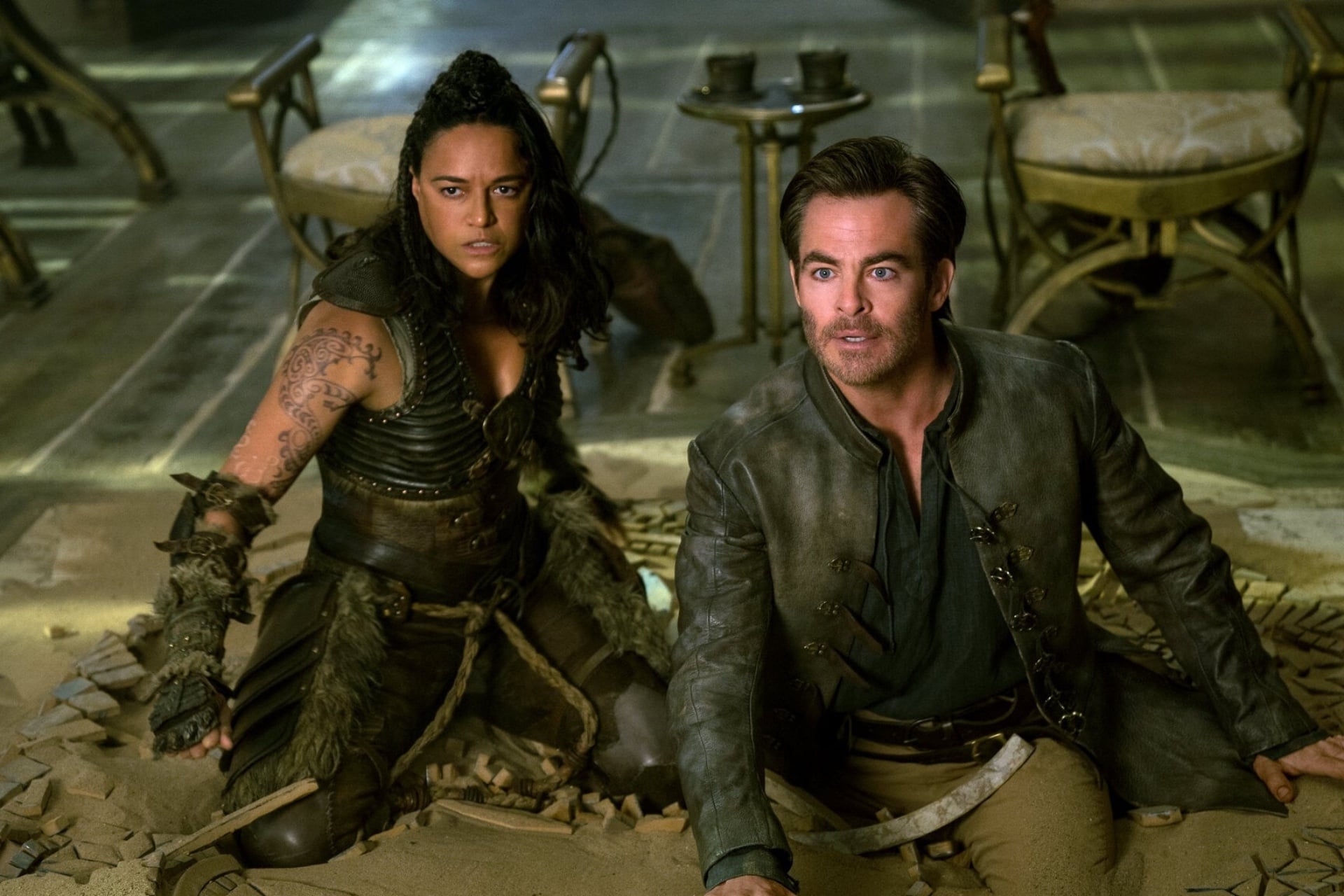
Audiences formed genuine emotional attachments to the charismatic cast. Leading man Chris Pine showcased exceptional comedic timing, delivering one of his most endearing screen performances in recent memory. Co-stars Michelle Rodriguez, Justice Smith, and Sophia Lillis brought distinct charm and physical prowess to their respective roles, while Regé-Jean Page won over crowds with his straight-faced portrayal of the noble paladin Xenk Yendar.
Chris Pine’s Appetite for an Edgin Darvis Return
Pine has spoken publicly and passionately about his enthusiasm for reprising the role of Edgin Darvis. In multiple press conversations following the movie’s physical media and digital streaming success, Pine reiterated that he would jump at the chance to revisit the character if a studio could find an economically sustainable formula. The actor candidly recognized that Hollywood’s financial landscape requires smaller budgets, suggesting publicly that a follow-up could thrive on a tighter, more intimate scale.
Securing the returning ensemble will inevitably hinge on scheduling and competitive salary packages. Hollywood options on talent contracts typically lapse after twelve to eighteen months if a sequel is not formally greenlit into active pre-production. A new acquiring studio would need to execute fresh contractual agreements with Pine and Rodriguez, who remain in high demand across competing prestige film and television productions.
Lore Expansion: Exploring the Underdark and Iconic Villains
Should a sequel proceed with the original creative DNA, the Forgotten Realms setting offers thousands of rich lore threads waiting to be explored. Jonathan Goldstein and John Francis Daley demonstrated exceptional reverence for deep-cut tabletop mechanics, including displacer beasts, mimic chests, and the rules governing spellcasting components. A sequel could expand far beyond Neverwinter and delve into iconic D&D mythology:
- The Underdark: A deeper expedition into the subterranean domain of the Drow, mind flayers, and monstrous beholders, building directly on the brief Underdark escape sequence featured in the first film.
- The Cult of the Dragon: Introducing legendary draconic villains like Tiamat, the five-headed dragon goddess, offering higher stakes and grand fantasy spectacle.
- Drizzt Do’Urden: Introducing the legendary dual-scimitar-wielding ranger, one of the most beloved literary figures in all of fantasy fiction, created by author R.A. Salvatore.
- Waterdeep and the Sword Coast: Exploring the City of Splendors, providing a dense, urban fantasy playground filled with thieves’ guilds, political intrigue, and rival adventuring parties.
- Baldur’s Gate Synergy: Weaving in locations and factions made universally famous by recent video game successes, creating an immediate visual hook for modern gaming audiences.
For more detailed breakdowns of fantasy filmmaking and production developments, check out the comprehensive box office analysis at Bright Celebrity to stay informed on changing casting announcements and studio negotiations. You can also consult the verified IMDb profile for the film to review the comprehensive cast and production team credits.
People Also Ask
Why did Paramount cancel the Dungeons and Dragons sequel?
Paramount passed on financing a sequel primarily due to financial underperformance. The 2023 movie earned $208 million worldwide against an expensive $150 million production budget, resulting in theatrical losses under standard studio revenue splits.
Will Chris Pine return for Dungeons and Dragons 2?
Chris Pine has expressed strong enthusiasm for returning as Edgin Darvis if a sequel moves forward. However, his formal participation will depend on whether an incoming studio greenlights the script and successfully renegotiates talent contracts.
Which studios might buy Dungeons and Dragons 2?
Potential suitors shopping the sequel include Universal Pictures, Warner Bros. Discovery, and streaming powerhouses like Amazon MGM Studios and Netflix. Hasbro Entertainment is currently pitching the project across multiple theatrical and digital distributors.
How much money did Honor Among Thieves lose at the box office?
With a production cost of $150 million and global marketing expenses exceeding $75 million, the film required approximately $375 million worldwide to break even theatrically. Its $208 million gross left a significant box office deficit before home entertainment revenue.
Is the live-action Dungeons and Dragons TV series still happening?
Yes, an eight-episode live-action television series remains in active development at Paramount+, guided by showrunner Drew Crevello. The television project operates independently of the feature film distribution packaging currently being shopped to other studios.
The Future Road for Dungeons and Dragons 2
The cinematic journey of Dungeons and Dragons 2 proves that artistic quality alone does not guarantee smooth sailing in contemporary Hollywood. The original film achieved something truly remarkable: it banished the lingering memory of the poorly received 2000 film adaptation and delivered a warm, witty, visually striking adventure that resonated deeply with critics and core gaming audiences alike. You rarely see an intellectual property achieve such high audience goodwill on its first modern attempt.
As Hasbro Entertainment shops the project to new partners, the path forward will require compromise, financial discipline, and creative ingenuity. If an ambitious studio like Universal or Amazon steps up to embrace the brand with a smartly calibrated $90 million budget, moviegoers may yet see the beloved party of thieves assemble for another grand campaign across the Forgotten Realms. The roll of the twenty-sided die has not come up as a critical failure just yet; the party is simply regrouping at the tavern, mapping out their next daring heist.
More Like This
For more updates, check out our latest entertainment and sports news.