⚡ Key Takeaways
- The Ivan Franko National Academic Drama Theater in Kyiv is staging “Odysseus, Maeotis,” a contemporary reimagining of Homer’s epic.
- Active-duty soldiers from the 1st Corps Azov, including lead actor Daniil Mireshkin, perform alongside professional actors.
- The play’s title reference “Maeotis” is the ancient Greek name for the Sea of Azov, home to the besieged port city of Mariupol.
- Classic monsters like Cyclops and Sirens are replaced by terrifying, modern aerial drones and electronic war machines.
- The narrative directly highlights the plight of over 600 Azov Brigade servicemen who remain in Russian captivity.
You might believe that ancient Greek myths belong solely to the dusty pages of history, but a groundbreaking new production in Kyiv is proving otherwise with a powerful **Ukrainian Odyssey**. The chilling reality of a modern wartime struggle is unfolding right now on the stage of the Ivan Franko National Academic Drama Theater. This theatrical masterpiece, titled “Odysseus, Maeotis”, blends active-duty combat veterans and professional actors to portray the agonizing journey of survival, captivity, and the desperate struggle to return home. It represents an artistic act of absolute defiance in the face of ongoing geopolitical trauma.
This profound **Ukrainian Odyssey** arrives at a moment when Homer’s classic narrative is capturing global attention across multiple mediums. While Western audiences flock to IMAX theaters to experience massive blockbuster spectacles, Kyiv theatergoers are witnessing a story written in real blood and tears. The production faced numerous delays due to relentless air raid sirens and Russian missile strikes on the capital city. Despite these life-threatening challenges, the dedicated cast and crew persevered to bring this vital message of survival to the stage.
Director Ivan Uryvskyi has stripped away the traditional grandiosity of the Greek epic to expose its raw, psychological core. This is not a tale of romanticized heroics, but rather a somber reflection on collective survival. Through this artistic medium, the theater serves as both a sanctuary and a megaphone for a nation in agony. By connecting ancient suffering with contemporary warfare, the production creates a timeless space for mourning, healing, and resistance.
Unveiling The Ukrainian Odyssey Masterpiece
The creative genesis of this **Ukrainian Odyssey** lies in a radical deconstruction of the original epic poem. Rather than reciting Homer’s dactylic hexameter, playwright Oleksii Dorychevskyi wrote an entirely fresh script from scratch. The production retains only the fundamental narrative arc: a warrior’s grueling, painful journey home and the agonizing wait of those he left behind. By stripping away the ancient filler, the play focuses intensely on the psychological torment of exile and displacement.
The stage design itself is intentionally minimalist, harsh, and unsettling to evoke the atmosphere of an active combat zone. Darkened sets are laced with harsh neon light bars that pierce through the gloom like tracer rounds. Projections wash over the actors, blurring the lines between physical reality and digital nightmare. The mythical monsters that once challenged Odysseus have been updated for the twenty-first century. The terrifying Cyclops and seductive Sirens are replaced by the buzzing of recon drones and the lumbering silhouettes of robotic war machines.
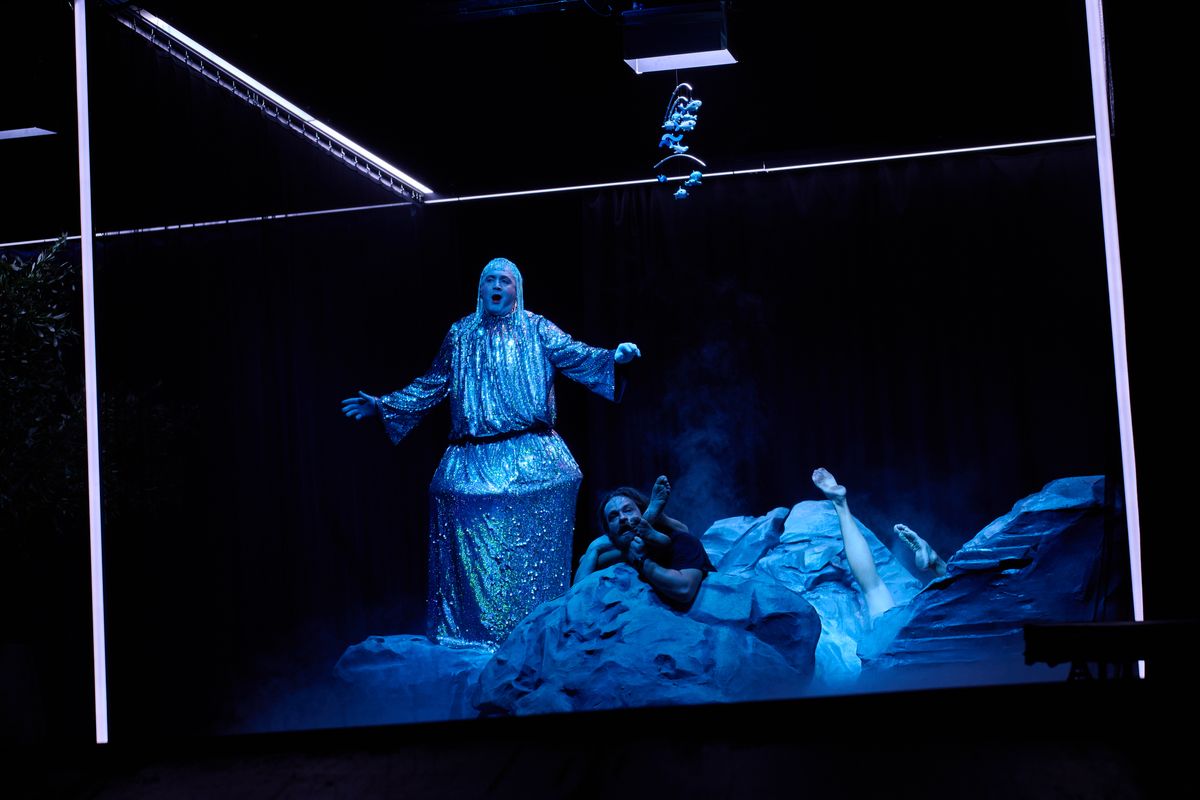
This stylistic choice connects the ancient world directly to the daily lived experiences of Ukrainians. For civilians in Kyiv, the buzz of a drone is not a metaphorical threat but a precursor to potential devastation. By utilizing these modern elements, the play strips away any comforting historical distance. Audiences are forced to confront the harsh reality that the monsters of antiquity are active today in the skies over Ukraine, shaping this unique **Ukrainian Odyssey**.
The Meaning of Maeotis
To truly comprehend this modern adaptation, one must understand the significance of the word “Maeotis” in the play’s title. Ancient Greek geographers used this term to describe the Sea of Azov, a body of water once considered the absolute edge of the known civilized world. Today, this body of water is synonymous with some of the most brutal fighting of the modern era. It is the geographic heart of Mariupol, the historic port city that fell to Russian forces after a devastating siege in 2022.
By anchoring this **Ukrainian Odyssey** in the Sea of Azov, the production creates a direct bridge to the tragedy of Mariupol. The characters onstage are not wandering abstract seas; they are navigating the haunted shores of occupied territories. This clever historical reference grounds the mythical journey in a very real, very painful geography. It reminds the audience that the edge of the known world is not a fantasy, but a place where their countrymen are fighting for survival.
The Dual Narrative of Pain
The structure of the play unfolds in parallel, presenting two distinct but interconnected forms of suffering. On one hand, we witness the physical and psychological torment of Odysseus as he struggles through hostile territory. On the other, we see the agonizing endurance of Penelope, played with shattering vulnerability by Daryna Leheida. Penelope’s torment is not passive; it is an active, exhausting battle against despair, mirroring the reality of millions of Ukrainian women today.
This dual structure ensures that the play honors both the soldiers on the front lines and the families waiting at home. The psychological weight of waiting is portrayed as a heavy, exhausting labor. For Penelope, every passing day is a battle against the creeping fear that her husband is lost forever. This thematic focus transforms the production from a simple war story into a deeply empathetic exploration of domestic endurance, cementing its place as a landmark **Ukrainian Odyssey** of survival.
The Real Azov Soldiers Onstage
What elevates this theatrical production to a historic cultural event is the participation of real-world combat veterans. The lead role of Odysseus is played by Daniil Mireshkin, an active-duty serviceman in the Ukrainian Armed Forces. Mireshkin brings an unparalleled level of authenticity to the role, drawing on his personal combat experiences to portray the weary warrior king. When Mireshkin speaks of the exhausting struggle to return home, he is not merely delivering memorized lines; he is voicing the deepest desires of his brothers-in-arms, creating a truly authentic **Ukrainian Odyssey** on stage.
The collaboration between professional actors and active combatants creates a unique creative energy. The stage becomes a sacred space where the division between civilian and military life dissolves completely. This creative integration allows the cast to explore the complex psychological transition from the battlefield back to civilian society. It is a therapy session, a memorial service, and a piece of high art all rolled into one.
Playwright Oleksii Dorychevskyi, who also serves in the 1st Corps Azov, spent over a year interviewing former prisoners of war. These raw, firsthand accounts of captivity and torture form the narrative backbone of the script. The dialogues are infused with the dark humor, quiet desperation, and stubborn hope of those who survived Russian detention centers. This documentary approach ensures that every line spoken onstage carries the weight of absolute truth, enriching their personal **Ukrainian Odyssey**.
According to the military leadership of the 1st Corps Azov, an estimated 600 soldiers from the Azov Brigade remain in Russian captivity. This staggering figure hangs over the production like a dark cloud. The play is not just an artistic exercise; it is an urgent plea for the rescue and return of these captured heroes. Every performance serves as a solemn reminder of the lives hanging in the balance.
Expert Take:
“Wartime theater in Ukraine has historically served as a vital mechanism for collective trauma processing,” says Dr. Kateryna Pavlyuk, a leading drama therapist. “By casting active-duty soldiers from the Azov Brigade, ‘Odysseus, Maeotis’ transcends traditional performance art. It functions as an active site of cultural resistance and clinical therapy, allowing both the performers and the audience to externalize and process profound grief. This is a crucial step in maintaining national psychological resilience during an active, existential conflict.”
Wartime Theater By The Numbers
Operating a world-class theater in the middle of an active conflict zone presents extraordinary logistical hurdles. The Ivan Franko National Academic Drama Theater has had to adapt to a reality of blackouts, missile sirens, and military drafts. Yet, the appetite for high culture in Kyiv has never been stronger. The performances of this stunning **Ukrainian Odyssey** are routinely sold out, demonstrating the public’s deep hunger for stories that help them process their collective trauma.
To understand the sheer scale of the challenges faced by the production team, we can look at the logistical data surrounding the creation of the play. The team has had to balance artistic standards with strict military protocols and civil defense requirements. The following table illustrates the stark realities of staging this monumental theatrical work during wartime, reflecting the true nature of this **Ukrainian Odyssey**:
| Production Metric | Wartime Reality & Logistical Impact |
|---|---|
| Premiere Delays | 4 major postponements due to active Russian missile strikes on Kyiv. |
| Cast Composition | 50% active-duty soldiers from the 1st Corps Azov, 50% professional civilian actors. |
| Captivity Database | Over 12 months of compiled interview transcripts from repatriated Ukrainian prisoners of war. |
| Active Captives | Approximately 600 Azov Brigade servicemen currently remain in Russian custody. |
| Theater Safety | 100% of audience and crew evacuated to bomb shelters during active air raid alerts. |

These statistics reveal the immense dedication required to keep the arts alive under fire. Every single ticket sold is a testament to the defiance of the Ukrainian public. Rather than retreating into hiding, they gather in darkened halls to confront their shared pain through the lens of ancient myth. This is cultural defense in its purest form, showing how deeply rooted this **Ukrainian Odyssey** is in the hearts of the citizens.
Comparing Ancient Myth and Modern War
The thematic overlap between Homer’s Odyssey and the modern Ukrainian experience is incredibly precise. In ancient times, the Odyssey was not just an adventure story; it was a manual for understanding the high cost of victory. It addressed the difficult return of soldiers who had been changed by the horrors of the Trojan War. Similarly, today’s Ukrainian defenders must navigate the complex journey of returning to civilian life after experiencing the absolute worst of human conflict, representing the core of this modern **Ukrainian Odyssey**.
The figure of Penelope holds a special place in this comparison. In the classical text, Penelope is often portrayed as a symbol of passive fidelity, waiting patiently at home for her husband’s return. In this modern interpretation, Penelope represents the active resistance of the home front. Her long wait is depicted as a fierce battle against hopelessness, fear, and the steady erosion of her world in this harrowing **Ukrainian Odyssey**.
The Battle for National Identity
At its core, the play is a battle for self-discovery and cultural survival. As the global entertainment landscape continues to evolve, understanding cultural narratives is more important than ever. While sites like BrightCelebrity track the latest trends in cinema and high-profile public figures, this theater production in Kyiv reminds us of the raw, societal power of performance art. The actors are not playing for fame or fortune; they are performing to preserve their very identity as a sovereign people, shaping this heartbreaking **Ukrainian Odyssey** narrative.
For lead actor Daniil Mireshkin, playing Odysseus is a way to reclaim his identity from the brutalizing effects of combat. The war strips away everything, leaving only the bare instinct for survival. Through the character of Odysseus, Mireshkin can explore the pieces of himself that he lost on the battlefield. The theater becomes a space for reconstruction, allowing him to piece together a fragmented self.
Exile, Captivity, and Return
The theme of captivity is the most painful and urgent aspect of the production. For the families of the missing and captured Azov soldiers, the play is a direct reflection of their daily torment. The script does not shy away from the horrific realities of modern captivity. Instead, it uses the myth of Odysseus’ imprisonment by Calypso and the Cyclops to address the psychological torture of being held in isolation, creating a profound parallel in this tragic **Ukrainian Odyssey**.
This thematic focus ensures that the play remains an active political statement. It demands that the world does not look away from the ongoing plight of Ukrainian prisoners of war. By framing their struggle within a timeless epic, the creators elevate the story of the Azov defenders to a universal mythic level. They ensure that their sacrifice will never be forgotten or dismissed as mere headline news.
Frequently Asked Questions
What is the play Odysseus, Maeotis about?
The play “Odysseus, Maeotis” is a contemporary Ukrainian theatrical production that adapts Homer’s classic epic poem, the Odyssey, to the context of the modern Russia-Ukraine war. It focuses on the themes of war, captivity, the agony of waiting, and the difficult psychological journey of returning home, utilizing active-duty military personnel and professional actors on stage to portray a modern **Ukrainian Odyssey**.
Who are the main creators of this Ukrainian Odyssey?
The production is directed by Ivan Uryvskyi at the prestigious Ivan Franko National Academic Drama Theater in Kyiv. The script was written by playwright Oleksii Dorychevskyi, who is also a serviceman in the 1st Corps Azov, based on extensive interviews with repatriated Ukrainian prisoners of war who inspired this **Ukrainian Odyssey**.
Are there active-duty military personnel performing on stage?
Yes, the lead role of Odysseus is played by Daniil Mireshkin, an active-duty Ukrainian serviceman. His participation, along with playwright Oleksii Dorychevskyi, brings an unparalleled level of authenticity to the performance, integrating real soldiers directly into the cast of this **Ukrainian Odyssey**.
Why is the word Maeotis included in the title?
“Maeotis” is the ancient Greek name for the Sea of Azov, a body of water that borders Mariupol, the port city that fell to Russia after a brutal siege in 2022. The title directly links the mythical journey of Odysseus to the real-world geography of the war and the struggle of the Azov Brigade defenders.
The Eternal Hope Of Ukrainian Odyssey
Ultimately, this extraordinary **Ukrainian Odyssey** is a powerful testament to the unbreakable spirit of a nation under siege. Through the timeless framework of Homer’s epic, the artists and soldiers at the Ivan Franko National Academic Drama Theater have created a profound cultural monument. They have taken the raw, bleeding wounds of their country and transformed them into a work of enduring art. It stands as a reminder that even in the darkest times, the human spirit can find expression and hope through creation.
The journey of Odysseus is famous because, despite all the monsters, the shipwreck, and the long years of captivity, he eventually made it home. This is the ultimate message of hope that the play offers to the people of Ukraine. It is a promise that the long, agonizing night of war will eventually end, and those who are lost will find their way back, completing their own **Ukrainian Odyssey**.
As the curtain falls in Kyiv, the applause is not just for the excellent performances, but for the sheer survival of the culture itself. Amidst air raids and blackouts, the theater lights continue to shine, illuminating the path forward. Through this remarkable **Ukrainian Odyssey**, the people of Kyiv are reclaiming their past, confronting their present, and boldly asserting their right to a free and sovereign future.
More Like This
For more updates, check out our latest entertainment and sports news.