⚡ Key Takeaways
- Yayoi Kusama’s work was born from childhood hallucinations where patterns consumed her surroundings.
- She transitioned from a penniless artist in 1950s New York to the world’s top-selling living female artist.
- Her 2023 collaboration with Louis Vuitton marked a historic intersection of fine art and high-luxury retail.
- Kusama has voluntarily lived in a psychiatric hospital in Tokyo since 1977, maintaining a daily studio practice.
- The concept of “Self-Obliteration” remains the driving philosophical force behind her repetitive patterns.
Polka Dots are much more than a simple pattern for Yayoi Kusama; they are a gateway to the infinite and a shield against the void. You might recognize her vibrant pumpkin sculptures or her immersive mirrored rooms on Instagram, but the story behind this global success is one of survival and relentless obsession. Imagine being a young girl in rural Japan, looking at a tablecloth, and suddenly seeing those patterns crawl across the floor, the walls, and eventually, your own skin.
This vivid hallucination became the blueprint for a career that has spanned over seven decades and redefined the boundaries of contemporary art. Today, the 95-year-old artist is a household name, but her journey was anything but a straight line to fame. From the conservative landscapes of Matsumoto to the gritty avant-garde scene of 1960s New York, her Polka Dots have conquered the world one circle at a time. To understand her success, you must look beyond the aesthetics and into the profound psychological weight of her repetitive motifs.
As she continues to break auction records and attract millions of visitors to her traveling retrospectives, the “Princess of Polka Dots” remains an enigma. Her work is a bridge between the visceral trauma of her youth and the commercial heights of modern celebrity culture. By exploring her life’s work, we uncover a narrative of resilience that proves how personal vulnerability can be transformed into a universal language of art and beauty.
Polka Dots: The Infinite Vision of Yayoi Kusama
The obsession with Polka Dots began as a defensive mechanism during Kusama’s childhood in wartime Japan. Growing up in a family that owned a seed nursery, she was surrounded by fields of flowers and plants that often overwhelmed her senses. She began painting to document the hallucinations she experienced, where patterns of light and color would “obliterate” her sense of self. This concept, which she calls “Self-Obliteration,” became the cornerstone of her entire artistic philosophy.
Kusama’s early life was marked by a strained relationship with her mother, who was reportedly unsupportive of her artistic ambitions. This conflict fueled her desire to escape, leading her to write to Georgia O’Keeffe, who encouraged her to move to the United States. When she arrived in New York in 1958, she brought with her hundreds of drawings and a burning ambition to become a star in the male-dominated art world. Her “Infinity Net” paintings, which featured thousands of tiny, repetitive strokes, were the first major evolution of her pattern-based work.
The Psychological Engine of Repetition
For Kusama, the act of painting millions of dots is a form of “art-medicine.” It allows her to control the overwhelming nature of her visions by externalizing them onto a canvas. This repetitive process is a meditative labor that bridges the gap between her inner turmoil and the external world. Analysts often point to her work as a supreme example of using creative output to manage mental health conditions, long before such discussions were commonplace in the public sphere.
In the 1960s, she took her patterns off the canvas and onto the streets of New York, staging “Happenings” where she would paint Polka Dots on nude participants in high-profile locations like Wall Street or Central Park. These protests against the Vietnam War and the establishment showcased her ability to merge art with political activism. Despite her growing notoriety, she often felt marginalized as a Japanese woman in an industry that favored white male artists like Andy Warhol and Claes Oldenburg.
Expert Take: The Market Evolution
According to high-end art market analysts, Kusama’s financial trajectory is unprecedented for a living female artist. Between 2004 and 2024, her auction turnover increased by over 1,000%, driven largely by the secondary market for her 1950s Infinity Nets and her late-career sculptures. A key driver of this growth is the “cross-generational appeal” of her work; it appeals to traditional museum curators and the social-media-savvy youth alike. Her ability to maintain high supply without diluting brand value is a feat typically reserved for luxury fashion houses rather than individual artists.
Statistical Analysis of Kusama’s Global Dominance
The numbers behind Yayoi Kusama’s success are as staggering as her artwork itself. From the number of visitors her exhibitions attract to the millions of dollars her pieces fetch at auction, the data confirms her status as a global powerhouse. Her 2013-2015 tour, “A Dream I Dreamed,” was the most-visited art exhibition in the world during those years, drawing over 2 million people across Asia. This level of engagement is rarely seen outside of blockbusters featuring Old Masters like Leonardo da Vinci or Van Gogh.
Furthermore, her collaboration with major brands has solidified her presence in the luxury market. When Louis Vuitton first collaborated with her in 2012 under Marc Jacobs, it was a massive success, but the 2023 collaboration took things to a new level. Massive animatronic Kusama figures were placed in windows from Paris to Tokyo, and 100-foot-tall murals of the artist adorned buildings, making the Polka Dots an unavoidable part of the urban landscape. This synergy between fine art and retail demonstrates how her brand has transcended the gallery walls.
| Metric | Detail/Value | Significance |
|---|---|---|
| Record Auction Price | $10.9 Million (2021) | For a 1959 “Infinity Net” painting. |
| Total Auction Sales (2023) | $189 Million+ | Highest for any living female artist. |
| Museum Attendance | 5 Million+ (5 years) | Based on global touring retrospectives. |
| Permanent Museum | Shinjuku, Tokyo | Yayoi Kusama Museum opened in 2017. |
As seen on Reuters, the surge in the valuation of contemporary Asian art has been led by Kusama’s consistent performance. Her work provides a sense of stability for investors, as her aesthetic is instantly recognizable and has a proven track record across different cultures. Whether it is a small pumpkin sculpture or a massive immersive room, the demand consistently outstrips the supply, maintaining a high floor for her market prices.
The Psychological Roots of Polka Dots
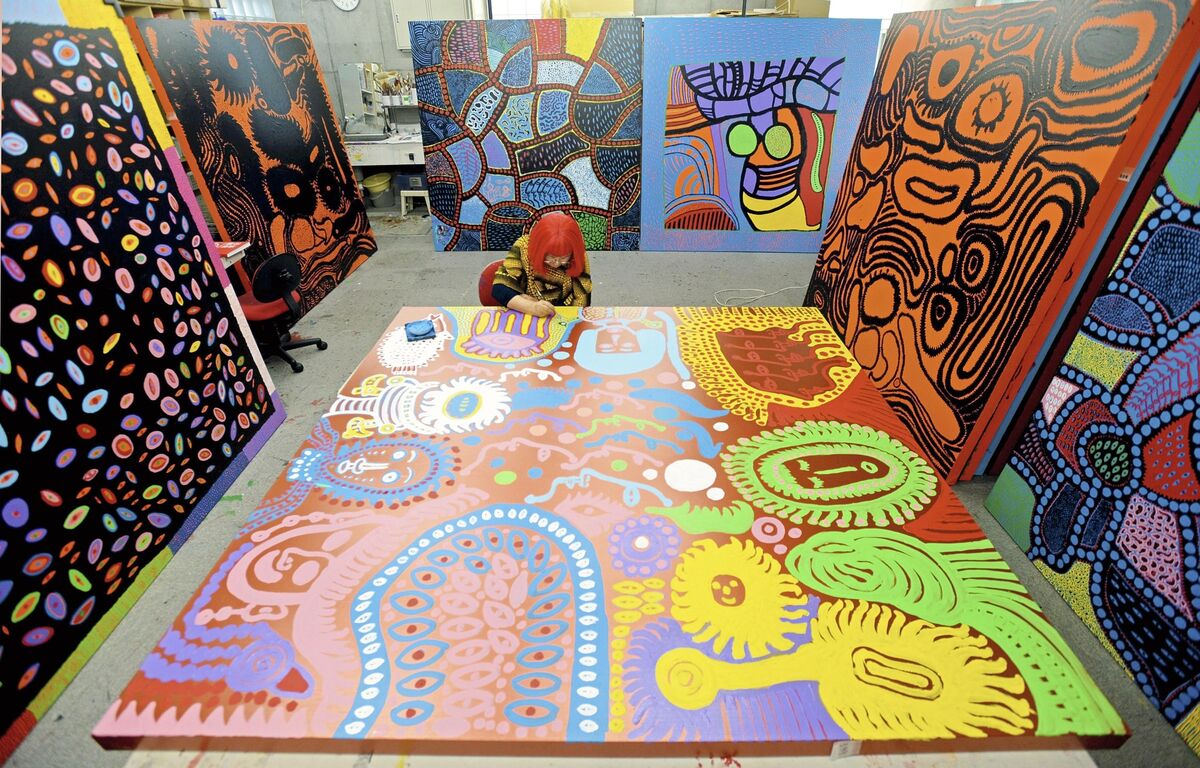
To truly grasp why the world is fascinated by these patterns, one must look at the psychological landscape of the artist. Since 1977, Kusama has lived by choice in the Seiwa Hospital for the Mentally Ill in Tokyo. Her daily routine is remarkably disciplined: she walks from the hospital to her nearby studio every morning, works for several hours painting Polka Dots and other motifs, and returns to the hospital in the evening. This structured existence has allowed her to produce a massive volume of work while managing her long-term psychiatric conditions.
Her “Infinity Mirror Rooms” are perhaps the ultimate expression of her mental state. These installations use mirrors and LEDs to create the illusion of an endless space filled with floating lights or patterns. For the viewer, it is a moment of sublime beauty; for Kusama, it is a representation of the infinite cosmos that she feels she is a part of. The popularity of these rooms in the age of Instagram is a fascinating cultural pivot, where a deeply personal and somewhat painful artistic vision has become the world’s most sought-after photo opportunity.
By The Numbers: The Instagram Effect
Data from social media analytics shows that the hashtag #YayoiKusama has over 1.2 million posts, while #InfinityRoom has nearly 500,000. For a museum, hosting a Kusama exhibition is a guaranteed way to drive ticket sales and digital engagement. For example, the Broad Museum in Los Angeles saw record-breaking traffic when it debuted its Kusama collection, with tickets selling out in minutes. This “viral” nature of her work has helped her bypass traditional art world gatekeepers and connect directly with a global audience.
Critics sometimes argue that the commercialization of her work detracts from its psychological depth, but Kusama herself seems to embrace the reach. She has always wanted her art to be “for the people” and to spread a message of love and peace. By placing her Polka Dots on handbags and high-fashion runways, she is essentially achieving her goal of universal self-obliteration, where her patterns cover the entire globe.
From New York Avant-Garde to Global Icons
The 1960s were a pivotal decade for Kusama, but they were also fraught with professional frustration. Living in a small studio with no heat, she produced some of her most groundbreaking work, including the “Accumulation” series—furniture covered in thousands of soft, phallic-shaped fabric protrusions. These pieces were precursors to the Pop Art and Minimalism movements, yet Kusama often saw her ideas mirrored in the works of her more famous male peers without receiving credit. This sense of erasure eventually contributed to her decision to return to Japan in the early 1970s.
Upon her return, she was largely forgotten by the international art community for nearly two decades. She focused on writing surrealist novels and poetry while continuing her painting in relative obscurity. It wasn’t until the 1993 Venice Biennale, where she represented Japan with a stunning solo pavilion, that the global art world rediscovered her genius. This comeback is one of the most remarkable in art history, proving that her vision was simply ahead of its time. You can find more about celebrity comebacks and artist profiles at brightcelebrity.com.
The Symbolism of the Pumpkin
Aside from Polka Dots, the pumpkin is Kusama’s most famous motif. She describes pumpkins as having a “generous unpretentiousness” and a spiritual quality that she relates to. Her massive yellow and black pumpkin on the island of Naoshima has become a pilgrimage site for art lovers. During a 2021 typhoon, the sculpture was swept into the sea and damaged, sparking global headlines and a massive recovery effort. This incident highlighted just how much these objects have become beloved cultural landmarks rather than just pieces of art.
The pumpkin represents a stable, grounded force in her otherwise chaotic hallucinations. While the dots represent the infinite and the dissolving of the self, the pumpkin represents a kind of sturdy, humble resilience. Together, they form a balanced visual language that speaks to the human condition—the desire to be part of something larger than ourselves while maintaining a core sense of identity and purpose.
Frequently Asked Questions
Why does Yayoi Kusama use so many polka dots?
Kusama uses dots because they are a direct representation of the hallucinations she has experienced since childhood. She views them as a way to “obliterate” herself and the world, connecting everything into a single, infinite pattern that she finds both terrifying and beautiful.
Is Yayoi Kusama the most expensive female artist?
As of 2024, Yayoi Kusama is consistently ranked as the top-selling living female artist by auction turnover. Her paintings from the late 1950s and early 1960s are particularly valuable, often selling for over $10 million at major auction houses like Christie’s and Sotheby’s.
Where can I see Yayoi Kusama’s art permanently?
The best place to see her work is the Yayoi Kusama Museum in Tokyo, Japan. However, her work is held in the permanent collections of major museums worldwide, including the MoMA in New York, the Tate Modern in London, and the Centre Pompidou in Paris.
Why did Yayoi Kusama move into a psychiatric hospital?
Kusama chose to move into the Seiwa Hospital in 1977 to better manage her obsessive-compulsive neurosis and hallucinations. This decision allowed her to live in a safe, structured environment while continuing to focus entirely on her prolific artistic production.
The Eternal Legacy of Polka Dots
In the final analysis, the global success of Yayoi Kusama is a testament to the power of a singular vision. She did not follow trends; she waited for the world to catch up to her. Her Polka Dots have evolved from symbols of personal distress into icons of hope, love, and universal connection. For a woman who once felt she was disappearing into her own patterns, she has ironically become one of the most visible and indelible figures in human history.
As she approaches her centenary, her output shows no signs of slowing down. She continues to paint every day, driven by the same internal necessity that motivated her as a child in Matsumoto. Her story reminds us that obsession, when channeled through the medium of art, can become a source of immense strength. Whether you see her work in a prestigious gallery or on a luxury handbag, you are witnessing the triumph of a woman who turned her darkest fears into a bright, dotted reality that the entire world now wants to be a part of.
The legacy of the Polka Dots will likely endure for centuries, as they tap into a primal human fascination with the infinite. Kusama has given us a way to visualize the vastness of the universe within the palm of our hands—or the walls of a mirrored room. Her journey from the fringes of society to the center of the cultural zeitgeist is a masterclass in staying true to one’s self, no matter how many dots it takes to get there.
More Like This
For more updates, check out our latest entertainment and sports news.