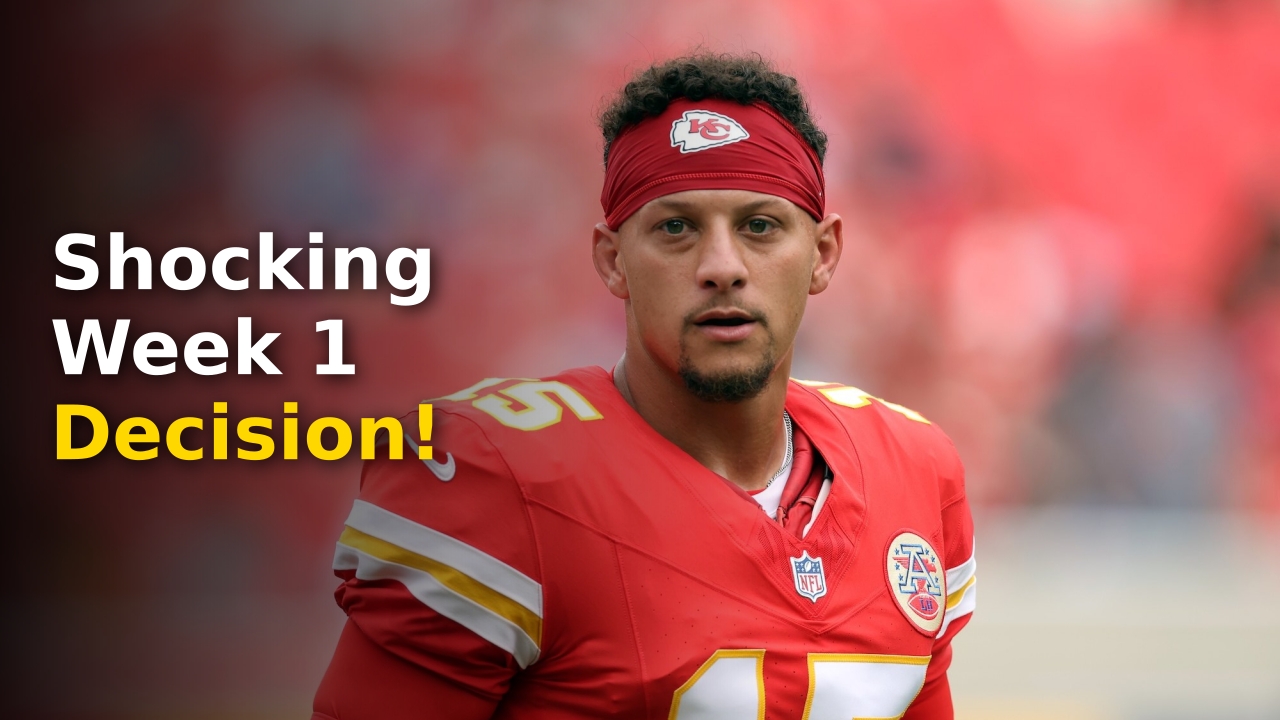
⚡ Key Takeaways
- Patrick Mahomes remains highly questionable for the Week 1 opener against the Denver Broncos on Monday Night Football.
- Head coach Andy Reid refuses to name Mahomes the starter, adopting a strict day-by-day evaluation protocol.
- The franchise quarterback is recovering from a torn ACL suffered in December 2025, representing a tight nine-month recovery window.
- While cleared for training camp practices, Mahomes continues early-morning rehab to address hesitancy during lateral cuts.
- The Chiefs face massive long-term franchise risks if they rush their four-hundred-and-fifty-million-dollar asset back too soon.
You might think the Kansas City Chiefs have their entire season securely planned, but the reality of the **Mahomes recovery** from a torn ACL is threatening to derail their Week 1 strategy. Is the league’s most dominant quarterback ready to take the field against the Denver Broncos on September 14? The immediate answer is highly complicated, as head coach Andy Reid is taking a strict day-by-day approach while the training staff evaluates Mahomes’ lateral movement. The NFL world now holds its breath as the ultimate competitor races against a tight nine-month medical timeline.
This high-stakes uncertainty has transformed the **Mahomes recovery** into the most closely watched storyline of the NFL pre-season. While the thirty-year-old superstar expresses confidence in his knee, the Kansas City front office knows that one premature cut could alter the franchise’s trajectory for the next decade. Behind closed doors, a massive debate is unfolding between athletic drive and medical caution.
To understand the depth of this situation, you must look beyond the standard training camp press conferences. The intersection of modern sports science, franchise economics, and on-field strategy makes this recovery a unprecedented challenge for the defending AFC West champions.
The Mahomes recovery Race Against Time

The atmosphere at the Kansas City training facility in St. Joseph, Missouri, is charged with intense anticipation. Every eyes is fixed on the starting quarterback as he navigates individual drills and early morning rehabilitation sessions. For Patrick Mahomes, the daily routine begins long before his teammates step onto the practice turf. His mornings are dedicated to specialized physical therapy designed to restore the explosive lateral power that defines his unique playing style.
Medical personnel working on the **Mahomes recovery** program have emphasized that structural healing is only half the battle. Rebuilding the neuromuscular pathways required for elite scrambles is an entirely different obstacle. Mahomes has acknowledged that while the knee feels strong, his brain must relearn to trust the joint under sudden duress. This mental hurdle is often the most difficult phase of returning from a major ligament reconstruction.
On the turf, Mahomes is fully cleared for practice, yet the team is keeping a highly watchful eye on his repetitions. The coaching staff is intentionally limiting his exposure to chaotic pocket environments where accidental contact could occur. This controlled environment allows him to throw from a clean platform, but it does not fully simulate the violent unpredictability of a live NFL game.
Despite these limitations, Mahomes’ competitive drive remains completely undiminished. He is actively pushing the coaching staff for more reps, eager to prove his readiness for the primetime opener. However, the decision-makers in Kansas City are keeping a firm grip on the reins, prioritizing long-term health over early-season urgency.
Cautious Optimism in KC
Andy Reid spoke directly to reporters, emphasizing that there are absolutely no predictions regarding Week 1. The sixty-eight-year-old head coach is relying entirely on the medical team’s daily assessments. Reid’s coaching philosophy has always prioritized player longevity, and he is not about to change that approach for his franchise cornerstone. The staff is prepared to pivot to backup options if Mahomes exhibits even a slight physical limitation.
For more updates on lifestyle and high-profile NFL stars off the field, check out Bright Celebrity. Understanding how athletes manage high-pressure personal and professional recovery phases is essential to appreciating their dedication on the gridiron.
Fighting the Urge to Cut
During team drills, Mahomes has admitted to occasionally holding back on explosive, off-platform movements. The instinctual urge to scramble and make defenders miss is what makes him special, but it is also the ultimate test for his surgical graft. Coaches are constantly reminding him to protect himself, treating practice as a controlled laboratory rather than a live arena.
This restraint is highly unusual for a player who has built a career on defying physical limitations. The transition from a freestyle playmaker to a disciplined, pocket-bound protector is a temporary necessity that Mahomes is forced to embrace. How this mental adjustment translates to a high-pressure game situation remains the biggest question mark of the pre-season.
Analyzing the December Injury Timeline
The origin of this crisis traces back to a cold December night in 2025 during a crucial matchup against the Los Angeles Chargers. Mahomes suffered a clean tear of his anterior cruciate ligament, instantly ending his season and forcing him to miss the final three games. The injury cast a dark shadow over what was already a highly disappointing campaign for the Chiefs. The subsequent surgical procedure set off a grueling rehabilitation calendar with a target date of September 2026.
Typically, a complete **Mahomes recovery** from an ACL reconstruction requires nine to twelve months for an elite professional athlete. Because his surgery occurred in late December, the season opener on September 14 places him at exactly the nine-month mark. This timeline is considered the absolute earliest window for a safe return to competitive football. Rushing this process carries a statistically significant risk of graft failure or compensatory injuries to the opposite leg.
To put this recovery timeline into historical context, we must examine how other elite quarterbacks have fared after suffering similar major knee ligament injuries. The table below illustrates the varying recovery durations and subsequent performance levels of notable NFL signal-callers.
| Quarterback | Injury Date | Return Timeline | Performance Level Post-Injury |
|---|---|---|---|
| Tom Brady | September 2008 | 12 Months | Elite (Won Multiple Super Bowls) |
| Joe Burrow | November 2020 | 9 Months | Elite (Led Team to Super Bowl) |
| Kyler Murray | December 2022 | 11 Months | Highly Productive Mobile Style |
| Patrick Mahomes | December 2025 | 9 Months (Target) | Pending Week 1 Status |
By The Numbers: The Medical Reality
According to sports science databases, NFL players returning from ACL reconstruction before the ten-month mark experience a dynamic shift in joint mechanics. Biomechanical studies indicate that lateral cutting efficiency decreases by up to fifteen percent in the initial return phase. This statistical reality explains why the Chiefs’ training staff is focusing heavily on joint stabilization exercises. Ensuring that Mahomes can decelerate and change direction safely is the primary medical milestone before he can be cleared for live action.
Furthermore, the physical demand of escaping modern NFL edge rushers requires instantaneous reactions. If a quarterback’s mind hesitates for even a fraction of a second to protect a healing knee, the risk of taking a direct, high-impact hit increases dramatically. Consequently, the team is analyzing high-speed video footage of Mahomes’ dropbacks to detect any subconscious favoring of his left leg.
Andy Reid’s Calculated Day-by-Day Philosophy

Andy Reid is no stranger to managing high-profile injuries throughout his storied coaching career. Having coached legendary players through severe physical setbacks, Reid knows that public pressure must never dictate medical clearance. The veteran head coach is keeping his cards close to his chest, frustrating fantasy football managers and sportsbooks alike. This calculated silence is a deliberate strategy to shield Mahomes from unnecessary media expectations.
The coaching staff is actively preparing the backup quarterbacks to take first-team reps in the event that the **Mahomes recovery** requires more time. Reid has expressed high confidence in his reserve options, emphasizing that the offensive system is designed to adapt to different skill sets. By preparing the entire roster for a potential Mahomes absence, the Chiefs are minimizing the chaotic impact of a last-minute game-time decision.
Historically, Reid has been highly conservative with his players’ health, choosing to lose an early-season game rather than risk a season-ending re-injury. This long-term perspective has served the Chiefs incredibly well during their decade of dominance. The upcoming Monday Night Football matchup against Denver is a major divisional game, but it is only the first step in a long seventeen-game journey.
Behind the scenes, the communication between Reid, Mahomes, and the medical staff is constant. The daily evaluations involve precise testing of the knee’s range of motion, strength symmetry, and post-practice swelling. If any of these metrics fall below the established safety thresholds, the decision to sit Mahomes for Week 1 will be made without hesitation.
The Backup Plan in Motion
If Mahomes is forced to sit out, the offensive game plan will shift from a highly creative, downfield passing attack to a disciplined, run-heavy scheme. The coaching staff will rely on quick-release passes, screen plays, and establishing a dominant ground game to protect the reserve quarterback. This strategic adjustment is designed to shorten the game and reduce the overall offensive burden.
The Chiefs’ offensive line will play a critical role in this contingency plan. Featuring elite interior blockers, the unit must step up to create a clean pocket and consistent running lanes. By establishing a physical presence up front, Kansas City can neutralize the Denver pass rush and support whoever is taking snaps under center.
The Massive Long-Term Franchise Stakes
The financial and cultural impact of Patrick Mahomes on the Kansas City Chiefs cannot be overstated. As the recipient of a historic ten-year, four-hundred-and-fifty-million-dollar contract, Mahomes is not just a player; he is the single most valuable asset in the entire league. The front office is fully aware that rushing him back for a single Week 1 game could jeopardize the remaining years of his career. Protecting this massive financial and competitive investment is the primary objective of the entire organization.
From an executive perspective, the risks of a premature return far outweigh the benefits of a single divisional victory. The Chiefs are built to compete for championships over a multi-year window, not just individual games. If the **Mahomes recovery** requires an extra two to three weeks of rest, the organization is fully prepared to absorb early-season losses to secure his long-term health.
This perspective is shared by sports medicine experts across the country. Many independent orthopedic surgeons suggest that giving a reconstructed ACL a full ten to eleven months to mature significantly reduces the rate of secondary tears. The extra time allows the surgical graft to undergo complete ligamentization, reaching maximum tensile strength.
As the Chiefs prepare for their primetime opener, the eyes of the entire sports world remain fixed on Kansas City. You can follow the live updates and game-day inactive lists on official sports platforms like ESPN to see if the franchise quarterback will ultimately defy the odds and take the field.
Expert Take: The Orthopedic Perspective
Leading sports orthopedic specialists agree that modern rehabilitation techniques have revolutionized the return-to-play timeline for NFL athletes. However, the graft itself still requires a biological timeline to fully integrate into the bone. Rushing an athlete back at the nine-month mark is always a calculated gamble, as the structural integrity of the knee is still maturing. The decision ultimately balances clinical objective testing with the player’s subjective feedback regarding knee stability.
In Mahomes’ case, his reliance on unpredictable, off-platform throws places an extraordinary amount of rotational stress on his knee. Unlike traditional pocket passers, his unique playstyle requires exceptional rotational stability. Consequently, the medical team must ensure that his knee can handle the extreme torque generated during his signature sidearm throws and cross-body launches.
Frequently Asked Questions
Will Patrick Mahomes play in Week 1 against the Denver Broncos?
Patrick Mahomes’ status for the Week 1 game remains highly uncertain and will be determined by a game-time decision. While he is cleared for training camp, the coaching staff is taking a day-by-day approach to evaluate his readiness.
When did Patrick Mahomes tear his ACL?
Mahomes suffered a torn ACL during a late-season game against the Los Angeles Chargers in December 2025. The injury sidelined him for the final three games of that campaign and required major offseason surgery.
Who will start at quarterback if Mahomes is not ready?
If Mahomes is ruled out for the season opener, the Chiefs will turn to their backup quarterback depth chart to lead the offense. The coaching staff is currently preparing the reserve players with first-team reps to ensure a smooth transition.
Is Mahomes participating in training camp practices?
Yes, Mahomes has been fully cleared for practice before the start of training camp. However, he is undergoing intensive early-morning rehabilitation work and is avoiding high-risk lateral cuts during team drills.
A Defining Moment for Mahomes recovery
The unfolding saga of the **Mahomes recovery** represents a critical crossroads for the Kansas City Chiefs’ franchise. The competitive spirit that has defined Mahomes’ legendary career is driving him to overcome the odds and start on September 14. Yet, the wisdom of Andy Reid and the medical staff serves as a vital safeguard against long-term catastrophe. This delicate balance between athletic ambition and medical caution will shape the entire 2026 NFL season.
Ultimately, the final decision will rest on whether Mahomes can step onto the field and truly be himself without hesitation. If he can trust his body to make the dynamic plays that have captivated millions, he will lead his team out of the tunnel. If not, the Chiefs will patiently wait, knowing that their championship hopes depend on a fully healed superstar.
More Like This
For more updates, check out our latest entertainment and sports news.