⚡ Key Takeaways
- The fully guaranteed $230 million deal remains the most disastrous transaction in modern NFL history.
- Deshaun Watson’s abysmal performance and lack of self-awareness have pushed Cleveland fans to open mutiny.
- Ownership and front-office leaders like Jimmy Haslam and Andrew Berry bear the ultimate moral and financial blame.
- Unlike Denver and Miami, who swallowed historic dead cap hits to move on from QB mistakes, Cleveland remains paralyzed by stubbornness.
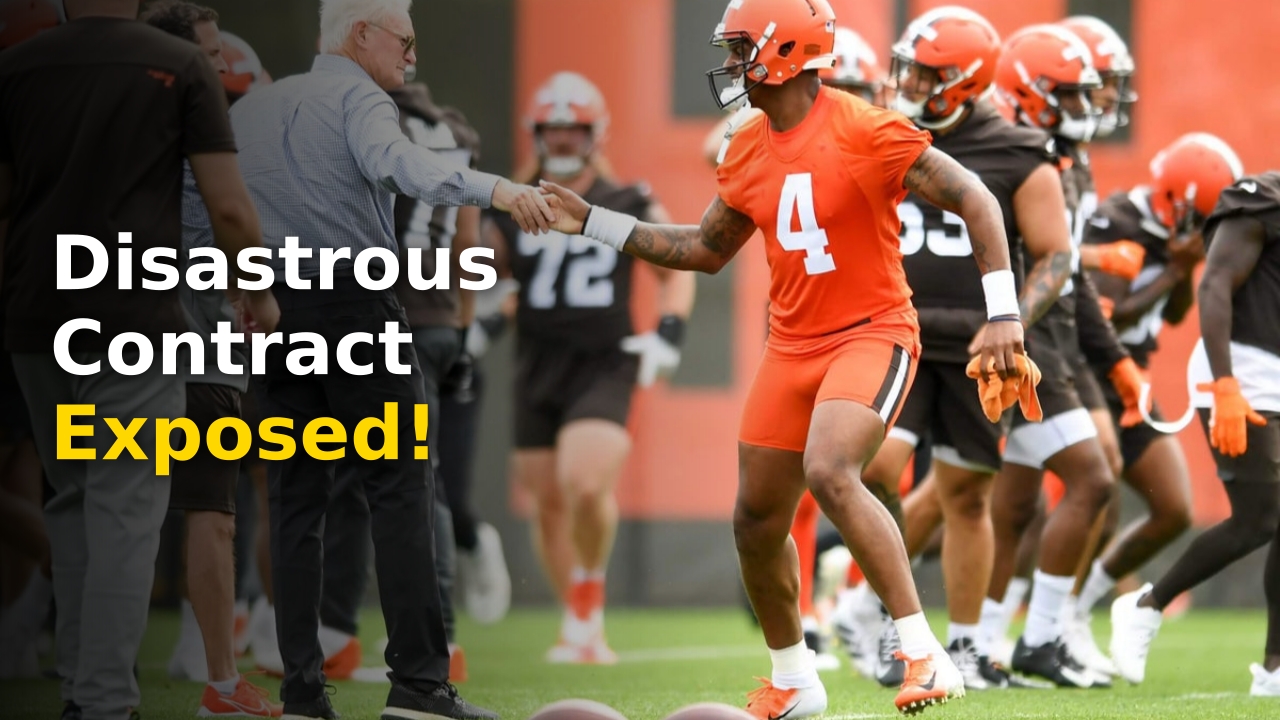
You are looking at the exact moment the NFL completely lost its mind, and the infamous **Watson contract** is the smoking gun. For a franchise defined by decades of heartbreaking losses, the Cleveland Browns somehow managed to construct a self-inflicted disaster that surpasses every fumble, interception, and blown lead in their tortured history. The disastrous **Watson contract** represents the ultimate intersection of executive hubris, moral bankruptcy, and catastrophic on-field performance. Indeed, the Watson contract was a historic blunder that alienated a loyal fanbase, wrecked the team’s salary cap, and turned a once-proud franchise into the league’s primary laughingstock.
When the Browns traded a king’s ransom of draft picks to acquire a quarterback facing dozens of sexual misconduct allegations, they wagered their soul for competitive relevance. What they received in return was a player who has looked like a shell of his former self, a locker room shrouded in constant controversy, and a stadium filled with the resounding chorus of deserved booing. This comprehensive investigative analysis dives deep into the administrative failure, the financial ruin, and the ethical decay of the Cleveland Browns.
Why the Watson contract failed
When the Cleveland Browns executed the trade, they knew the Watson contract would rewrite league history. The details of the agreement were unprecedented: a five-year, $230 million deal that was fully guaranteed from the very first second. Every single dollar of the Watson contract was fully guaranteed, a move that sent shockwaves through the league front offices and completely shattered the traditional market dynamics for quarterback extensions. Critics of the Watson contract highlighted the complete lack of moral accountability, noting that the organization chose to reward Watson despite his ongoing legal battles and massive public outcry.
To understand why this deal crumbled so spectacularly, one must look at the sheer disparity between Watson’s past performance and his current output. In Houston, Watson was a dynamic, dual-threat playmaker who could carry a franchise on his back. In Cleveland, he has looked hesitant, fragile, and utterly disconnected from the flow of modern NFL offenses. The structure of the Watson contract left zero room for error, meaning that any regression in play would instantly become an anchor dragging down the entire roster.
Furthermore, Watson’s physical deterioration has only accelerated the downfall. A series of major injuries, including a broken shoulder bone and a ruptured Achilles tendon during the 2025 season, have kept him off the field for extended stretches. When he has played, his statistics have been historically bad, characterized by high sack rates, inaccurate passes, and a complete lack of pocket presence. The gamble that Watson would return to his Pro Bowl form has proven to be a catastrophic miscalculation.
Anatomy of a market-breaking deal
The ripple effects of this deal extended far beyond northern Ohio. Agents around the league immediately pointed to the Watson contract as a new benchmark, demanding fully guaranteed contracts for their own star clients. This created immense friction between owners and players, as franchise executives fought desperately to prevent guaranteed contracts from becoming the standard.
- The Browns surrendered three first-round draft picks, a third-round pick, and a fourth-round pick to the Houston Texans just for the right to pay Watson.
- The contract’s unique funding rule forced the Browns to place the entire $230 million into an escrow account upfront, tying up massive amounts of liquidity.
- Watson was suspended for 11 games in 2022 and fined $5 million by the NFL under its personal conduct policy.
- In his first three seasons with Cleveland, Watson failed to play even half of the team’s regular-season games due to suspensions and severe injuries.

Financial ruin of guaranteed money
Calculating the true cost of the Watson contract requires looking beyond the salary cap. While other franchises have made massive quarterback blunders, they eventually found the courage to cut their losses and rebuild. The Denver Broncos, for instance, swallowed their pride and took a massive $85 million dead cap hit to release Russell Wilson after just two seasons. Similarly, the Miami Dolphins absorbed a historic $99.2 million cap hit to move on from Tua Tagovailoa when it became clear his future lay elsewhere.
No other franchise has bound itself to a player quite like the Watson contract did. Because the money is fully guaranteed, Cleveland has repeatedly restructured the deal to push the cap hits into future years, creating a financial ticking time bomb. The Browns are facing astronomical dead cap figures that make releasing Watson nearly impossible without completely gutting the rest of their competitive roster.
This premium table shows how the Watson contract compares to other massive QB contracts and divorces across the league:
| Quarterback | Contract Total | Guaranteed Amount | Dead Cap Hit upon Release | On-Field Status |
|---|---|---|---|---|
| Deshaun Watson | $230,000,000 | $230,000,000 (100%) | $100M+ (Estimated) | Active / Underperforming |
| Russell Wilson | $245,000,000 | $165,000,000 | $85,000,000 | Released by Denver |
| Tua Tagovailoa | $212,400,000 | $167,000,000 | $99,200,000 | Released by Miami |
By The Numbers: The cap gymnastics
The financial reality of the Watson contract has paralyzed the Browns’ ability to build a sustainable contender. According to financial data compiled by ESPN, the Browns have had to repeatedly kick the can down the road by converting Watson’s base salary into signing bonuses. This temporary relief has bloated his future cap hits to over $63 million per season, a number that represents nearly a quarter of the entire team’s salary limit.
When analyzing the Watson contract against other quarterback divorces, Cleveland’s situation is uniquely agonizing. The front office cannot simply wave a magic wand and cut him, as doing so would trigger an immediate cap penalty that would prevent them from fielding a functional 53-man roster. This financial handcuffs scenario is a direct result of Andrew Berry’s willingness to grant 100% guaranteed funding to a highly risky asset.
The toxic Cleveland culture dynamic
From a public relations standpoint, the Watson contract was toxic from day one. By prioritizing athletic talent over basic human decency, the Browns’ leadership signaled to their fanbase—and the world—that wins were more important than the safety and dignity of women. The details of the allegations against Watson were stomach-churning, involving more than two dozen massage therapists who described patterns of coercive and inappropriate behavior during private sessions.
For many lifelong fans, this trade was an unforgivable betrayal that forced them to choose between their beloved football team and their personal morals. While some fans stood strong and walked away from the franchise, others chose to defend Watson, leading to toxic debates both online and outside the stadium. The emergence of crude, bootleg merchandise mocking the victims of sexual harassment showcased the absolute lowest depths of fan tribalism.
While sites like Bright Celebrity document the glamorous lifestyles of the rich and famous, the reality inside Cleveland’s locker room is anything but glamorous. Watson has consistently refused to show genuine contrition, choosing instead to paint himself as the victim of a personal media campaign. This lack of self-awareness reached a boiling point when Watson publicly dismissed the boos of fans during a preseason game as ‘personal’ and ‘disrespectful.’
The split in the Dawg Pound
The fan response has shifted from desperate optimism to pure, unadulterated rage as Watson’s poor play stripped away any remaining justification for his presence. The same fans who once cheered his arrival are now leading the charge to boo him off the field, realizing that the team sacrificed its reputation for nothing.
- The silent majority of Browns fans have expressed deep resentment over having their franchise hijacked by a controversial figure.
- Fan groups have openly boycotted merchandise sales and game attendance, directly affecting the team’s local revenue streams.
- The generational divide between older fans who value team legacy and younger fans who demand social responsibility has never been wider.
- Watson’s defiant attitude has alienated the remaining segments of the fanbase that tried to support him through his initial suspension.

Accountability dodged by Browns brass
Ownership’s desperation directly birthed the Watson contract. Jimmy and Dee Haslam, the managing partners of the Cleveland Browns, have a long history of aggressive and often erratic decision-making. Their tenure has been defined by a constant carousel of head coaches, general managers, and starting quarterbacks, all in a desperate bid to find a shortcut to the Super Bowl. When Watson became available, the Haslams saw an opportunity to secure a top-tier talent, completely ignoring the massive red flags and ethical concerns.
General Manager Andrew Berry, celebrated as a Harvard-educated analytical genius, was tasked with executing and defending the Watson contract. During Watson’s introductory press conference in 2022, Berry infamously proclaimed his ‘confidence in Deshaun the person’ and stated they had ‘a lot of faith in him.’ This blind faith has aged incredibly poorly, as Watson’s actions and statements since then have shown zero growth, accountability, or remorse.
Rather than admitting their mistake and taking the logical steps to move on, the Browns’ leadership has doubled down at every opportunity. According to reports from Reuters, the organization’s refusal to bench or void the Watson contract is viewed by many league insiders as a desperate attempt to save face. Admitting that the Watson contract was a historic failure would mean admitting that the entire front-office strategy was fundamentally flawed from the beginning.
Expert Take: The cost of administrative arrogance
A veteran NFL front-office executive, speaking on the condition of anonymity, described the Cleveland situation as a masterclass in administrative arrogance. ‘When you give a player that much guaranteed money, you surrender all leverage as an organization,’ the executive explained. ‘The player knows he cannot be cut, and the coaches know they cannot bench him without answering to ownership. It ruins the meritocracy of the locker room.’
By shielding Watson from the natural consequences of his play and his actions, the Haslams and Berry have created an environment of entitlement. The locker room is forced to pretend that Watson is the undisputed leader, even as his backup quarterbacks consistently outplay him whenever they get the opportunity. This organizational dysfunction has trickled down to the coaching staff, leaving head coach Kevin Stefanski with the impossible task of winning games with an unplayable quarterback.
Frequently Asked Questions
Why did the Browns agree to the Watson contract?
The Cleveland Browns agreed to the fully guaranteed $230 million deal out of sheer desperation to secure a franchise quarterback. After decades of draft misses and short-term fixes, ownership believed Watson was a top-five talent who could instantly make them Super Bowl contenders, leading them to overlook his massive legal troubles and ethical red flags.
Is there any way out of the Watson contract?
As of now, there is no easy way out of the deal because the money is entirely guaranteed. Releasing Watson would trigger an unprecedented dead cap hit that would paralyze the team’s roster construction. The only realistic exit ramp would be if Watson violated specific personal conduct clauses in the contract that allowed the team to void his future guarantees, which remains highly unlikely.
How did other NFL teams respond to the Watson contract?
Other NFL owners and executives were privately furious with Cleveland for agreeing to a fully guaranteed contract. They feared it would set a precedent that would force them to guarantee entire contracts for other star quarterbacks. Fortunately for them, the disastrous outcome of the Cleveland deal has deterred other teams from offering similar 100% guaranteed contracts.
The final Watson contract verdict
In retrospect, the Watson contract will go down as the worst executive decision in modern sports. It was a transaction built on a foundation of moral compromise, intellectual laziness, and financial recklessness. The Browns believed they could bypass the hard work of building a culture of success by simply writing a massive check to a compromised superstar. Instead, they bought themselves a lifetime of ridicule, financial paralysis, and a divided fanbase that may never fully heal.
The fallout of the Watson contract will be felt for another decade, serving as a monument to administrative hubris. Every team in professional sports will look at the Watson contract as a cautionary tale of what happens when you prioritize short-term talent over long-term organizational health. The boos raining down from the Dawg Pound are not just for the quarterback’s bad passes; they are a rejection of the entire philosophy that brought him to Cleveland.
In the end, the **Watson contract** proved that some short cuts lead straight to a dead end. No matter how many games the Browns win or lose in the coming seasons, the stain of this era will remain. It is a stark reminder that in professional sports, just like in life, character, accountability, and respect for others cannot be bought, sold, or guaranteed.
More Like This
For more updates, check out our latest entertainment and sports news.