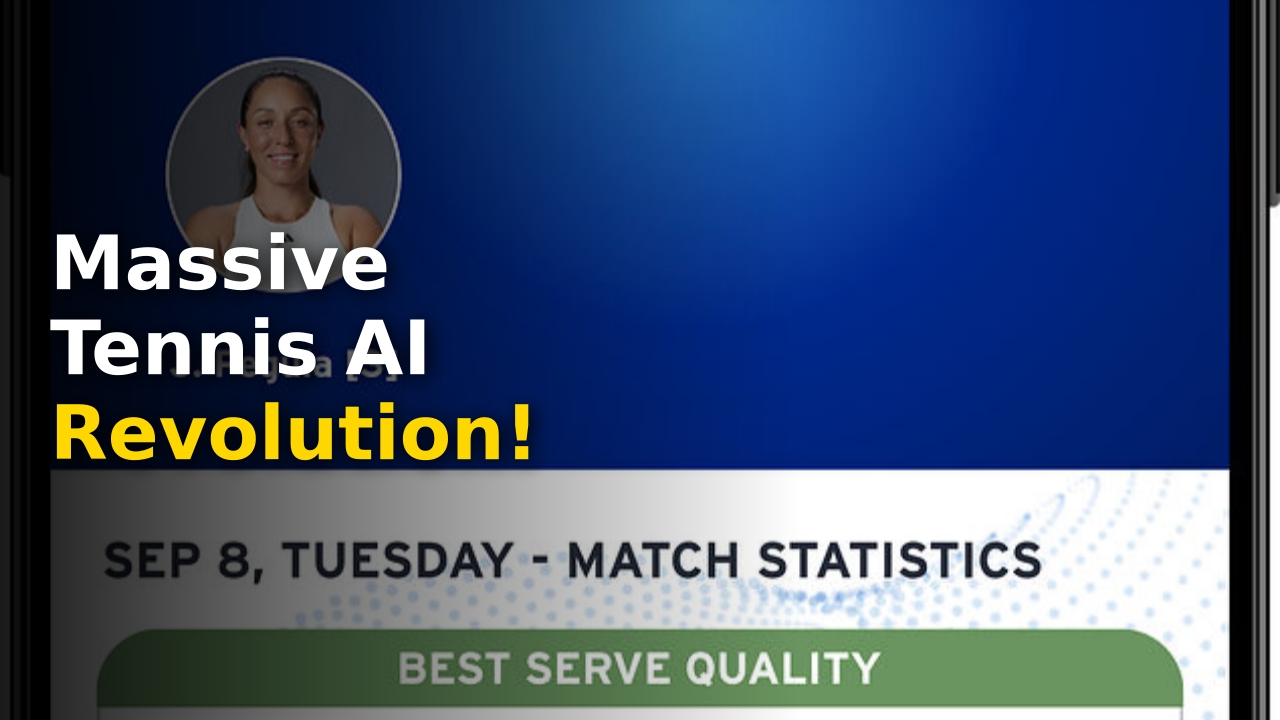
You might think you know tennis, but the 2026 US Open is about to shatter your reality with 1.2 billion data points. Tennis AI is the core engine behind this digital transformation, as IBM and the USTA roll out advanced features like ‘Serve Quality’ and ‘Key Moments’ to redefine spectator immersion. If you want to understand how technology is changing the game for the elite, you can visit Bright Celebrity to stay updated on the latest trends.
The 2026 US Open, running from August 23 to September 13, is no longer just a physical battle of endurance on the hard courts of New York. It has become a sophisticated data arena where every wrist flick and leg drive is scrutinized by machine learning models. This year, the focus is squarely on accuracy, ensuring that the 14 million global fans receive insights that are as precise as a Novak Djokovic return.
This digital pivot comes at a time when audience demand for high-tech features is reaching a fever pitch. According to a global survey from Morning Consult, a staggering 91% of tennis fans utilize sports apps during live matches. Even more telling is the 64% trust rating in AI-generated content, proving that the era of ‘gut feeling’ commentary is being replaced by cold, hard data.
Tennis AI Redefines Court Engagement
At the very heart of this year’s experience is the all-new Live Updates homepage, a feature designed to handle the chaos of a Grand Slam. This isn’t just a scoreboard; it is a smart, personalized hub that learns what you care about. If you are following a specific underdog’s run, the Tennis AI ensures their stats, highlights, and momentum shifts are front and center on your device.
The USTA and IBM have been partners since 1992, but 2026 marks a paradigm shift in how stories are told. By cutting through the noise, fans can prioritize their favorite players and quickly zero in on the specific matches that carry the most weight. This level of customization is essential when managing the sheer volume of data coming from hundreds of matches across the tournament.
Beyond simple score tracking, the system utilizes IBM Watsonx Orchestrate to power a conversational companion known as Match Chat. You can ask this AI anything from ‘How many aces has Carlos Alcaraz hit today?’ to ‘What is the historical head-to-head on this surface?’. The responses feel natural because the models are trained specifically on the editorial style of the USTA and the nuanced language of tennis professionals.
The integration of visual media into these chats is a game-changer. Instead of just getting a text response, the AI can now serve up relevant photos and videos to provide instant context. This creates a multi-modal experience that keeps you glued to the app, providing a deeper level of engagement than traditional broadcasting ever could.
Industry leaders believe this is the blueprint for the future of all professional sports. As reported by Reuters, the sports analytics market is expected to grow exponentially as fans demand more transparency and deeper insights into athlete performance. The US Open is simply the largest stage for this technological evolution to play out in real-time.
Ultimately, the goal is to make every fan feel like they have a professional coach sitting next to them. The Tennis AI acts as that expert, pointing out the subtle shifts in momentum and technical flaws that the naked eye might miss during a high-speed rally on Arthur Ashe Stadium.

Hyper-Personalized Content Streams
Personalization is the buzzword for 2026, but IBM is backing it up with serious infrastructure. The app now allows for ‘Favorite Player’ prioritization that triggers custom alerts for every break point, set point, and controversial call. This ensures that even if you are at work or on the move, you never miss the moments that define a career.
The backend of this system is managed by IBM Confluent, which handles the live data streams with zero latency. This means the update on your phone often happens faster than the delay on a satellite television broadcast. It creates a ‘second screen’ experience that is actually ahead of the ‘first screen,’ giving app users a distinct informational advantage.
The Science of the Perfect Serve
The most visually impressive addition this year is the Serve Quality metric, a tool that puts a whole new spin on how fans watch the opening shot of every point. Available across all 254 singles matches, this AI-powered tool uses advanced limb-tracking technology. This wasn’t built overnight; it was developed in collaboration with IBM Bob to analyze the precise mechanics of the human body in motion.
Imagine tracking 21 different points across the body and racquet, 50 times every single second. That is exactly what is happening on the courts of Flushing Meadows. The system captures everything from the flex of a player’s wrist to the explosive transfer of energy from their legs through their torso. This generates roughly 1.2 billion data points over the course of the three-week tournament.
The data stream is then distilled into a single, easy-to-understand Serve Quality score. This score factors in four critical pillars: efficiency, accuracy, consistency, and ball toss. If a player’s toss is slightly off-center, the AI detects it instantly, explaining why their first-serve percentage might be dropping in the third set.
For decades, fans have talked about ‘big servers,’ but we’ve never truly had a metric to quantify the ‘quality’ beyond just speed in miles per hour. Now, we can see if a 120 mph serve was actually more ‘effective’ than a 135 mph serve based on the placement and the energy expended by the player. It adds a layer of tactical appreciation that was previously reserved for high-level coaches.
This technology also has massive implications for player health and longevity. By tracking limb mechanics so closely, the data can eventually be used to identify fatigue patterns that lead to injuries. While the fans see a ‘quality score,’ the underlying data is a goldmine for sports scientists looking to optimize human performance at the highest level.
The USTA is committed to making this data accessible. You don’t need a PhD in physics to understand the Serve Quality tool. The app presents the information through intuitive graphics that highlight the ‘power zones’ and ‘strike points,’ making the invisible mechanics of tennis visible to everyone from casual viewers to die-hard stat-heads.
The Role of IBM Bob in Motion Capture
- Limb Tracking: Captures 21 specific nodes on the human frame for total movement analysis.
- Frequency: Operates at 50Hz, ensuring no micro-movement is missed during the serve phase.
- Data Volume: Processes over 1 billion data points to ensure the accuracy of the Serve Quality score.
- Real-Time Delivery: Managed by IBM Confluent to ensure the score appears on-screen seconds after the ball hits the court.
Smart Predictions Change the Game
Understanding who is winning is easy, but understanding why they are winning is where the Tennis AI truly shines. The enhanced Key Moments feature takes the popular Likelihood to Win metric and adds a layer of narrative depth. It calculates a player’s probability of victory by cross-referencing current match stats with historical data and expert opinions.
What makes Key Moments different is its ability to summarize the turning points. It identifies the ‘momentum shifts’ that change a match in an instant. For example, if a player saves three break points in a row, the AI calculates how that specific sequence of events has swung the win-probability percentage and explains the psychological weight of that moment.
This level of analysis is powered by watsonx, IBM’s flagship AI and data platform. By using fit-for-purpose models, the system can digest millions of data points and output a summary that feels like it was written by a veteran sports journalist. It provides the ‘richer information’ that fans crave, especially during the high-stakes matches of the quarter-finals and beyond.
The Likelihood to Win feature has become a staple for fans following the tournament on ESPN or the official app. It uses a combination of historical performance on hard courts, recent form, and live match momentum to provide a dynamic percentage that updates after every single point. It’s a nail-biting way to watch a match, seeing the percentage flip as a player begins a comeback.
Brian Ryerson, the Senior Director of Digital Strategy at the USTA, noted that this work has been ‘game-changing.’ By pushing the boundaries of digital fan engagement, they are able to tell more compelling stories. It isn’t just about who hoisted the trophy at the end; it’s about the thousand small victories and failures that happened along the way.
The predictive nature of the AI also helps in managing the broadcast schedule. By identifying matches that are likely to become ‘instant classics’ based on momentum shifts, the USTA can better direct fan attention to the courts where history is being made. It is an editorial tool powered by algorithms, ensuring the best tennis gets the most eyes.

Tennis AI Data Impact Summary
The following data highlights the sheer scale of the technological integration for the 2026 tournament. The numbers reflect the infrastructure required to support millions of fans and billions of data points simultaneously across the globe.
| Feature Metric | Data Detail | Fan Impact |
|---|---|---|
| Total Data Points | 1.2 Billion | Unprecedented Match Depth |
| Limb Tracking Nodes | 21 Points | Pro-Level Serve Analysis |
| Match Coverage | 254 Singles Matches | Total Tournament Transparency |
| AI Trust Factor | 64% of Global Fans | High Confidence in Content |
| Tracking Frequency | 50 Times Per Second | Real-Time Precision |
Behind the IBM USTA Partnership
The longevity of the partnership between IBM and the USTA is rare in the tech world. Since 1992, they have survived the transition from the early internet to the mobile revolution and now into the age of generative AI. This continuity allows them to build on a massive repository of historical data, which is the ‘fuel’ for the Tennis AI models used today.
Jonathan Adashek, Senior Vice President at IBM, emphasized that their work goes beyond just showing scores. It is about taking millions of live data points and routing them into workflows that deliver usable insights in minutes. This requires a hybrid cloud infrastructure that can scale instantly to handle the traffic spikes when a major star like Coco Gauff takes the court.
By leveraging Red Hat OpenShift, IBM ensures that the digital transformation of the US Open is secure and efficient. This is critical because the tournament attracts over 14 million digital users, making it one of the most trafficked sports events in the world. Security and reliability are just as important as the flashy AI features themselves.
The USTA also uses these insights to enhance their editorial capabilities. The AI agents are trained in the specific ‘voice’ of the US Open, ensuring that the automated summaries and chat responses feel consistent with the brand’s prestigious image. It is a fusion of human editorial expertise and machine efficiency.
Furthermore, the partnership focuses on inclusivity. The AI features are designed to be accessible across various devices, from high-end smartphones to basic mobile browsers, ensuring that fans in all 175 countries where IBM operates can enjoy the same high-quality experience. This global reach is a testament to the power of cloud-based AI delivery.
Looking ahead, the collaboration shows no signs of slowing down. As quantum computing and more advanced neural networks emerge, the level of detail provided to fans will only increase. We are moving toward a world where you won’t just watch a match; you will inhabit it through a digital layer of intelligence that explains every nuance of the sport.
Final Verdict on Tennis AI
The 2026 US Open stands as a landmark event in the intersection of sports and technology. By placing Tennis AI at the center of the fan experience, the USTA and IBM have solved the problem of data overload. Instead of being buried under a mountain of statistics, fans are presented with clear, actionable, and personalized stories that enhance their love for the game.
Whether it is the limb-tracking precision of the Serve Quality tool or the conversational ease of Match Chat, the innovations this year prove that AI is a tool for connection, not just calculation. It brings the fans closer to the players, helping them understand the immense physical and mental effort required to compete at the US Open.
As you prepare for the tournament this August, the official app and USOpen.org will be your essential companions. The Tennis AI will be working tirelessly in the background, processing billions of data points to ensure that your viewing experience is smarter, faster, and more personalized than ever before in the history of the sport.
In the end, the winner of the 2026 US Open won’t just be the player holding the trophy on the final Sunday. The real winner is the fan who, for the first time, can truly see the ‘why’ behind the ‘win.’ Technology has finally caught up to the speed of the pro circuit, and the results are nothing short of spectacular.
More Like This
For more updates, check out our latest entertainment and sports news.