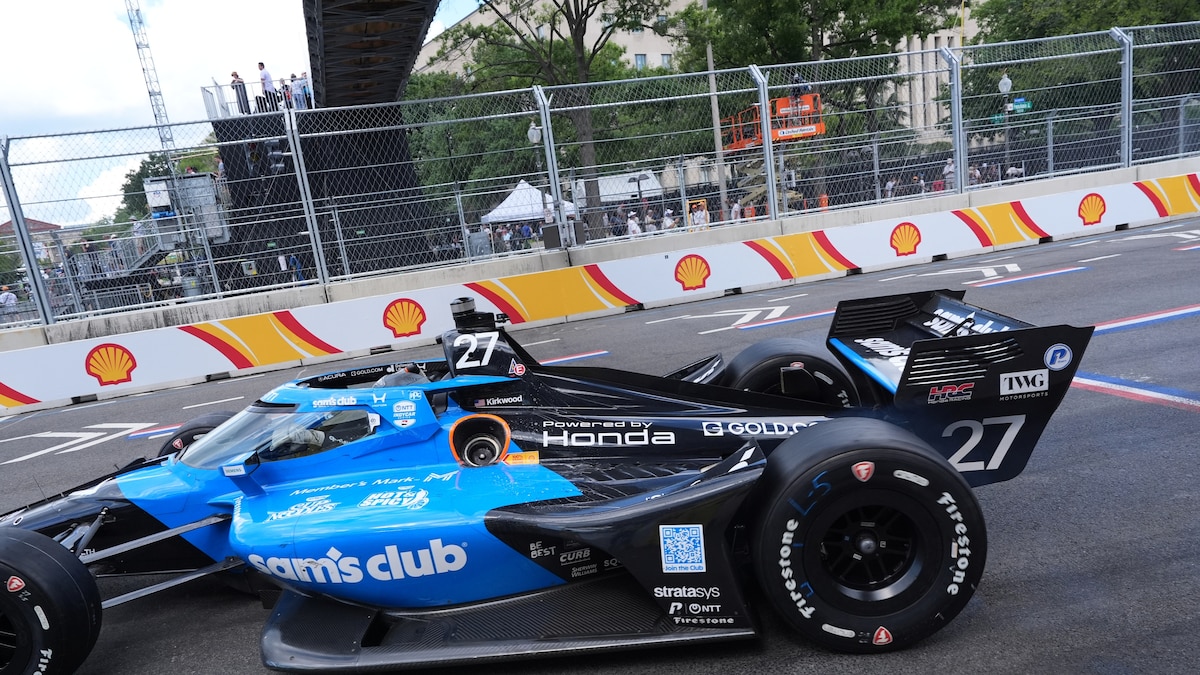
You might think winning a street race is just about speed, but the Kirkwood Victory on the streets of Washington D.C. proved that narrative entirely wrong. Kyle Kirkwood secured a historic win at the Freedom 250 in the heart of the nation’s capital, leading a staggering 128 laps in his No. 27 Honda to claim his second win of the season. This event, held as a centerpiece for the country’s 250th birthday celebration, saw an American driver cross the finish line just 3.09 seconds ahead of Christian Lundgaard, marking a patriotic milestone in the shadow of the U.S. Capitol.
The atmosphere was electric, blending high-stakes motorsport with a rare level of political prestige. With President Donald Trump waving the green flag and Mayor Muriel Bowser acting as grand marshal, the race transformed into a massive cultural phenomenon. You could feel the tension as the field navigated the 1.7-mile circuit, a track that demanded perfection from every driver. For Kirkwood, this wasn’t just another trophy; it was a career-defining performance that solidified his reputation as the undisputed “King of the Streets.”
This Kirkwood Victory represents more than just points in the standings; it is a signal of a shifting tide in the IndyCar series. As we dive into the details of how this dominant performance unfolded, we see a masterclass in defensive driving and pit strategy. The streets were awash in red, white, and blue, and the sheer magnitude of the crowd—over 215,000 strong—set a new benchmark for urban racing events in America. It was a day where strategy, luck, and raw talent collided under the bright D.C. sun.
Historic Kirkwood Victory in D.C.
When you look at the career trajectory of Kyle Kirkwood, his performance in Washington D.C. stands out as a pinnacle of professional excellence. This was his seventh career victory, yet he ranked it alongside his very first win in terms of emotional impact. The weight of the moment was palpable as he navigated the Pennsylvania Avenue straightaway, passing the Canadian embassy and its unique flag displays. For an American driver to win the Freedom 250 during such a historic anniversary is the kind of script Hollywood usually rejects for being too perfect.
The race itself was a showcase of dominance that few expected on a brand-new street circuit. Street courses are notoriously difficult because the pavement is often uneven, and the walls provide zero margin for error. Kirkwood, however, seemed to find a rhythm that eluded veteran champions. He controlled the pace from the start, managing his tires and fuel with the precision of a seasoned veteran. His Andretti Global teammates, Will Power and Marcus Ericsson, provided solid support by finishing third and fourth, respectively, highlighting the team’s overall technical superiority.
To understand the depth of this accomplishment, you have to look at the competition he faced. Christian Lundgaard and Scott McLaughlin are among the most aggressive drivers in the series, yet neither could find a way past the No. 27 car. Every restart was a test of nerves, and Kirkwood passed every single one without a hint of hesitation. The Kirkwood Victory was built on a foundation of early-season preparation and a deep understanding of how street tires interact with temporary asphalt surfaces.
The logistics of setting up a race in downtown D.C. were immense. Organizers worked for months to ensure the 1.7-mile track met rigorous safety standards while providing passing opportunities. The result was a circuit that felt tight yet allowed for high-speed drafting. Fans who gathered near the U.S. Capitol had a front-row seat to automotive history. This race was designed to be an event that transcended sports, and by all accounts, it succeeded brilliantly.
Many spectators were drawn to the event not just for the cars, but for the sheer spectacle of seeing IndyCar machines scream past iconic landmarks. You could see people lining the balconies of office buildings and hotels, desperate for a glimpse of the action. The merchandise sales alone, topping $969,000 on Saturday, suggest that the local economy felt a massive boost. This was a win for the city as much as it was for the driver, proving that D.C. can handle major international sporting events with ease.
Kirkwood’s post-race comments reflected the gravity of the situation. He noted that the magnitude of winning in the capital, under the Freedom 250 banner, might actually top his maiden victory. It’s rare to see a driver so cognizant of the historical context of their win. His maturity on and off the track is a primary reason why he is considered the future face of American open-wheel racing. This triumph has fundamentally changed the conversation around the 2025 championship race.

Chaos on the Concrete Streets
Street racing is never without its victims, and the Washington D.C. circuit claimed several high-profile scalps early in the day. The very first caution came out almost immediately due to debris, a common occurrence on temporary tracks where the surface hasn’t been “cured” by weeks of regular traffic. However, the real drama began when David Malukas lost control and hit the wall. With nowhere to go, Sting Ray Robb plowed into him, ending the day for two of the field’s eight Americans in a single, gut-wrenching moment.
The technical difficulty of the turns, especially those coming off the long Pennsylvania Avenue straight, forced drivers into awkward braking zones. If you missed your mark by even a few inches, you risked a season-ending collision. Marcus Armstrong found this out the hard way when he was penalized for contact with Christian Rasmussen. The ripple effect of that incident saw Rinus VeeKay end up in the wall, leading to a fiery post-race interview where VeeKay questioned the spatial awareness of his fellow competitors.
These crashes were more than just spectacle; they shifted the entire strategy for the lead lap cars. Every caution period allowed teams to reconsider their fuel windows and tire choices. For Kirkwood, these interruptions were moments of high stress where he had to defend his lead against fresh-tired opponents. The Kirkwood Victory was nearly derailed by a late-race restart where Scott McLaughlin attempted a daring pass. McLaughlin’s car ended up in the tire barrier, a testament to the high-risk, high-reward nature of this specific layout.
The role of the safety crew cannot be overstated. They worked with clinical efficiency to clear the track and reset the barriers, ensuring the race could finish under green flag conditions. Fans on Reuters and other major news outlets noted that the response times were among the best seen all year. This level of professionalism allowed the race to maintain its momentum despite the frequent yellow flags. It also kept the pressure squarely on the leaders, who had to stay focused through every delay.
Interestingly, the track conditions changed as the sun moved across the sky. The shadows from the tall D.C. buildings created “cold spots” on the asphalt, making grip unpredictable in certain corners. This environmental factor played a role in Alex Palou’s spin later in the race. Drivers had to constantly adjust their brake bias to account for these micro-climates on the track. It was a cerebral challenge that separated the elite from the merely talented on this fateful Sunday afternoon.
As the race reached its final stages, the attrition rate became a major talking point. Only a fraction of the starting grid finished on the lead lap. This highlighted the importance of staying out of trouble, a feat Kirkwood managed with seemingly effortless grace. While others were bickering over contact and penalties, he was focused on hitting his apexes and managing his gap to Lundgaard. The mental fortitude required to lead 128 laps under these conditions is truly extraordinary.
Key Incidents and Penalties
- David Malukas & Sting Ray Robb: Early exit due to a multi-car collision in a tight turn.
- Alex Palou: Suffered a drive-through penalty for hitting a tire in a neighboring pit stall.
- Marcus Armstrong: Penalized for avoidable contact with Christian Rasmussen.
- Scott McLaughlin: Crashed into a tire barrier while attempting a pass for the lead with 19 laps to go.
- Rinus VeeKay: Caught in the crossfire of the Armstrong-Rasmussen incident, ending his podium hopes.
- Alex Palou (Again): Experienced a loose tire during a pit stop, falling off the lead lap.
Political Power and Racing Pomp
It is not every day that a sporting event features the leader of the free world and the city’s highest-ranking official in such prominent roles. President Donald Trump was not just a guest; he was an active participant, providing the command for drivers to start their engines. His presence underscored the importance of the Freedom 250 as a national celebration. Many political commentators on ESPN suggested that this event was a unique bridge between the world of high-octane sports and national pride.
The visual of IndyCars racing past the U.S. Capitol is an image that will likely be used in tourism and sports marketing for decades. The area was transformed into a sea of red, white, and blue, with fans traveling from across the country to witness the spectacle. This wasn’t just about racing; it was about celebrating the 250th anniversary of the United States in a way that felt modern and exciting. The coordination between the Secret Service, local police, and race organizers was a massive undertaking that went off without a major hitch.
Mayor Muriel Bowser served as the Grand Marshal, further cementing the local government’s support for the race. There had been some initial skepticism about shutting down major arteries in downtown Washington, but the sheer attendance numbers proved the demand was there. Over 215,000 people attended over the weekend, a figure that rivals some of the biggest races in the world. The economic impact for D.C. businesses, from hotels to local eateries, is expected to be in the tens of millions.
The involvement of the Canadian embassy added a touch of international flavor to the proceedings. Located right on the Pennsylvania Avenue straightaway, the embassy displayed flags that perfectly complemented the race’s color scheme. This subtle nod to North American cooperation was not lost on the attendees. The Kirkwood Victory felt like a win for the entire region, showcasing Washington as a city that can embrace unconventional and thrilling entertainment options.
During the post-race press conference, the discussion quickly turned to the future. Bud Denker, the race chair, mentioned that President Trump was highly enthusiastic about keeping the race in D.C. for the long term. The idea of a five-year contract was floated, which would ensure the event continues through the next several political cycles. This kind of high-level endorsement is exactly what a new street race needs to become a permanent fixture on the IndyCar calendar.
The celebrity presence extended beyond the political sphere, with stars from various industries seen in the paddock. For more on the celebrities who frequent high-profile events like this, check out Bright Celebrity. The blend of influencers, politicians, and world-class athletes created a unique social ecosystem. It reminded many of the glamorous atmosphere found at the Monaco Grand Prix, but with a distinctly American twist. The Kirkwood Victory provided the perfect ending to a weekend defined by power and prestige.
Freedom 250 Performance Data
To truly appreciate the Kirkwood Victory, one must examine the raw data from the 250-mile marathon. Kirkwood’s ability to maintain a consistent gap of over three seconds in the final stages of the race is a testament to his car’s setup and his own physical conditioning. While many drivers struggled with the heat and the physical toll of the bumpy street circuit, Kirkwood looked as fresh on lap 147 as he did on lap one. The following table provides a clear look at the top performers and the statistics that defined the weekend.
| Driver | Team | Laps Led | Finish Position |
|---|---|---|---|
| Kyle Kirkwood | Andretti Global | 128 | 1st |
| Christian Lundgaard | Rahal Letterman Lanigan | 12 | 2nd |
| Will Power | Penske/Andretti (Partner) | 5 | 3rd |
| Marcus Ericsson | Andretti Global | 2 | 4th |
| Alex Palou | Chip Ganassi Racing | 0 | 20th |
The data clearly shows that Kyle Kirkwood was in a league of his own. By leading over 87% of the race, he effectively neutralized the strategies of every other team. This kind of dominant performance is rare in the modern era of IndyCar, where the field is typically separated by fractions of a second. The fact that he achieved this on a 1.7-mile circuit where he had never raced before makes the Kirkwood Victory even more impressive. It suggests a level of adaptability that will serve him well in future seasons.
Another fascinating data point is the merchandise revenue. To sell nearly a million dollars in gear in a single day is an unprecedented feat for a non-Indianapolis race. This indicates a massive “buy-in” from the D.C. community and traveling fans. The demographic data suggests a younger, more diverse audience than typical races, which is a key growth metric for the series. It turns out that racing in the streets of a major city is the most effective way to reach new fans.
Finally, we have to look at the championship standings. Alex Palou arrived in D.C. with a comfortable 133-point lead, looking to clinch the title early. However, his 20th-place finish—his second-worst showing of the year—saw that lead shrink to just 91 points. With three races remaining, the championship is suddenly back in play. Kirkwood’s win has not only vaulted him up the standings but has also injected a massive dose of adrenaline into the final stretch of the season.
Championship Dreams and Pit Disasters
While Kirkwood was celebrating, Alex Palou was left wondering where it all went wrong. For a driver of his caliber, the series of errors that plagued his day was uncharacteristic. It began with a drive-through penalty for a pit road infraction, a mistake that put him on the defensive. But the real blow came during a subsequent stop when a tire was left loose. This forced him back into the pits and ultimately caused him to fall off the lead lap, a nightmare scenario for any title contender.
Palou’s spin later in the race was the final nail in the coffin for his D.C. weekend. It was a rare lapse in judgment from a driver known for his surgical precision. Despite the frustration, Palou remained composed in his post-race interviews, noting that he was glad all the bad luck happened on one day. The reality is that his massive lead has been significantly dented, and he can no longer afford a “safe” race. He will need to return to his winning ways to hold off the charging pack.
The Kirkwood Victory has placed him as the primary challenger to Palou’s crown. If Kirkwood can maintain this level of street-circuit dominance, he could potentially pull off one of the greatest upsets in racing history. The gap is still significant, but the momentum has clearly shifted. Racing fans are now eagerly looking forward to the next three events to see if the young American can continue his historic run. The pressure is now entirely on the Chip Ganassi Racing team to respond.
What makes the IndyCar championship so compelling is how quickly fortunes can change. One loose wheel or one ill-timed caution can erase months of hard work. In Washington D.C., we saw the best and worst of the sport. We saw a masterclass in driving from Kirkwood and a series of technical and human errors from Palou. It serves as a reminder that in motorsport, nothing is guaranteed until the checkered flag drops. You can have the fastest car in the world, but if your pit crew or your focus wavers, you will find yourself at the back of the pack.
The technical analysis of Palou’s pit road penalty reveals a lot about the tight confines of street circuit racing. In traditional permanent tracks, there is more space for drivers to maneuver. In D.C., the pit boxes were incredibly cramped. Palou appeared to hit a tire in a neighboring team’s area while exiting, a violation of the strict safety protocols. This split-second error had a massive ripple effect, highlighting the importance of total situational awareness at all times.
Looking ahead, the championship battle will likely come down to who can handle the pressure of these high-stakes urban environments. Kirkwood has proven he is a master of the concrete canyons. Palou, on the other hand, will need to prove that his D.C. disaster was a one-time fluke. The battle between the seasoned Spanish champion and the rising American star is the central narrative of the season. Every lap from here on out is a high-speed game of chess.
The Bright Future of Washington Racing
As the sun set over the U.S. Capitol, the primary question on everyone’s mind was whether the Freedom 250 would return. Bud Denker, the race chair, sounded incredibly optimistic during his final briefing. He credited the success of the event to the unique partnership between the series and the city. The sheer volume of fans and the global media attention have made a compelling case for Washington D.C. to become a permanent stop on the tour. The Kirkwood Victory was the perfect advertisement for the sport’s potential in major urban markets.
The five-year plan proposed by President Trump would provide the stability needed to grow the event even further. A multi-year commitment allows for better planning, more sponsors, and a more permanent infrastructure. This could lead to a tradition that rivals the Long Beach Grand Prix or the Detroit Grand Prix. For local fans, it means an annual opportunity to see world-class racing in their own backyard. For the drivers, it’s a chance to compete on one of the most prestigious stages in the world.
The economic benefits are also hard to ignore. With nearly a million dollars in merchandise sold and hundreds of thousands of fans staying in local hotels, the Freedom 250 has proven to be a financial windfall. In a city where politics usually dominates the headlines, the roar of engines provided a welcome and lucrative distraction. The Kirkwood Victory helped ensure that the inaugural race was a resounding success both on the track and on the balance sheet.
Ultimately, the success of the weekend belongs to the fans. Their enthusiasm and energy transformed a simple race into a national event. You could see the passion in the grandstands and the excitement on the streets. This event showed that there is a massive appetite for IndyCar racing in the Northeast. As the series owners discuss the future with Roger Penske, the data from Washington will be the strongest argument for expansion. The streets of D.C. have proven they belong in the world of high-speed sports.
What’s next for the “King of the Streets”? Kirkwood is already looking toward the next challenge. He knows that one win doesn’t make a season, but it certainly sets the tone. His focus is now on closing the gap in the championship and proving that his performance in the capital was no fluke. With the support of Andretti Global and a car that seems perfectly tuned for street circuits, he is a force to be reckoned with. The racing world will be watching closely as the season reaches its climax.
The Kirkwood Victory at the Freedom 250 will be remembered as a turning point for the sport. It brought racing to the heart of American democracy and crowned a homegrown hero in front of a global audience. Whether it’s the political prestige, the technical drama, or the sheer speed of the cars, this event had something for everyone. As we look back on this historic weekend, one thing is clear: IndyCar has found a new home in Washington D.C., and the future has never looked brighter.
More Like This
For more updates, check out our latest entertainment and sports news.