
The massive soccer boom sweeping across the United States has reached a critical turning point that could change American sports forever.
You have likely noticed your social feeds, local pubs, and neighborhood parks buzzing with unprecedented energy.
But is this genuine, lasting growth, or simply a temporary high fueled by the historic 2026 FIFA World Cup?
Decoding the Digital Hype
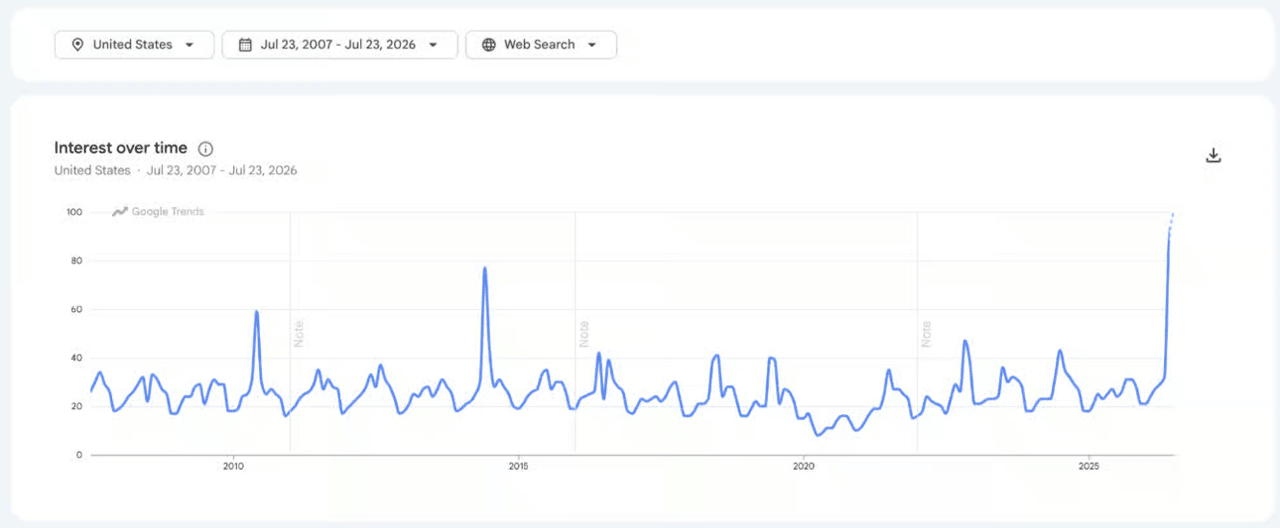
Google Trends recently recorded an all-time high for the search term “soccer” during the summer of 2026.
This digital activity climbed steadily for nearly six months before the opening kickoff.
Yet, history tells us that what goes up must inevitably come down once the global spotlight turns off.
To understand the longevity of this interest, you must look at how search patterns have behaved over the last two decades.
Historically, major tournaments act as massive catalysts that quickly fade.
For instance, the 2014 FIFA World Cup saw search interest spike to a then-record 77% of peak volume.
Within a few short months, that number plummeted back down into the teens as traditional sports reclaimed the stage.
The trend repeated during the 2015 and 2019 Women’s World Cups, despite the legendary triumphs of the USWNT.
The championship match in 2015 pulled in over 25 million viewers, generating a massive cultural conversation.
Yet, search trends dropped from a peak of 35 down to 27 almost immediately after the trophy was lifted.
To sustain a true soccer boom, fans must remain engaged long after the final whistle blows.
The 2018 men’s tournament barely made a dent in American search engines.
This lack of interest directly correlated with the failure of the USMNT to qualify for the event in Russia.
This reveals a harsh reality: American fans are deeply event-driven rather than year-round consumers of the sport.
Even the unusual winter schedule of Qatar 2022 showed a similar dynamic.
Despite overlapping with the peak of the NFL and college football seasons, search interest hit 47.
It was an impressive showing, but still followed the classic pattern of a rapid post-tournament decline.
You must realize that these spikes represent casual curiosity rather than systemic fandom.
Millions of sports fans tune in to participate in the global cultural moment.
Once the tournament ends, they quickly return to their established viewing habits.
The Illusion of Breakthroughs
Every four years, media pundits declare that soccer has finally arrived in mainstream America.
The data suggests this is a recurring illusion rather than a permanent shift.
Within eight weeks of every major final, search engines show that interest routinely drops by at least half.
Tim Howard’s Iconic Stand
Take the 2014 tournament in Brazil, where search interest hit a staggering pre-2026 high.
Even after Tim Howard set a World Cup record with 16 saves against Belgium on July 1, 2014, interest collapsed.
By August, the sport was back to its pre-tournament baseline, largely forgotten by casual viewers.
Analyzing the soccer boom

If you want to understand the true trajectory, you must examine how the current soccer boom compares to past eras.
Unlike previous tournaments, the 2026 edition took place on home soil, offering unprecedented physical access to matches.
This geographical advantage created a deeper emotional connection than any broadcast from distant time zones could achieve.
However, physical proximity does not automatically translate into lifelong engagement.
For many casual fans, attending a match or buying a scarf was simply about being part of a historical party.
Once the caravan moves on, the sport must survive without the glitz of global superstardom.
You can find similar historical patterns in the wake of the legendary 1994 tournament hosted by the U.S.
That event famously catalyzed the launch of Major League Soccer in 1996, showing that home tournaments can build lasting infrastructure.
But the league spent its first decade fighting severe financial deficits and empty NFL stadiums.
Today’s digital ecosystem is vastly different, allowing fans to stream global leagues instantly on their phones.
This ease of access could help sustain the current momentum in ways that were impossible in the nineties.
Yet, this abundance of choice also means soccer must fight harder against rival entertainment options.
The question remains whether local clubs can capture this fleeting audience.
If fans only care about elite international stars, local leagues will continue to struggle for mainstream attention.
The transition from a World Cup viewer to a weekly domestic supporter is a massive hurdle.
Let us look at the official Google Trends peak values over the last two decades to understand this pattern clearly.
| Tournament Year | Peak Search Index | 6-Month Post-Tournament Index | U.S. Performance / Host Status |
|---|---|---|---|
| June 2010 | 59 | Under 20 | Round of 16 (South Africa) |
| June 2014 | 77 | Under 20 | Round of 16 (Brazil) |
| July 2015 (Women’s) | 35 | 18 | Champions (Canada) |
| June 2019 (Women’s) | 40 | 21 | Champions (France) |
| November 2022 | 47 | Under 20 | Round of 16 (Qatar) |
| Summer 2026 | 100 | TBD | Co-Host (United States) |
The Infrastructure Bottleneck
Even the most passionate fans cannot play or watch the sport without proper support systems.
Critics point out that mega-events rarely generate lasting local participation on their own.
For the sport to take root, communities need accessible fields, affordable programs, and trained coaches.
The current reality in American municipal sports is highly alarming.
A recent study revealed that 67% of local parks departments across the nation face severe shortages of soccer fields.
Without physical space to play, eager young athletes are forced to turn to other sports.
The coaching pipeline is dangerously thin.
Approximately 82% of athletic agencies report a massive shortage of volunteer coaches.
This makes it incredibly difficult to scale up local youth leagues to meet post-tournament demand.
Without addressing these root issues, it is impossible to keep the soccer boom alive.
The lack of public infrastructure creates a systemic bottleneck that blocks organic growth.
If kids cannot find a field or a qualified coach, their passion for the game will quickly vanish.
The Rising Cost Barrier
American youth sports have become a multi-billion dollar “pay-to-play” industry.
Elite academies often demand thousands of dollars annually from families.
This pricing structure locks out talented players from working-class backgrounds, limiting the growth of the sport.
The Stadium Logistics Nightmare
While stadiums were packed during the cup, local matches often struggle with transit.
Many MLS and NWSL clubs operate in suburban areas without robust public transportation.
Getting to games remains a friction point that discourages casual fans from regular attendance.
Competing for Finite Attention
You must realize that consumer attention is a finite resource.
A fan might download a streaming app, buy a player’s kit, and watch three matches in July.
But once September arrives, they are forced to choose between soccer and massive American giants.
The NFL, college football, the NBA, and the MLB dominate the media landscape.
These leagues have deep-seated generational roots in the American household.
Soccer often acts as a temporary filler rather than a replacement for these existing entertainment habits.
The physical toll of attending these major summer tournaments is also a factor.
Fans spent thousands of dollars on ticket prices, expensive parking, and long-distance travel.
This level of spending is simply unsustainable for the average family on a weekly basis.
With massive inflation squeezing wallets, families will prioritize their legacy sporting loyalties.
A temporary tournament interest rarely disrupts decades of family dedication to local football or baseball teams.
Therefore, soccer must prove its ongoing value to survive this relentless competitive landscape.
The Broadcast Battleground
Broadcasters are investing heavily to secure premium international soccer television rights.
From the English Premier League to the UEFA Champions League, options are plentiful.
Yet, this fragmentation forces fans to purchase multiple streaming services to follow the sport.
Global Stars vs. Local Heroes
American fans love to watch elite global icons perform on the biggest stages.
However, keeping them engaged in lower-tier domestic matches is a completely different challenge.
For insights on celebrity culture and lifestyle trends, check out the vibrant community at Bright Celebrity, where fans connect daily.
Sustaining the soccer boom
The path forward requires a coordinated effort from every corner of the soccer ecosystem.
Jonathan Sperling, an associate director at Columbia Business School, emphasizes that the tournament served as an introductory handshake.
Now, the real work begins to keep those new fans from walking away.
According to the latest Ipsos poll, a majority of Americans believe this interest will persist.
But optimism must be backed by strategic investment in local infrastructure.
Clubs must make matches highly accessible and affordable to build a generational fan base.
If the domestic leagues can capitalize on this momentum, the U.S. could become a global soccer superpower.
The sheer demographic size and commercial power of America make it an incredibly lucrative market.
But history warns us that without deep structural changes, this spike will fade just like the rest.
Local clubs must create localized activations to keep the soccer boom active.
Simply relying on the memory of global superstars will not sustain stadium attendance in the long run.
Instead, leagues must offer ticket promotions, family nights, and community integration to secure loyalty.
Local municipal departments must streamline field permit approvals for youth programs.
Making it easier for grassroots clubs to establish leagues is crucial for propelling the soccer boom forward.
If we fail to build these local pathways, the entire effort will have been for nothing.
The Role of Community Programs
Grassroots initiatives are essential for converting casual tournament viewers into lifelong fans.
Schools and local clubs must partner to offer free after-school soccer programs.
This removes the financial barriers that have historically held the sport back.
Cultivating Authentic Fan Culture
Authentic fan culture cannot be manufactured overnight by corporate sponsors.
It must grow organically through local supporter groups, stadium experiences, and community pride.
When fans feel a deep personal connection to their local club, they remain loyal through wins and losses.
The ultimate test of this historic soccer boom will play out over the next few years.
More Like This
For more updates, check out our latest entertainment and sports news.