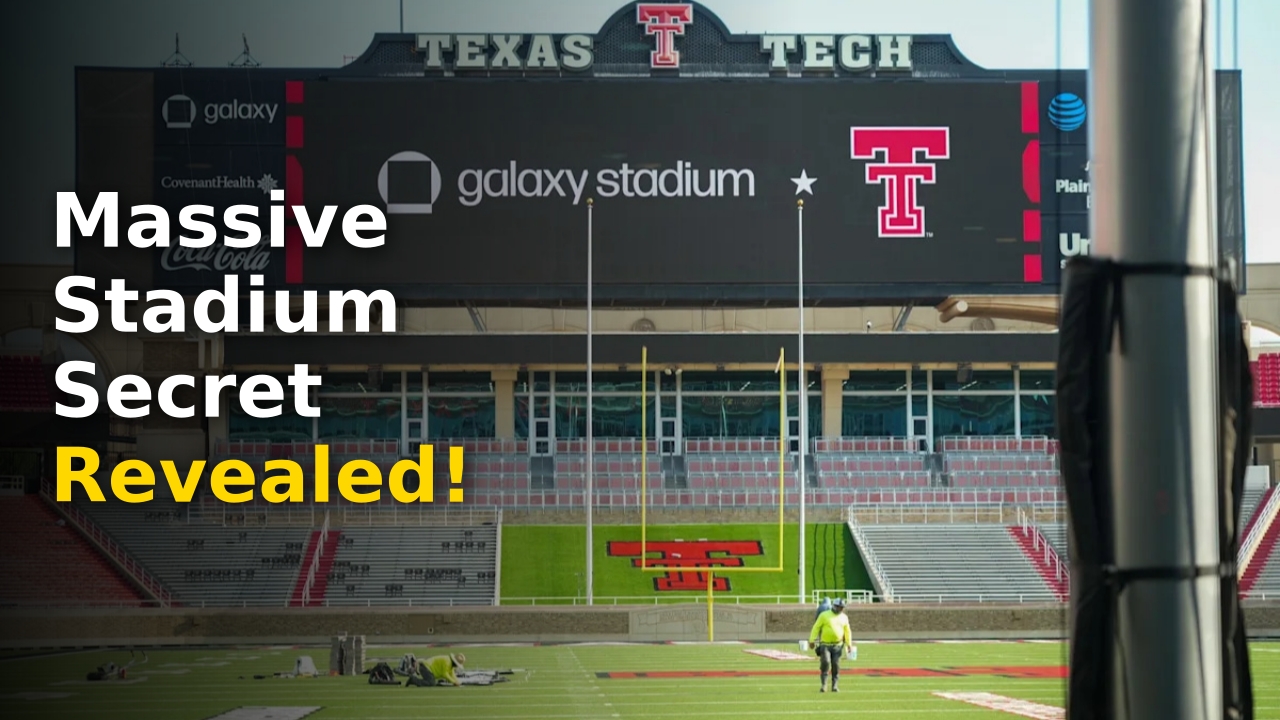
Jones Stadium is a name that resonates deep within the soul of every Red Raider fan, standing as a testament to decades of grit and West Texas pride. You might have heard whispers that the legendary moniker was vanishing forever, but the truth is far more complex and strategically brilliant. Texas Tech officials recently pulled off a masterstroke in branding that keeps the past alive while securing a lucrative future for the program.
While the exterior of the venue now sports the Galaxy Stadium branding, the heart of the field—the roaring student section—will forever belong to the Jones family. This pivot ensures that the 12,500 students who make Lubbock the most intimidating environment in college football still have a home with a history. You are witnessing a new era where tradition meets high-stakes corporate investment without losing its identity.
Athletics Director Kirby Hocutt made the announcement clear during a high-energy Red Raider Club kickoff luncheon at the Memorial Civic Center. He urged the student body to continue their tradition of making gamedays a living nightmare for opponents. The strategy is simple: keep the spirit of the “Jones” alive where the noise is loudest, ensuring the legacy of Clifford B. Jones remains embedded in the university’s DNA.
Jones Stadium Heritage Preserved
The decision to keep the Jones Stadium name attached to the student section is not just about nostalgia; it is about honoring a debt of gratitude. Clifford B. Jones served as the third president of Texas Tech from 1939 to 1944, a pivotal time when the university was finding its footing. He and his wife, Audrey Jones, were more than just administrators; they were the financial lifelines of the athletic department.
When the stadium was dedicated in November 1947, it was a modest structure compared to the modern coliseums of today. Reports from that era highlight that Jones personally contributed $100,000 toward the $400,000 construction cost. In today’s economy, that kind of personal investment from a university leader is virtually unheard of. It set a precedent for the “Pack the Jones” culture that defines every Saturday in Lubbock.
By 1972, another donation of $75,000 from the Jones family allowed the university to expand the seating capacity to 47,000. This expansion allowed the program to grow into the Power Four powerhouse you see today. When Jones passed away that same year, former AD JT King expressed a wish that the stadium would always serve as a memorial to the couple’s generosity. Keeping the name for the students fulfills that decades-old promise in a modern way.
The student section, now officially dubbed “The Jones Student Section at Galaxy Stadium,” will house the most passionate fans in the Big 12. This move bridges the gap between the 1947 dedication and the 2024 season. It allows the younger generation to connect with a history they might not have otherwise known, keeping the story of the Jones family relevant for another fifteen years and beyond.
Think about the psychological impact on the players when they look toward the north end zone. They aren’t just seeing a corporate logo; they are seeing a tribute to the people who literally built the foundation they stand on. This continuity is essential for recruiting and maintaining the unique culture of Texas Tech football that sets it apart from the sterile environments found in some pro-style college venues.
As you look at the latest collegiate sports trends, it is clear that many schools are struggling to balance tradition with the need for modern revenue streams. Texas Tech has effectively navigated this minefield. By segmenting the branding, they have satisfied the requirements of a $75 million contract while appeasing a fanbase that values its roots above all else.

The $100k Legacy Foundation
The original $100,000 gift from Clifford B. Jones was a staggering sum for the 1940s, representing 25% of the total stadium cost. This level of private support was the catalyst for Tech’s entry into the major ranks of college athletics. Without this initial seed money, the program might have languished in regional obscurity rather than becoming a national brand.
Audrey Jones was equally influential, often seen as the matriarch of the Red Raider community. Her involvement ensured that the athletic department was viewed as a family endeavor rather than a cold business. This familial atmosphere is what Joey McGuire taps into today when he talks about the “brand” of Texas Tech football. It is a lineage of support that started in a small office in 1939 and continues in the luxury suites of Galaxy Stadium.
The 1972 expansion was the next major milestone, turning Jones Stadium into a true fortress. That expansion happened right as the program was entering a golden era of Southwest Conference play. The timing of the Jones family’s gifts always seemed to coincide with the university’s greatest moments of need, proving their commitment was lifelong and unwavering.
The $75 Million Tech Deal
Money talks in the modern Big 12, and the 15-year, $75 million agreement with Galaxy is a loud statement of intent. Galaxy is a cutting-edge technology firm specializing in advanced data center infrastructure and digital assets. This partnership is a massive upgrade from the previous 20-year deal with AT&T, which expired in June after the telecom giant declined to negotiate new rights.
You have to realize that $5 million per year in naming rights revenue is a game-changer for a program like Texas Tech. This capital allows for facility upgrades, coaching staff retention, and the NIL (Name, Image, and Likeness) resources needed to compete with the likes of Alabama and Ohio State. It is the fuel that powers the engine of a championship-caliber athletic department.
Athletics Director Kirby Hocutt, who has been in his post since February 2011, has been the architect of this financial growth. He recently surpassed Gerald Myers as the longest-serving AD in school history. Under his leadership, Tech has transitioned from being a “good” program to one that is consistently “great,” as evidenced by the school’s recent College Football Playoff appearance and Big 12 Championship win.
The deal with Galaxy reflects the university’s forward-thinking approach. While other schools stick to traditional banking or insurance partners, Tech has aligned itself with the future of digital infrastructure. This synergy makes sense given the university’s strong engineering and technology programs. It is a partnership that extends beyond just a sign on the stadium wall; it represents a shared vision of innovation.
Critics of corporate naming rights often argue that it kills the soul of the game. However, when you consider that the alternative is falling behind in the arms race of college sports, the choice becomes clear. Texas Tech managed to secure the bag without selling its soul, a feat that requires a delicate touch and a deep understanding of the Lubbock community’s values.
The $75 million influx will also assist with the university’s broader debt management, as noted in recent opinions regarding the Galaxy Stadium deal. It provides a stable financial floor for the next decade and a half, allowing the administration to take calculated risks in other areas of the university’s development. This is high-level institutional management at its finest.
Red Raider Gridiron Stats
To understand why a company like Galaxy would invest $75 million, you have to look at the numbers on the field. Texas Tech isn’t just a participant; they are a winner. Last year, the team went 12-2, a record-breaking performance that culminated in an Orange Bowl appearance and a Big 12 trophy. These aren’t just stats; they are the resume of a program on the rise.
| Season Metric | Stat / Achievement | Historical Context |
|---|---|---|
| 2023 Season Record | 12-2 | Most wins in program history |
| Bowl Game | Orange Bowl | First Orange Bowl appearance |
| Conference Status | Big 12 Champions | First Big 12 title for Tech |
| Enrollment 2024 | 44,904 | New all-time university record |
| Coach Joey McGuire | 35-18 Record | Defining a new generation |
The statistical dominance extends beyond the football field. Texas Tech was one of only four Power Four programs last year to reach the College Football Playoff, as well as both the men’s and women’s NCAA Basketball Tournaments. They are in elite company with Alabama, Georgia, and Ohio State. This across-the-board success makes the Jones Stadium brand incredibly valuable to sponsors.
President Lawrence Schovanec pointed out that the university is defying national narratives. While many colleges are seeing enrollment drops, Tech is surging. With 44,904 students enrolled this fall, the “Jones Student Section” is going to be more crowded and louder than ever. This growth provides a massive, captive audience for the Galaxy brand every single week.
Fueling the Gameday Atmosphere
The magic of a Saturday in Lubbock is something you have to feel to understand. It is a desert oasis where 60,000 people congregate to scream their lungs out. By keeping the Jones name for the students, the university is acknowledging that the fans are the ones who truly own the stadium. Kirby Hocutt knows this, which is why he challenged the students to make it the “wildest environment in all of college football.”
Coach Joey McGuire has been a revelation for the program. In his four seasons, he hasn’t just won games; he has rebranded the entire culture of the Red Raiders. He emphasizes a brand of “toughness” that mirrors the West Texas landscape. For the newest generation of fans, Jones Stadium and winning are synonymous, creating a positive feedback loop of high expectations and legendary results.
The student section is the epicenter of this energy. They are the ones who arrive early, stay late, and create the “nightmare” atmosphere for opposing quarterbacks. By officially naming their territory “The Jones,” the university has given the students a sense of ownership over the program’s history. It is a brilliant psychological move that will undoubtedly pay dividends in decibel levels.

You can expect the Sept. 5 home opener against Abilene Christian to be a sellout. The anticipation for the new season, combined with the curiosity over the Galaxy Stadium upgrades, has created a fever pitch in the community. It will be the first time fans walk into the venue under its new name, but they will still be packing the “Jones” just like they have since 1947.
Student Section Traditions
- The Guns Up hand signal, which originated in the early 1970s and remains a staple.
- The Tortilla Tossing tradition, a quirky and beloved ritual that baffles outsiders.
- The Masked Rider‘s legendary entrance, galloping across the turf to ignite the crowd.
- The Matador Song, sung in unison by thousands of students at the conclusion of every game.
These traditions are the heartbeat of the Jones Stadium experience. They provide a sense of continuity that transcends naming rights or corporate sponsors. When the students toss those tortillas this September, they will be doing so in a section that honors the very man who made the stadium possible. It is a beautiful irony that the most “wild” part of the stadium is also its most historical.
Jones Stadium Future Horizons
As the sun sets over the South Plains, the silhouette of the stadium stands as a beacon for the entire region. The transition to Galaxy Stadium while maintaining the Jones Stadium student section is a template for the future of collegiate sports. It proves that you can embrace the 21st-century economy without erasing the 20th-century pioneers who paved the way.
The 15-year commitment from Galaxy provides a window of stability that few programs enjoy. It allows Joey McGuire and his staff to recruit with confidence, knowing the facilities and financial backing are top-tier. You are seeing a university that refuses to be ignored on the national stage, lead by a president and an AD who understand the intersection of business and tradition.
The Jones Stadium name will never truly leave the lips of the faithful. Even as the signs change and the technology evolves, the “Jones” will remain a sacred place for generations of Red Raiders. It is a memorial to a man and his wife who believed in the potential of a small school in Lubbock, and a promise that their impact will never be forgotten.
In the final analysis, the Jones Stadium story is one of evolution. From a $400,000 construction project to a $75 million tech partnership, the journey has been nothing short of miraculous. As you prepare for the kickoff of a new season, remember that you aren’t just watching a game; you are participating in a legacy that has been eighty years in the making. Wreck ’em, Tech!
More Like This
For more updates, check out our latest entertainment and sports news.