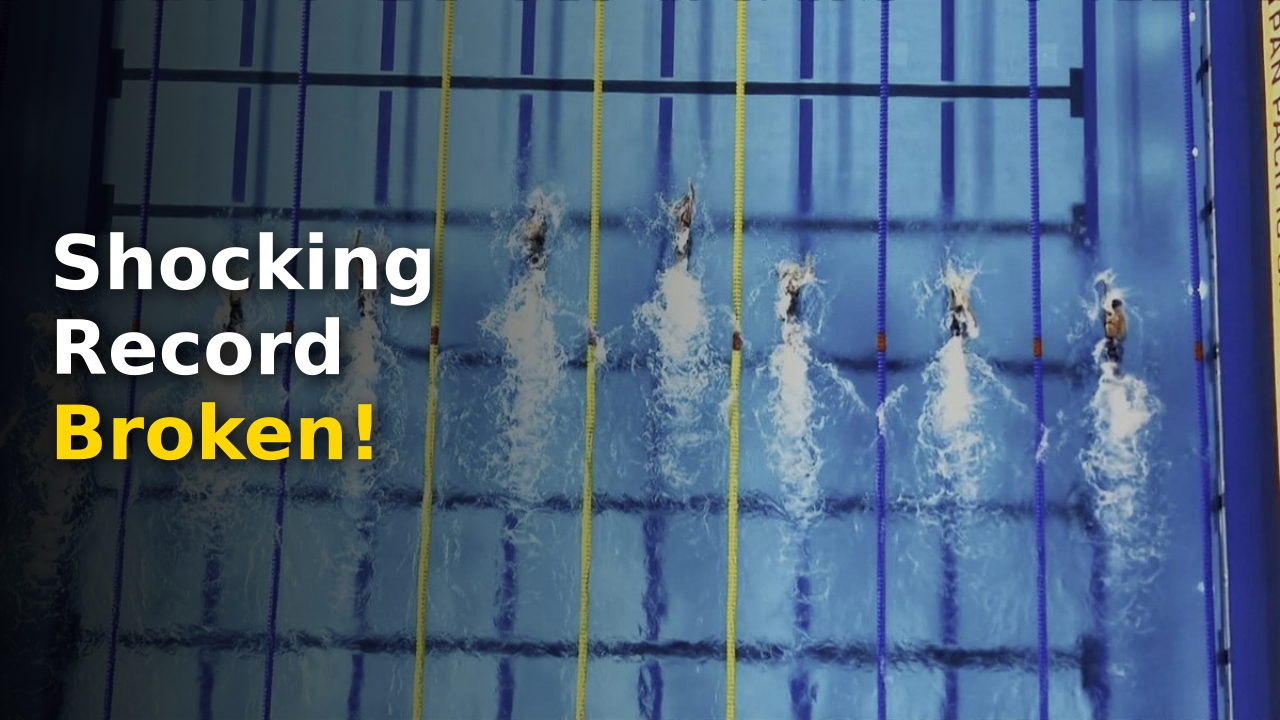
Kate Douglass has redefined the limits of human speed, leaving the world of competitive swimming in complete awe after her latest performance. Kate Douglass dominated the pool during the Pan Pacific Championships, proving that her technical prowess is currently unmatched on the global stage. You are witnessing history in the making as she recalibrates what we thought was possible in the 50m freestyle sprint.
Can you imagine shaving precious milliseconds off a world record twice in a single afternoon? This is the reality of the current era in aquatics where Kate Douglass serves as the primary disruptor. Her recent time of 23.19 seconds isn’t just a number; it is a testament to years of grueling training and physiological perfection.
Kate Douglass Masterclass Performance
When you watch the tape of this race, the first thing you notice is the explosive start off the blocks. Most swimmers experience a slight drag, but Douglass seems to glide across the surface with almost zero resistance. Her stroke efficiency has reached a level that even top-tier coaches are struggling to replicate or explain.
This isn’t just about raw power; it is about the physics of movement in the water. By maintaining a high tempo without compromising the integrity of her catch, she manages to hold speed where others typically fatigue. You can see the determination in her eyes as she touches the wall, knowing exactly what that clock represents.
The rivalry between Kate Douglass and Gretchen Walsh has become the most anticipated matchup in the sport. While Walsh remains a titan in her own right, the gap shown at the Pan Pacific Championships suggests a significant evolution in Douglass‘s strategy. This isn’t just about winning gold; it is about setting a standard that may stand for decades.
Many analysts believe we are seeing the peak of short-distance swimming capability. If you look at the evolution of swimming, records usually fall by hundredths of a second. To see a record broken twice in one day, with a final margin of over half a second, is simply unprecedented.

The physical toll on a swimmer performing at this level is immense, yet Douglass makes it look effortless. Her core strength allows her to keep her hips high, reducing the drag coefficient significantly during the final ten meters. It is a masterclass in biomechanics that aspiring athletes should study religiously.
For more insights into the training regimens of elite performers, check out professional athletic profiles that break down the daily habits of champions. Understanding the routine is the first step toward appreciating the sheer volume of work required to achieve such a monumental feat.
The Science Of Speed
What exactly happens when a body moves at 23.19 seconds? It requires a nervous system firing in perfect synchronicity with muscle groups that have been conditioned for explosive power output. Douglass utilizes a unique breathing pattern that allows her to maintain an oxygen-rich environment despite the massive anaerobic strain.
Think about the resistance of water compared to air; it is nearly 800 times denser. When Kate Douglass hits that speed, she is essentially fighting a wall of liquid that wants to push back against her frame. Her ability to cut through this pressure is a direct result of specialized resistance training protocols developed in recent years.
The Pan Pacific Championships serve as the ultimate proving ground for these athletes. Unlike standard dual meets, the pressure of international competition forces swimmers to tap into reserves they didn’t know they possessed. Douglass thrives under these lights, showing a psychological resilience that mirrors her physical output.
Coaching staffs often emphasize the transition phase—the moment between the start and the final stretch. In this race, Douglass excelled in her turnover rate, refusing to let her stroke length diminish as the race progressed. It is this consistency that separates a great swimmer from a record-breaking icon.
If you have ever participated in competitive sports, you know that the final five meters are where the mind usually quits before the body. The record-breaking performance in this instance confirms that Douglass has mastered the art of mental endurance. She remains calm while her heart rate is elevated to near-maximal levels.
This performance has ignited a firestorm of discussion across social media and sports news outlets like Reuters, where experts are debating if she can push the barrier even lower in upcoming seasons. The ceiling is nowhere in sight.
Statistical Breakdown And Analysis
To truly grasp the significance of 23.19 seconds, we have to look at the numbers. The following table provides a clear view of how her time compares to previous benchmarks established by legendary figures in the sport.
| Metric | Performance Details |
|---|---|
| Record Holder | Kate Douglass |
| Time Achievement | 23.19 Seconds |
| Event Date | August 15, 2026 |
| Margin of Victory | 0.5 Seconds over Walsh |
| Venue | Pan Pacific Championships |
As you can see, the half-second lead is essentially a lifetime in a 50m sprint. Such margins are rare at this level of competition. Typically, the top five swimmers are separated by mere hundredths of a second. Douglass is clearly operating in a different tier.
The data suggests that her trajectory is still pointing upward. When you analyze her splits, you find that she accelerates throughout the first 25 meters, a strategy that many coaches caution against but that she executes with terrifying precision. It is a high-risk, high-reward approach that is currently paying massive dividends.
We have to consider the environment as well. Modern pools use advanced filtration and lane rope technology to reduce turbulence. Douglass has learned to use this environment to her advantage, minimizing the backwash from her competitors. Every small detail counts when you are chasing fractions of a second.
The 2026 swimming season has already been marked by several breakthroughs, but none as significant as this. Douglass has effectively changed the conversation for the next Olympic cycle. Athletes who were preparing for a different set of times now have to adjust their entire race strategy to catch up.
In the coming months, we expect to see other swimmers attempting to emulate her training cycles. This is the hallmark of a true pioneer: she sets the standard that everyone else chases. The competitive ecosystem in the US has never been healthier, fueled by the healthy rivalry between top-tier talents.
Keep a close eye on her recovery protocols. With such an intense output, the ability to bounce back for subsequent rounds of heats is vital. If she continues this pace, there is no telling how many records will fall before the end of the year.
Future Training And Implications
What does this mean for the future of the sport? Training techniques will likely shift toward more explosive, high-resistance work. Coaches are realizing that speed can be built through specific strength-to-weight ratios that allow for faster turnover in the water.
You will likely see more focus on cognitive training. As Douglass demonstrated, staying composed under the pressure of a world record swim is just as important as the physical ability to swim fast. Mental cues and visualization techniques have become standard for elite athletes globally.
The nutrition and recovery aspect will also see a massive overhaul. You cannot hit these times without perfect fueling. The science of sports nutrition is evolving rapidly, with personalized data-driven diets becoming the gold standard for Olympic-level swimmers like Kate Douglass.
Looking ahead, we can expect the Pan Pacific Championships to be remembered as the event that launched a new era. Douglass has set a high bar, but history shows that where one athlete goes, others will follow. This rising tide is lifting the performance level of the entire national team.

As fans, we are lucky to be here to witness this. The intensity of watching a world record swim is matched only by the anticipation of what the next race will bring. Will she be able to maintain this? Only time will tell, but the early indicators are incredibly positive.
Remember that even the greatest athletes require rest. Her management of the calendar, choosing which meets to peak for, will be the next key strategic move. Expect her to continue dominating the headlines as the season progresses toward the next major international gathering.
Final Thoughts On Success
In the final analysis, Kate Douglass has proven that limits are meant to be broken. Her performance is not just a triumph of biology, but of dedication and mental toughness. As you reflect on her incredible achievement, consider the lesson that consistent, focused effort always leads to monumental rewards.
The world record of 23.19 seconds stands as a monument to her hard work. We will continue to follow her progress as she pushes toward new horizons. Keep watching the lanes, because the next massive record-breaking moment is likely just around the corner, waiting for someone with the drive to claim it.
Ultimately, Kate Douglass has cemented her name in the annals of swimming history. Her dominance is a reminder that when talent meets opportunity and preparation, the results can be truly spectacular. Stay tuned for more updates as this story continues to develop throughout the year.
More Like This
For more updates, check out our latest entertainment and sports news.