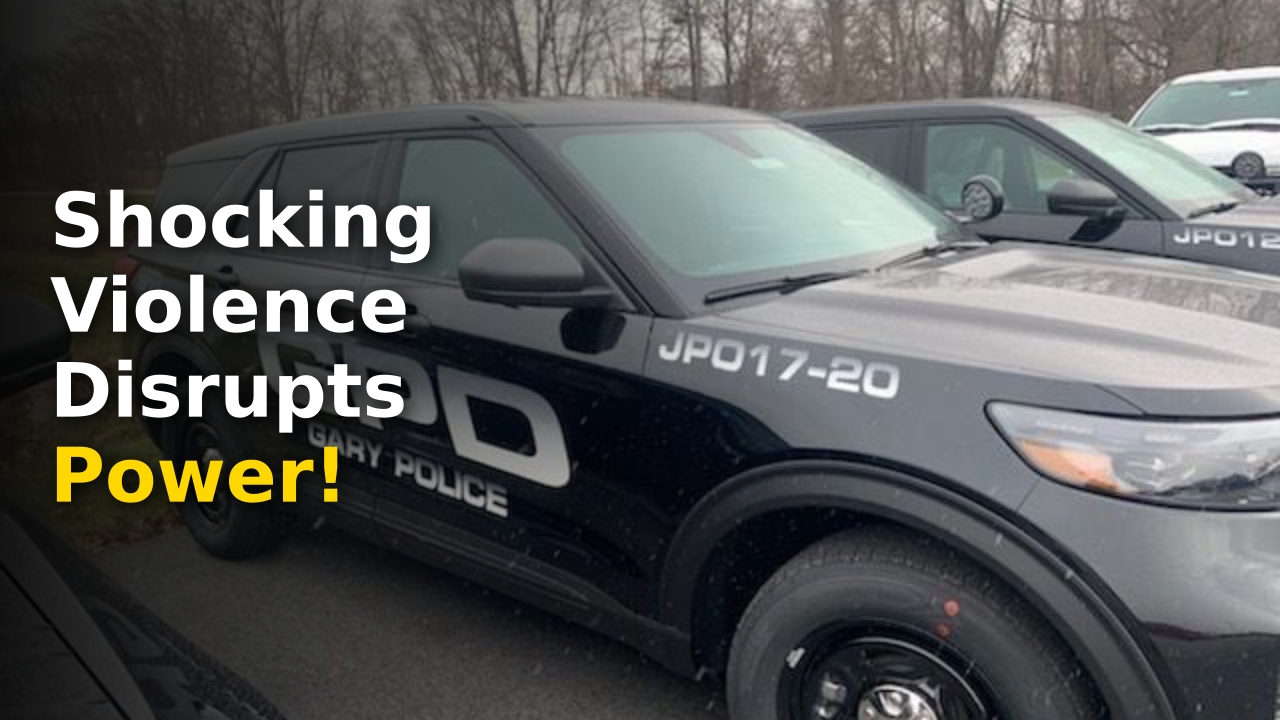
NIPSCO shooting incidents have shattered the relative calm of storm restoration efforts in Gary, Indiana, raising urgent questions about the safety of utility workers on the front lines. You rely on these crews to restore your power after a disaster, but the chilling reality of a vehicle being struck by gunfire serves as a stark reminder of the volatility they face in the field.
When you turn on your lights after a storm, you likely never consider that the worker who climbed the pole might have been dodging bullets just hours earlier. This incident on Saturday, August 16, has sent shockwaves through the community and forced a temporary halt to essential power restoration tasks across the city.
Understanding the NIPSCO shooting Incident
The situation began during a period of intense pressure for utility crews as they worked to clear storm-damaged infrastructure throughout Northwest Indiana. A NIPSCO vehicle was targeted by gunfire, transforming a standard restoration mission into a crime scene that necessitated immediate intervention from local law enforcement and utility management. This type of escalation is rare, yet it highlights the growing dangers faced by public service employees in high-stress urban environments.
Utility companies are currently operating under extreme conditions, with contractors from outside the state being brought in to bolster local teams. The logistics of coordinating these efforts—from staging areas at Southlake Mall to the aerial assessments conducted by helicopters—are massive. When an act of violence interrupts this chain, the ripple effect on power delivery for thousands of residents is significant.

Safety protocols for utility workers typically focus on electrical hazards and environmental threats, but this event forces a shift toward security-based risk mitigation. The NIPSCO leadership, including CEO Vince Parisi, is now tasked with balancing the urgent need to restore electricity against the non-negotiable requirement to protect their human capital from targeted violence. You can find more current event updates on how these organizations manage public perception during crises on our dedicated portal.
Law enforcement officials are investigating the trajectory and origin of the gunfire to determine if the vehicle was targeted intentionally or if it was a case of being in the wrong place at the wrong time. Until the investigation reaches a conclusion, work crews are operating with heightened caution, often requiring police escort in specific jurisdictions within the city. This level of uncertainty adds hours—if not days—to the expected timeline for power restoration for affected neighborhoods.
Community relations in Gary remain complex, and the company is urging local stakeholders to cooperate with the ongoing investigation to prevent future occurrences. The presence of mobile command centers and overnight sleep trailers indicates just how vital these crews are to the regional recovery effort. When those crews feel unsafe, the entire infrastructure of the city is effectively paralyzed.
Residents are expressing deep concern regarding the impact this will have on their daily lives. Beyond the lights staying off, there is a broader fear that essential services are becoming vulnerable to criminal elements. Public safety is the bedrock of a functioning society, and when utility vehicles—the very symbol of recovery—are hit by gunfire, that foundation is severely shaken.
Factors Influencing Utility Safety
- Increased urban crime rates impacting service vehicle routes.
- Communication gaps during large-scale emergency response deployments.
- The psychological toll on workers operating in high-risk zones.
- Coordination challenges between private utility security and public law enforcement.
Statistical Breakdown of Restoration Efforts
Data provided by NIPSCO management reveals the scale of the restoration mission, which has now been complicated by the security breach. The following table highlights the critical components currently under pressure due to the halt in operations following the NIPSCO shooting incident.
| Category | Operational Status | Current Risk Level |
|---|---|---|
| Power Grid Restoration | Temporarily Halted | High |
| Mobile Command Center | Active / On-site | Moderate |
| Aerial Assessment | Ongoing | Low |
| Contractor Deployment | Re-evaluating | Extreme |
To provide a broader perspective on worker safety, one must acknowledge the recent tragedy involving a worker at Cleveland-Cliffs, which adds to the general climate of concern in the industrial sector. The combination of industrial accidents and criminal threats paints a grim picture for the labor force in the region. As a reader, you should consider that the men and women doing these jobs are facing risks far beyond the voltage in the lines.
Restoration teams typically arrive in teams of three or four, utilizing specialized equipment to repair poles and lines. With the current pause, the backlog of pending repairs continues to grow by the hour. The financial impact of these delays on both the company and the residents will likely be tallied in the coming weeks. Every minute of lost time during a storm recovery phase represents a failure in service continuity that local businesses can ill afford.
Security measures are being escalated to ensure the safety of these teams. This may involve the use of private security firms, enhanced police patrolling, and more robust communication protocols for crews in the field. The goal is to move from a reactive stance to a proactive posture where utility crews can return to their duties with confidence. It is a massive undertaking to reorganize a mobile command center and redeploy hundreds of contractors safely.
As you wait for your power to return, try to remember that behind the status bars and outage maps are real people. The stress of being in a vehicle struck by gunfire is a trauma that stays with a person long after the lights are back on. These are not just line technicians; they are neighbors and citizens doing essential work in a hostile environment. Supporting their safety is a collective responsibility for every member of the community.
The administrative burden of this NIPSCO shooting also falls on the company’s internal teams who now have to balance safety logs with performance metrics. It is an impossible situation for managers who are held accountable for outages by shareholders and the public while also being held accountable for the physical wellbeing of their employees by safety regulators. This is the thin line that modern utility companies must walk in volatile times.

Historical Context of Utility Hazards
Historically, utility workers have faced risks ranging from high-voltage electrocution to extreme weather conditions, but gun violence against service fleets is a tragic anomaly. By analyzing industry reports from the past two decades, we see that while accidents on the job have declined due to better training, external threats to infrastructure workers have remained largely unaddressed in corporate risk models.
The evolution of utility work in urban centers has become increasingly dangerous. Infrastructure is aging, and the demand for constant connectivity means crews are working around the clock, often in dark or neglected areas of the city. These environments are naturally more prone to unpredictable social activities, making utility crews soft targets for criminal agendas or senseless acts of violence.
When we look at the history of power companies, there is a clear shift toward privatized, highly-monitored infrastructure. Yet, the physical presence of the worker remains the most vulnerable point in the network. If the human element is compromised, the technology that transmits electricity across the state becomes useless. Understanding this dynamic is crucial for any resident observing the slow pace of repairs.
Efforts to harden these sites against intrusion have traditionally focused on cyber threats or physical sabotage of substations. The recent shift to targeting moving vehicles is a tactical evolution that requires a rethink of how we secure public utility services. It is no longer enough to guard the central office or the power station; the crews in the trucks need a security strategy as well.
This incident will likely serve as a case study for national organizations focused on utility worker safety. It provides data that can be used to lobby for better protections, legislative support for utility workers, and perhaps even state-funded security initiatives for essential workers operating in high-crime zones. The goal of such advocacy is to ensure that a service worker in Gary has the same level of security as a worker in a more affluent suburb.
Looking toward the future, one might expect to see an increase in the use of drone technology for line inspections, reducing the need for human personnel to be physically present in areas identified as high-risk. While this is not a perfect solution for manual repairs, it is a significant step toward minimizing the exposure of vulnerable employees to external threats while maintaining grid stability.
The Road to Recovery and Safety
As the city recovers from the storm, the focus for NIPSCO will undoubtedly shift to restoring the broken trust and ensuring that workers feel safe enough to complete the job. This requires a transparent dialogue between the utility company and the residents of Gary. You are a stakeholder in this process, and your patience and support for the workers on the ground are critical during this tense time.
The long-term impact on the NIPSCO service schedule remains uncertain, but the immediate priority is clear: securing the perimeter for all restoration efforts. Future updates will provide a clearer picture of the resumption timeline and the steps being taken to prevent a recurrence of this violence. For now, the focus is on supporting those who were directly affected by this event and ensuring the safety of those still in the field.
We will continue to track these developments as they emerge. The intersection of infrastructure, public safety, and crime is a complex landscape that requires constant vigilance. For now, the NIPSCO shooting serves as a reminder that the utility grid is not just a collection of wires and poles; it is a vital system that relies on the dedication and safety of the people who build and maintain it every day.
Let this be a call to action for the city to foster a culture of respect for the public servants who keep our world running. Whether it is a lineman, a technician, or a contractor, these individuals deserve to return home to their families after every shift. It is the very least we can offer them for the hard work they do under the most difficult conditions imaginable.
More Like This
For more updates, check out our latest entertainment and sports news.