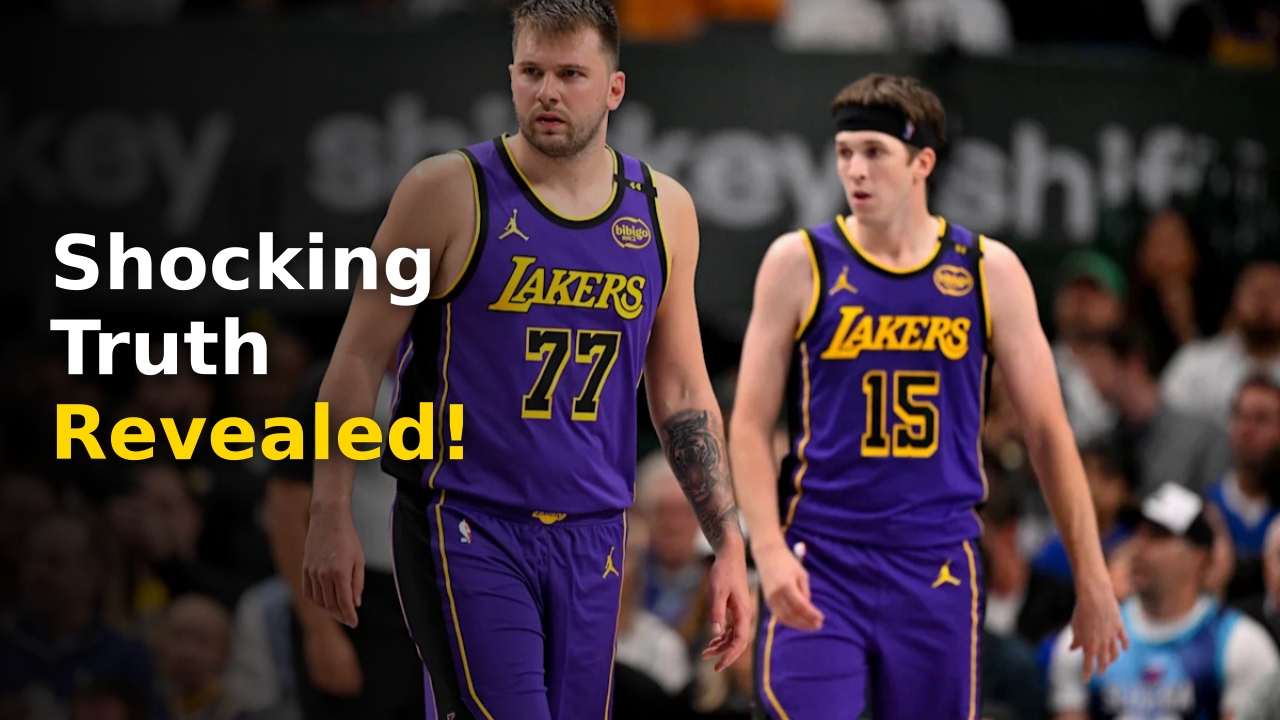
Did you ever think the post-LeBron era in Los Angeles would trigger such an immediate, explosive civil war among NBA insiders? The newly constructed Lakers roster is already sparking fierce debates across the basketball world before the summer of 2026 even draws to a close.
You might believe that pairing a generational superstar like Luka Doncic with fresh young talent is a masterclass in front-office management, but former champions are begging you to think again. Assessing the current Lakers roster design reveals deep divisions among those who study the game.
With key veterans departed, the franchise has completely pivoted, leaving fans and analysts to dissect every transaction. The stakes have never been higher for the purple and gold as they attempt to construct another legendary era.
Flawed Lakers roster exposed
Channing Frye, who hoisted the 2016 NBA Championship trophy alongside LeBron James with the Cleveland Cavaliers, did not hold back his criticism of the modern Lakers roster and its postseason viability. He completely dismissed the idea of this team making a deep playoff run in the brutal Western Conference.
You have to wonder if the front office underestimated the sheer physicality required to survive the West. Frye explicitly named juggernauts like the Denver Nuggets, Minnesota Timberwolves, Oklahoma City Thunder, and the rising Houston Rockets as teams that will easily dismantle this squad.
The critique centers on structural composition rather than individual talent. Many experts believe that by offloading championship-hardened veterans, the team has sacrificed its identity.
The Frye verdict
Frye’s blunt assessment highlights a massive gap between the front office’s vision and reality on the hardwood. He categorized the current setup as “ploppy” and overly reliant on slow, half-court sets.
This slow-paced style directly contradicts the fast-break, high-flying transition game that modern NBA offenses use to tear opponents apart.
You can find more detailed analysis of retired players turned analysts on major sports networks like Reuters to understand how modern team construction has shifted.
The Western Conference threat
The Western Conference has historically been a meat grinder for teams without a clear identity. With powerhouse teams bolstering their depth, there is absolutely zero margin for error.
Frye noted that even emerging teams like the Phoenix Suns, Utah Jazz, and San Antonio Spurs pose a massive threat to Los Angeles.
Without proper spacing and interior grit, this team risk falling into the lottery rather than challenging for a top-four seed.

Luka Doncic championship blueprint
To understand the logic behind these moves, you must look back at the 2024 Dallas Mavericks and their run to the NBA Finals. The franchise is clearly trying to replicate that specific blueprint to maximize the prime years of Luka Doncic with how the new Lakers roster attempts to emulate that past success.
However, attempting to copy a masterpiece with cheaper materials often results in a poor imitation. The Mavericks succeeded because they surrounded their superstar with elite, hyper-athletic rim protectors and lockdown perimeter defenders.
The current construction features players who simply do not fit those specific, highly demanding roles.
Mimicking the Mavericks
In 2024, Dallas relied heavily on the athletic gravity of players like Daniel Gafford, Derrick Jones Jr., and P.J. Washington. These athletes forced defense to collapse, leaving wide-open lanes for playmakers.
Critics argue that the Lakers roster lacks the raw vertical threat and defensive versatility that made the Dallas experiment work so well.
Instead of a cohesive, fast-running system, this team resembles a collection of mismatched pieces thrown together in desperation.
The half-court trap
Luka Doncic is master of the half-court, but even he needs dynamic transition play to keep defenses honest. If every single possession is a slow grind, elite defensive coaches will easily scheme to double-team the superstar.
This lack of transition threat was a key point of Frye’s analysis, pointing out that this squad seems content to walk the ball up the court.
Unless the coaching staff can design a hybrid system, the half-court offense might become too predictable to survive late-season adjustments.
Rebuilding post LeBron James
Replacing an icon is an impossible task, and doing so while trying to remain a title contender is even harder. The departure of LeBron James signaled the end of an era, and rebuilding the Lakers roster from the ground up was never going to be easy.
Gone are reliable contributors like Marcus Smart, Rui Hachimura, Luke Kennard, Deandre Ayton, and Jaxson Hayes. In their place, the front office has gambled on younger, unproven assets with highly inflated contracts.
Many fans are questioning the financial wisdom of these moves, openly criticizing how this Lakers roster was financed.
The cost of transition
Handing out outsized contracts during a transition phase is a classic front-office trap that can paralyze a franchise for years. If these players fail to live up to their billing, trading them will be virtually impossible.
You should explore the history of Hollywood basketball acquisitions on Bright Celebrity entertainment news to see how past roster shakeups compare to this summer.
Stripping away veteran leadership often leaves a locker room vulnerable during the inevitable cold streaks of an arduous 82-game season.
Draft capital exhaustion
To facilitate these massive trades, the front office had to deplete almost all of its remaining draft capital. This leaves the franchise with very little leverage to make mid-season corrections if things go south.
Relying entirely on free agency and buyout markets is a risky strategy that rarely pays off for cash-strapped franchises.
The current structure forces the team to win immediately, putting an enormous amount of pressure on a young and unproven coaching staff.

Statistical breakdown of talent
To truly appreciate the contrast between the old and new systems, you must examine the hard numbers and advanced metrics. Understanding the modern Lakers roster efficiency metrics requires looking at both individual and team stats.
The previous iteration struggled with perimeter shooting, finishing near the bottom of the league in 3-point accuracy.
Let us break down the key statistical profiles of the incoming rotation players to see if the front office’s gamble holds any analytical weight.
| Player | Position | Projected PPG | 3-Point Accuracy | Defensive Impact |
|---|---|---|---|---|
| Walker Kessler | Center | 9.5 | 21.4% | Elite Rim Protection |
| Quentin Grimes | Guard | 12.1 | 38.7% | Perimeter Lockdown |
| Collin Sexton | Guard | 18.4 | 35.5% | Average Speed |
| Sandro Mamukelashvili | Forward | 7.2 | 36.2% | Moderate Lateral |
Analyzing individual metrics
While the shooting percentages look solid on paper, translating those numbers into a cohesive team offensive rating is a different story.
Analysts argue that the Lakers roster relies heavily on backcourt speed to mask some of their glaring frontcourt depth issues.
Collin Sexton brings a high-scoring motor, but his high usage rate might conflict with the ball-dominant style of play that a superstar requires.
Defensive efficiency concerns
Defending the paint without a proven, veteran rim protector is a recipe for disaster in today’s league. While Walker Kessler has shown flashes of elite shot-blocking, his lateral quickness remains a concern.
Opponents will look to exploit these pick-and-roll vulnerabilities, forcing the perimeter defenders to over-help and leave open shooters.
Finding a balance between elite rim protection and perimeter containment will be the defining challenge of the upcoming campaign.
Analyzing athletic roster upgrades
Despite the harsh criticism, it is not all doom and gloom for the purple and gold faithful. Analysts agree this specific Lakers roster has dynamic upside due to a sudden influx of youthful energy.
Players like Quentin Grimes and Matisse Thybulle bring elite, disruptive defensive energy that can force turnovers and ignite transition play.
If these wings can consistently knock down corner threes, they will provide the perfect spacing required to let playmakers operate.
Youth and athleticism
The inclusion of younger prospects like Ziaire Williams and rookie guard Cameron Carr adds an element of unpredictable explosiveness to the bench, making this Lakers roster incredibly versatile.
Second-year forward Adou Thiero remains one of the most intriguing developmental projects in the league due to his incredible vertical leap.
Developing this young core while simultaneously demanding championship-level performance is a delicate balancing act that few coaching staffs ever master.
Perimeter shooting upgrades
One major area of improvement is the team’s projected 3-point shooting accuracy compared to previous years. With multiple players capable of shooting above 36% from deep, the spacing on the floor should improve dramatically.
Sandro Mamukelashvili’s evolution into a reliable stretch-four option gives the offense a unique dimension.
If the coaching staff can successfully integrate these shooting threats, it will make doubling the primary ball-handlers a very costly strategy.
Future of Lakers roster
Ultimately, only time will tell if this controversial Lakers roster can truly survive the Western Conference gauntlet. The upcoming season represents a massive gamble that could either cement the front office’s genius or lead to a total organizational collapse.
You can expect intense media scrutiny and constant trade rumors to follow this team every single week of the campaign.
Channing Frye’s warnings serve as a sobering reminder that names on a jersey do not automatically translate to championship chemistry.
Locker room chemistry
Integrating so many new faces simultaneously is a logistical nightmare for any coaching staff. Building trust, establishing defensive rotations, and defining offensive roles take time that this team simply does not have.
If early-season struggles lead to finger-pointing, the entire season could derail before the All-Star break.
The leadership core must step up immediately to foster a culture of accountability and resilience.
The final verdict
If the front office’s vision fails to materialize, the pressure on the coaching staff and ownership will reach unprecedented heights.
For now, fans must buckle up and prepare for one of the most volatile and fascinating experimental seasons in modern basketball history.
Whether this team rises to the occasion or falls flat, the unfolding drama surrounding the Lakers roster is guaranteed to keep you glued to your screen.
More Like This
For more updates, check out our latest entertainment and sports news.