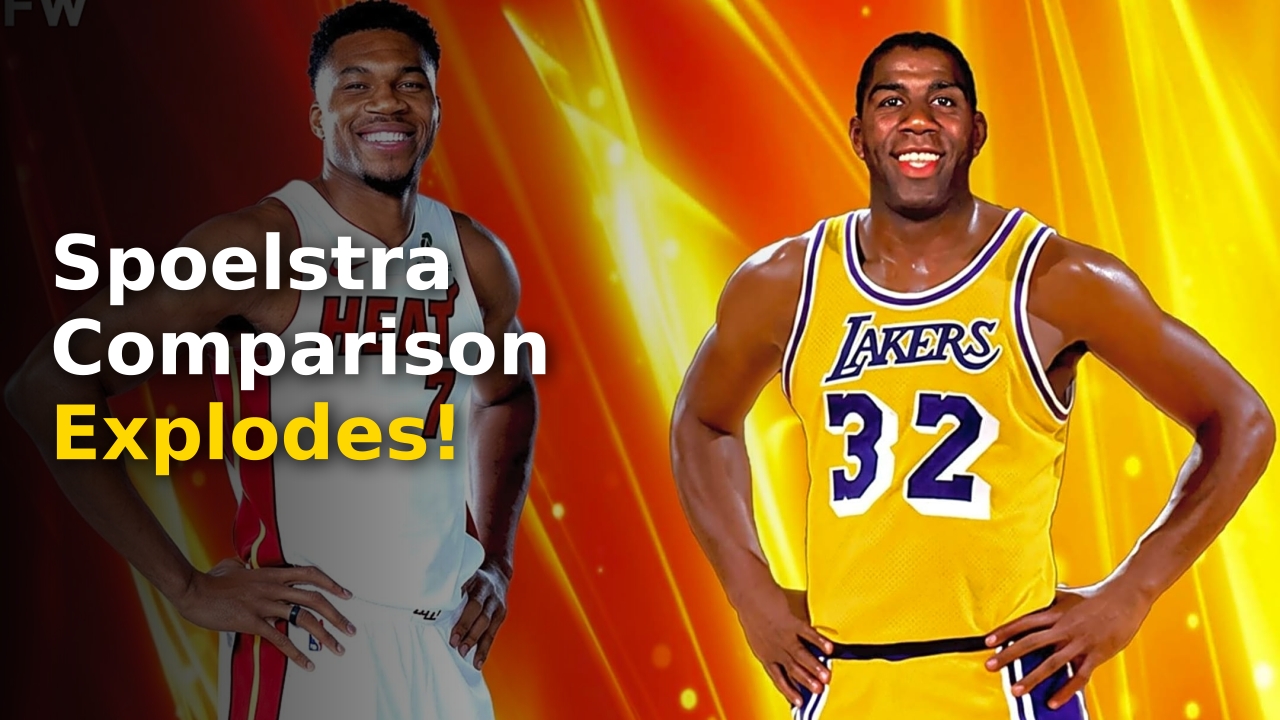
Key Takeaways
| Bold Comparison: Miami Heat coach Erik Spoelstra likened Giannis’ playmaking gravity to Showtime legend Magic Johnson. |
| Stunning Debut: Giannis logged 7 assists—all resulting in three-pointers—in just 14 minutes of preseason action. |
| Playmaking Metrics: While Magic remains an unmatched pure passer, Giannis utilizes physical gravity to generate historic perimeter looks. |
| Defensive Contrast: Giannis holds a massive defensive edge as a former Defensive Player of the Year and five-time All-Defensive selection. |
The recent debate surrounding the **Giannis Magic Johnson** comparison has ignited a massive conversation across the NBA landscape after Miami Heat head coach Erik Spoelstra made a stunning post-game declaration. Following Miami’s preseason victory over the Toronto Raptors, Spoelstra praised his new superstar’s playmaking ability. He noted that the way his forward handles the ball and delivers pinpoint passes resembles the legendary point guard Pat Riley coached in the 1980s. While some purists immediately dismissed the comparison, a closer tactical look reveals a fascinating overlap in their physical gravity. This analysis breaks down how a 6’11” modern powerhouse is channeling the spirit of a 6’9″ Hall of Fame playmaker.
Understanding this comparison requires looking past traditional position labels. The modern game relies heavily on positionless systems where size and court vision reign supreme. By examining how both stars command defensive attention, we can appreciate the nuance of Spoelstra’s bold coaching observation. Fans can follow ESPN’s comprehensive NBA coverage to stay updated on how this tactical experiment unfolds throughout the season.
The Giannis Magic Johnson Connection Explained
When Erik Spoelstra compares a modern forward to a Showtime icon, the basketball world listens intently. The most obvious point of comparison between these two generational talents is their sheer, imposing physical size. Magic Johnson revolutionized the point guard position by standing 6’9″ and commanding the floor with elite vision. Giannis Antetokounmpo stands at 6’11” and has consistently assumed primary ball-handling duties throughout his illustrious career.
This unique height allows both players to see over defensive schemes with ease. Smaller guards often struggle when double-teams arrive because their passing lanes are easily obstructed. For these tall playmakers, a secondary defender merely creates an opportunity to spot an open teammate on the opposite wing. This visual advantage is a cornerstone of modern offensive efficiency.
In his highly anticipated preseason debut for the Miami Heat, Giannis demonstrated this exact physical advantage. He played only 14 minutes but managed to dissect the Toronto Raptors defense with absolute precision. He finished the game with nine points, four rebounds, and seven assists while shooting a perfect 3-for-3 from the field. Intriguingly, every single one of his seven assists led directly to a made three-pointer.
This short performance provided a vivid blueprint for Miami’s offensive strategy. By utilizing exclusive NBA player updates, analysts have noted how Spoelstra plans to maximize this playmaking capability. Rather than requiring Giannis to execute complex guard sequences, the Heat simply want him to act as their primary engine. This approach mirrors how Pat Riley utilized Magic to unlock the transition game in Los Angeles.
The Evolution of Positionless Playmaking
The concept of a point-forward has evolved significantly since the 1980s. Magic Johnson was a true point guard who possessed the size of a power forward. Giannis is a physical power forward who possesses the ball-handling agility of a guard. Despite these inverted starting points, their functional roles on the basketball court share striking similarities.
Both players excel at grabbing a defensive rebound and immediately launching a fast break. This eliminates the need for a traditional outlet pass, keeping opposing defenses on their heels. This continuous offensive pressure prevents opponents from establishing their half-court defensive structures. It is a highly taxing style of play that wears down opponents over four quarters.

Expert Take: The Physics of Basketball Gravity
Basketball analysts often refer to court gravity as the physical pull a superstar exerts on defensive units. Magic Johnson commanded gravity through his brilliant deception and passing velocity. Defenders had to stay home on shooters because they knew Magic could thread the needle through any gap. Giannis commands gravity through the sheer threat of his physical momentum. When he barrels down the lane, defenses must collapse multiple players into the paint, which automatically leaves perimeter shooters wide open.
Playmaking Dynamics: Finesse Versus Physical Force
To truly appreciate the **Giannis Magic Johnson** dynamic, one must examine their starkly different playmaking philosophies. Magic was an artist who specialized in pure passing finesse and psychological manipulation. He could manipulate entire defensive schemes using only his eyes, forcing defenders to shift before delivering a no-look pass. His career average of 11.2 assists per game remains a testament to his historic playmaking volume.
Magic won four assist titles and earned ten All-NBA selections primarily due to this elite distribution. He understood the exact preferences of his teammates, delivering passes perfectly in their shooting pockets. He anticipated player movements seconds before they occurred, making the Showtime transition offense look like a choreographed dance. His passing was his primary weapon, while his scoring served as a secondary luxury.
Giannis, on the other hand, is a force-of-nature playmaker who creates passing lanes through sheer physical dominance. Opposing teams are so terrified of his driving ability that they routinely construct a wall of defenders in the paint. Giannis has developed the basketball IQ to recognize this defensive collapse and instantly kick the ball to waiting shooters. His playmaking is a direct byproduct of his unstoppable scoring threat.
His career average of 5.0 assists per game may look modest compared to Magic’s historic numbers. However, the quality of shots Giannis generates is incredibly high. In recent seasons, over 68% of his assists have resulted in three-pointers. This indicates that while he may not accumulate assist volume like a traditional guard, his passes yield maximum mathematical value. Fans tracking sports media trends will find that this high-value playmaking is highly coveted in today’s analytics-driven NBA.
The Contrast in Transition Execution
In transition, Magic was a maestro who controlled the speed of the entire floor. He could slow down to let trailers catch up, or accelerate to catch defenders sleeping. His passes were often spectacular, high-risk maneuvers that thrilled crowds and deflated opponents. He prioritized the spectacle of the assist just as much as the result.
Giannis operates like a runaway freight train in open space. He does not seek to dazzle with flashy, high-risk passes. Instead, he forces the defense to make a binary decision: commit to a hard foul or give up an easy dunk. If a third defender slides over, Giannis simply makes the simple, correct read to the corner. It is highly efficient, unselfish basketball that minimizes turnovers.
Statistical Comparison: Head-to-Head Numbers
To understand the structural differences between these two legendary figures, we must analyze their career statistics. The numbers paint a clear picture of two players dominating the sport through vastly different methodologies. While one focused on elite distribution, the other built his legacy on historic two-way paint dominance.
The table below highlights their career averages, highlighting their contrasting strengths on both ends of the court. You can find more granular data by visiting the official NBA stats database for historical comparisons.
| Metric / Statistic | Giannis Antetokounmpo | Magic Johnson |
|---|---|---|
| Career Points Per Game | 24.1 | 19.5 |
| Career Assists Per Game | 5.0 | 11.2 |
| Career Rebounds Per Game | 9.8 | 7.2 |
| Field Goal Percentage | 55.4% | 52.0% |
| Free Throw Percentage | 69.1% | 84.8% |
| Defensive Player of the Year | 1 (2020) | 0 |
This numerical breakdown illustrates the shooting disparity between the eras. Magic Johnson was a far more reliable perimeter and free-throw shooter. He finished his career shooting 84.8% from the line, making him an elite option in late-game situations. Giannis continues to face challenges from the free-throw line, where his 69.1% average remains a target for opposing defensive strategies.
However, Giannis compensates for his shooting limitations through historic interior efficiency. He routinely shoots over 60% from the field due to his ability to finish at the rim. In his recent campaigns, he posted an effective field-goal percentage of 63.6%. This interior focus allows him to anchor an offense without needing a highly developed jump shot.
Defensive Versatility: Where the Comparison Diverges
While the offensive comparison between **Giannis Magic Johnson** offers plenty of intrigue, their defensive impact is entirely different. Magic Johnson was an incredibly smart team defender who used his size to disrupt passing lanes. He averaged an impressive 1.9 steals per game throughout his career. Despite his intelligence, Magic was never considered an elite individual stopper and was often hidden on weaker offensive players to preserve his energy.
Giannis Antetokounmpo, conversely, is one of the most devastating defensive forces in modern basketball history. He is a rare athlete who has secured a Defensive Player of the Year award alongside five All-Defensive team selections. His career defensive metrics showcase his immense impact, featuring 1.1 steals, 1.2 blocks, and a stellar 105.9 defensive rating.
His physical versatility allows him to guard all five positions on any given possession. He can switch onto a lightning-quick point guard at the perimeter, deny a drive, and recover in time to block a center at the rim. This elite defensive capability provides his coaching staff with incredible tactical flexibility. It allows the team to play aggressive, switching defensive schemes that force turnovers.
Furthermore, Giannis’ defensive rebounds act as the immediate catalyst for his offense. When he secures a defensive board, he does not need to waste valuable seconds looking for a guard. He immediately initiates the break, putting immense pressure on back-pedaling defenders. This seamless transition from elite defense to fast-break offense is a unique weapon that few players in NBA history have possessed.
By The Numbers: The Defensive Impact Gap
To fully grasp this defensive disparity, we must examine their rim-protection analytics. Magic Johnson averaged 0.4 blocks per game, primarily contesting shots as a recovery defender. Giannis averages more than triple that volume while actively altering countless other shot attempts through his verticality. His presence in the paint completely changes how opposing guards attack the basket. This defensive anchoring is a luxury that Pat Riley never had with Magic, who relied on elite shot-blockers like Kareem Abdul-Jabbar to secure the paint.
This two-way dominance is why Giannis presents such a unique coaching opportunity for Spoelstra. In Miami’s system, defense remains the absolute foundation of their competitive identity. Adding a premier playmaker who also happens to be an elite rim protector is a coach’s dream. It allows Miami to remain highly competitive against the elite offenses of the Eastern Conference.

People Also Ask
Why is Erik Spoelstra comparing Giannis to Magic Johnson?
Spoelstra compared Giannis to Magic Johnson due to his unique ability to act as a massive point guard. At 6’11”, Giannis utilizes his size to see over defenses, handle ball-distribution duties, and initiate fast breaks in a manner reminiscent of the Hall of Fame guard.
How many assists does Giannis Antetokounmpo average per game?
Giannis Antetokounmpo averages 5.0 assists per game over his career. He has posted multiple seasons averaging over 6.0 assists, showcasing his development into one of the league’s premier frontcourt playmakers.
Who has more NBA championships, Magic Johnson or Giannis?
Magic Johnson has won five NBA championships with the Los Angeles Lakers. Giannis Antetokounmpo won his first NBA championship with the Milwaukee Bucks in 2021 before continuing his career with the Miami Heat.
What team does Giannis Antetokounmpo play for in 2026?
As of the 2025-26 season, Giannis Antetokounmpo plays for the Miami Heat under head coach Erik Spoelstra. This transition has unlocked new tactical configurations alongside co-star Bam Adebayo.
A New Era of Miami Heat Basketball
The evolving debate around **Giannis Magic Johnson** reflects a wider shift toward complete positionless basketball in the modern era. While purists may balk at comparing any player to the greatest point guard of all time, Spoelstra’s tactical perspective is highly practical. He is not suggesting that Giannis will replicate Magic’s flashy, look-away passing repertoire. Instead, he is focused on utilizing Giannis’ physical gravity to systematically dismantle modern defensive schemes.
By surrounding Giannis with elite perimeter shooters and a versatile co-star like Bam Adebayo, Miami has created a highly dangerous offensive system. Opposing defenses can no longer rely on simple single-coverage schemes to contain this physical powerhouse. If they collapse on his drives, they risk giving up wide-open three-pointers to elite shooters. If they stay home on shooters, they risk giving up high-efficiency layups and dunks.
Ultimately, Miami does not need Giannis to become an exact replica of Magic Johnson to achieve their championship aspirations. They simply need him to remain the most dominant, unselfish version of himself. As fans dive into detailed basketball analysis, it is clear that this unique partnership between an elite coach and a generational superstar has the potential to reshape the Eastern Conference hierarchy. Spoelstra may have indeed found the ultimate tactical hack to make an already unstoppable force even more devastating.
More Like This
For more updates, check out our latest entertainment and sports news.