Key Takeaways
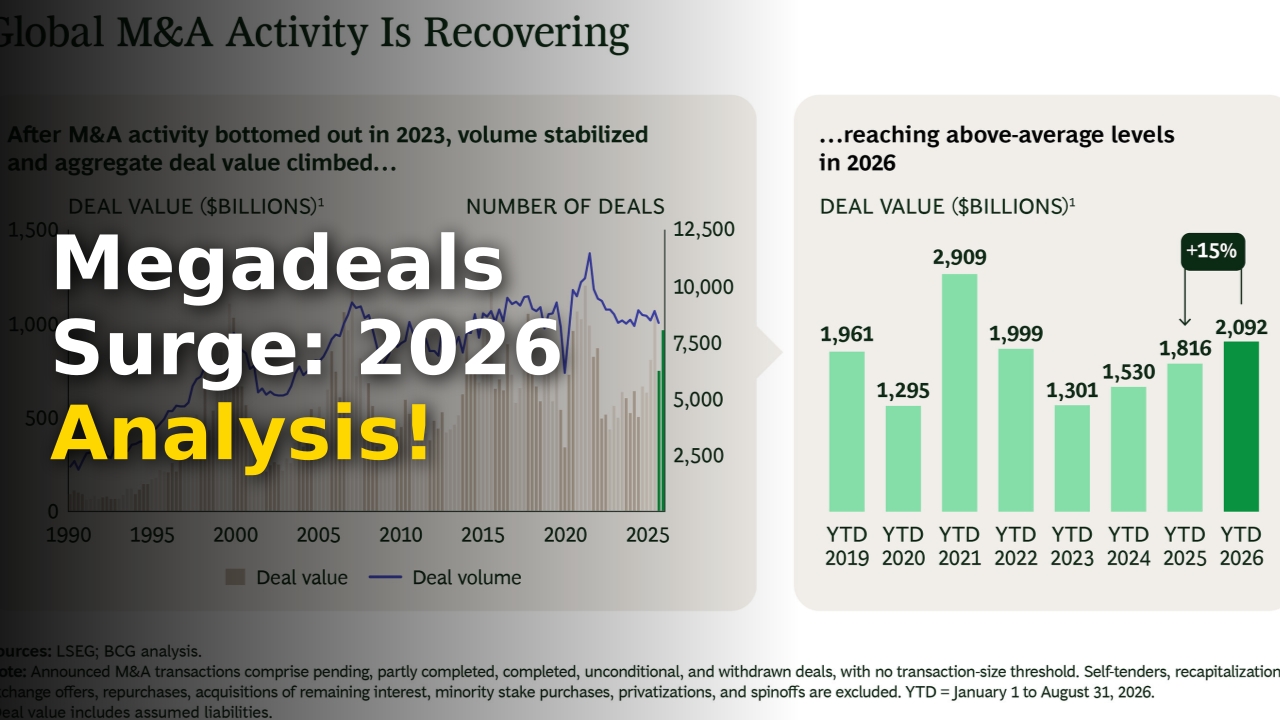
| Aggregate M&A deal value rose 15% year-over-year in the first eight months of 2026. |
| A record 37 megadeals have been recorded worldwide, surpassing the 2021 high of 32. |
| Market recovery remains narrow, with small and mid-cap transactions lagging behind long-term norms. |
| Technology and consumer sectors show growth in value despite cooling sentiment indices. |
Global M&A value is seeing a paradoxical resurgence, as you navigate a landscape where high-level activity dominates while the broader market struggles to find its footing. Despite a 15% year-over-year increase in deal volume and a record-breaking 37 megadeals, the economic recovery remains significantly narrow. Most analysts are pointing to a bottleneck in execution rather than a lack of capital as the primary inhibitor of a total market rebound.
As you examine the current financial climate, it becomes clear that capital is waiting on the sidelines. According to recent data from the Boston Consulting Group, the hurdle is not the ability to fund deals, but the ability to bridge valuation gaps and navigate complex regulatory environments. For institutional investors and corporate strategists, understanding this shift is the difference between a successful exit and a stalled negotiation.
Understanding Global M&A Value Trends
The concentration of value at the very top of the food chain is a defining characteristic of the 2026 fiscal cycle. While megadeals—transactions valued at $1 billion or more—are performing well above historical averages, the smaller end of the market remains stagnant. You are witnessing a environment where large-cap entities possess the resilience to bypass current economic friction, whereas smaller firms continue to face liquidity constraints.
This divide creates a challenging landscape for mid-market players. Without the scale to absorb operational or regulatory hurdles easily, smaller companies are seeing fewer exit opportunities. This phenomenon of a narrow recovery suggests that even as global M&A value climbs, the prosperity is not yet being distributed across all sectors or tiers of corporate capitalization.

The market dynamics governing these transactions are changing rapidly. You should consider the five tests identified by BCG: asset readiness, market-clearing economics, resilient financing, organizational capacity, and regulatory clearance. When any of these five pillars fail, the deal is effectively dead, regardless of the available capital in the system.
The Role of Artificial Intelligence
AI is functioning as a double-edged sword in the current marketplace. On one side, it is fueling the drive for new deals as companies attempt to acquire competitive advantages in the machine learning space. On the other, it is introducing massive uncertainty into the valuation process. As businesses struggle to determine the long-term revenue viability of AI-driven products, the price gap between buyers and sellers is widening, stalling otherwise promising negotiations.
Market Sentiment and Sector Divergence
| Sector | Sentiment Index Score |
|---|---|
| Financial Institutions | 108 |
| Real Estate | 108 |
| Health Care | 100 |
| Energy | 96 |
| Industrials | 66 |
| Technology | 52 |
The M&A Sentiment Index, now sitting at 83, highlights the uneven nature of current growth. While sectors like financial institutions and real estate are feeling confident, technology—despite its growth in total value—reports lower sentiment. This indicates that participants are closing large deals out of necessity or strategic defense rather than pure market optimism.

By the numbers, the LSEG data reveals that aggregate value growth in technology and consumer goods remains robust, even when sentiment remains tepid. This indicates that while corporations are cautious, the strategic pressure to modernize or defend market share is driving capital expenditure at an unprecedented scale. Learn more about these economic shifts at our market analysis page.
The Strategic Execution Bottleneck
For those involved in corporate finance, the current bottleneck is a matter of pure execution. Bridging the gap between the seller’s expectations and the buyer’s risk profile has become significantly more difficult in 2026. This is where professional advisory firms play a pivotal role in validating asset readiness.
Expert Take: Jens Kengelbach of BCG notes that the bottleneck has shifted from raw financing to transactional hurdles. Unlike in previous cycles where liquidity was the primary constraint, today’s market is defined by the rigorous testing of deal viability. If a target firm cannot prove its organizational capacity or regulatory standing, no amount of cash will force the deal through.
People Also Ask
What happened with global M&A activity in 2026?
Global M&A activity saw a 15% increase in aggregate value during the first eight months of 2026, driven primarily by a surge in megadeals valued at $1 billion or more.
Why is the current M&A recovery considered narrow?
The recovery is considered narrow because the growth is concentrated in large-scale transactions, while small and mid-cap deal volumes remain significantly below long-term norms.
How does AI impact current M&A deals?
AI is both a driver for new investment and a source of valuation uncertainty, often complicating deal closure by making it difficult to assess the long-term durability of business models.
What is the current M&A Sentiment Index?
The M&A Sentiment Index rose to 83 in the first eight months of 2026, an improvement from 79 at the start of the year, but still below the long-term average of 100.
Future Outlook and Conclusions
As you look toward the remainder of 2026, the trajectory for global M&A value hinges on whether smaller deals can regain momentum. While the top-heavy structure provides a strong headline narrative, a sustainable recovery requires participation across all market tiers. The companies that successfully navigate the current execution bottleneck will be those that prioritize agility and clear, AI-informed valuation strategies.
Ultimately, the market is in a transition phase. As regulatory landscapes stabilize and valuation gaps narrow, we may see a broadenening of the recovery. Until then, investors should remain cautious, focusing on asset readiness and the underlying strength of target companies in the face of shifting technological paradigms.
More Like This
For more updates, check out our latest entertainment and sports news.